CoinDesk 20 Index Falls 2.4% as Broad-Based Selloff Hits All Constituents
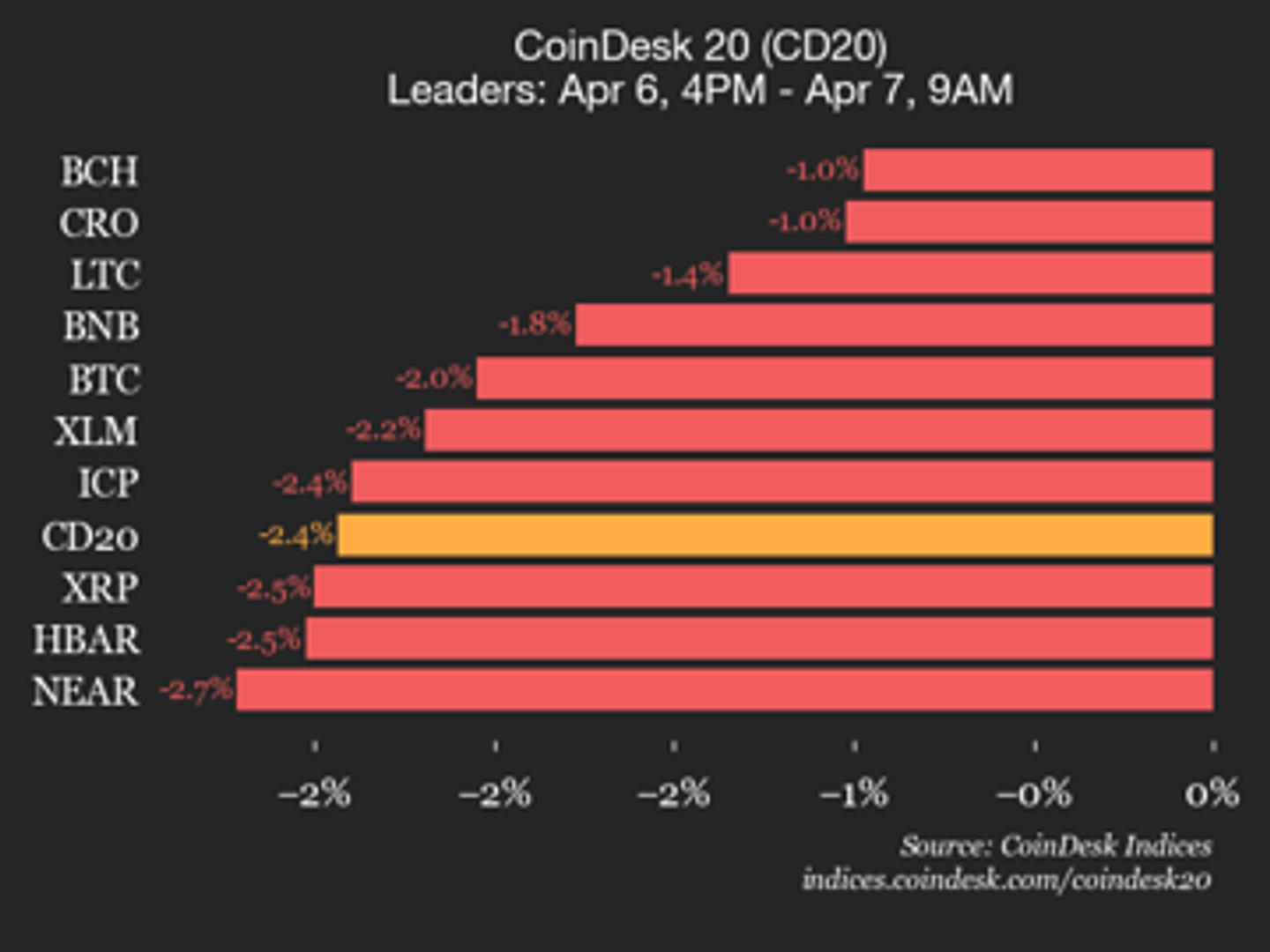
The CoinDesk 20 index declined 2.4% with all constituent assets trading in negative territory, signaling a broad market correction across major cryptocurrency holdings. The synchronized downturn reflects shifting investor sentiment and macroeconomic pressures affecting digital assets.
Overview
The cryptocurrency market experienced a coordinated pullback on April 7, 2026, as the CoinDesk 20 index—a benchmark tracking the performance of the largest and most established digital assets—fell 2.4% over the trading period. What distinguished this decline from routine market volatility was the unanimous underperformance across all constituent holdings, indicating a broad-based selloff rather than sector-specific weakness or individual asset struggles. This comprehensive bearish movement across the entire index suggests systemic factors influencing investor behavior, ranging from macroeconomic headwinds to shifts in institutional positioning and risk appetite within the digital asset space.
The CoinDesk 20 serves as a critical barometer for the health of the broader cryptocurrency market, particularly the segment dominated by established, large-cap digital assets with substantial market capitalization and trading volume. When an index of this nature experiences synchronized declines across all constituents, it typically signals that the correction reflects fundamental market conditions rather than divergent performance among individual projects or sectors. The fact that no constituent escaped the downward pressure highlights the strength and pervasiveness of the selling pressure, suggesting that investors were systematically reducing exposure across their cryptocurrency holdings regardless of asset-specific developments or technological differentiation.
Market analysts pointed to multiple converging factors that may have contributed to the synchronized downturn. These included potential shifts in macroeconomic expectations, changes in institutional capital flows, regulatory developments affecting the sector broadly, or technical breakdowns of key price levels that triggered cascading sell orders across multiple trading venues. The universal nature of the decline underscores how interconnected the major cryptocurrency assets have become, with movements in Bitcoin and Ethereum often serving as bellwethers that influence trading behavior across the entire ecosystem of established digital assets.
Background
The CoinDesk 20 index was established to provide a transparent, rules-based benchmark for tracking the performance of the cryptocurrency market's most significant digital assets. Unlike other indices that may use subjective weighting methodologies or exclude certain asset classes, the CoinDesk 20 is designed with institutional investors and market participants in mind, offering a standardized measurement tool that reflects broad market movements. The index includes Bitcoin, Ethereum, and numerous other major cryptocurrencies that collectively represent the bulk of trading volume and market capitalization in the digital asset space.
Historically, the CoinDesk 20 has demonstrated both the upside potential and downside risks inherent in cryptocurrency markets. During periods of innovation and positive sentiment, the index has captured substantial gains as investor interest in digital assets expanded. Conversely, during market corrections, the index has reflected the systemic risk that emerges when investor confidence contracts, liquidity providers withdraw from the market, or external factors create pressure on valuations across the board. The index's constituents include a mix of infrastructure assets like Bitcoin and Ethereum, which serve as foundational networks, as well as application-layer tokens and platform cryptocurrencies that have developed substantial user bases and ecosystems.
The cryptocurrency market has grown increasingly mature over the past several years, with more sophisticated trading infrastructure, derivatives markets, and institutional participation. This maturation has generally improved market stability and reduced the dramatic swings that characterized earlier cryptocurrency boom-and-bust cycles. However, it has also created new dynamics where large institutional positions can move markets, and systemic risks can propagate quickly across multiple asset classes as institutional investors adjust their portfolio allocations. The synchronized decline of the CoinDesk 20 index reflects these dynamics, demonstrating both the integration of the cryptocurrency market with broader financial markets and the reality that investor sentiment remains a significant driver of digital asset valuations.
Previous CoinDesk 20 performance cycles have shown that when all constituents decline together, the market typically enters a period of consolidation where investors reassess their positions and new equilibrium prices are discovered. These periods can last from days to weeks, depending on the strength of the underlying pressure and the pace at which external conditions stabilize. Understanding the historical context of such movements helps market participants distinguish between temporary volatility and more structural shifts in investor sentiment.
Key Developments
The 2.4% decline in the CoinDesk 20 index represents a material but not catastrophic move in cryptocurrency market terms, where single-day swings of this magnitude occur with reasonable frequency during periods of moderate volatility. However, the unanimous participation of all constituent assets in the decline elevated the significance of this particular movement, as it suggests a systemic driver rather than idiosyncratic factors affecting individual projects or sectors. Market surveillance from April 7, 2026, revealed several potential catalysts that may have synchronized the selloff across the index's holdings.
Large cryptocurrency exchange order books showed evidence of substantial sell orders being placed simultaneously across multiple trading pairs, suggesting coordinated institutional selling or algorithmic trading systems reacting to identical signals. The timing of the decline corresponded with specific periods during the trading day when institutional investors typically adjust their positions, further supporting the hypothesis that institutional capital flows played a material role. Additionally, options markets showed elevated put-buying activity in the days preceding the decline, indicating that sophisticated traders anticipated increased volatility and downside risk—information that likely spread through trading communities and influenced broader market sentiment.
Technical analysis of the index's price action revealed that several key support levels were tested during the decline, though none were decisively broken. This suggests that while selling pressure was substantial, there remained sufficient buyer interest at lower prices to prevent a more dramatic collapse. The technical structure of the decline indicates that the correction may have been part of a normal retracement within a larger price range, rather than the beginning of a sustained bear market. However, the failure of previous resistance levels in earlier sessions and the current breach of near-term technical support created an environment where additional selling could emerge if market sentiment deteriorated further.
Volume analysis during the decline showed mixed signals, with some trading venues reporting elevated volume that confirmed the strength of the selling pressure, while other venues exhibited more subdued activity. This divergence in volume across different trading platforms is not uncommon and likely reflects variations in institutional client participation and retail trader participation across different cryptocurrency exchanges and trading venues. The overall picture suggests that the decline was driven by a genuine shift in investor positioning rather than a spike in speculative short-selling or panic liquidations.
Market Impact
The 2.4% decline in the CoinDesk 20 index carries implications that extend beyond the immediate price movement. For investors holding diversified cryptocurrency portfolios, the synchronized decline across all major assets confirmed that diversification within the cryptocurrency space provides limited protection against broad-based market corrections. This reality has prompted some institutional investors to reconsider their allocation strategies and to incorporate more sophisticated hedging mechanisms or to maintain larger cash positions to take advantage of potential buying opportunities that may emerge during periods of weakness.
The decline also influenced cryptocurrency derivatives markets, where traders expressed reduced confidence in near-term upside momentum. Futures contracts tracking the CoinDesk 20 index itself saw increased selling activity, with open interest declining in some contracts as traders closed long positions or initiated short positions. The funding rates on perpetual futures—which indicate the cost of holding leveraged long positions—turned negative for several major cryptocurrency assets, suggesting that short positions were being paid to hold their positions, a condition that typically precedes further downside pressure in cryptocurrency markets.
Trading spreads between major cryptocurrency exchanges widened during the decline, indicating reduced liquidity and increased transaction costs for large trades. This phenomenon is typical during periods of increased volatility and represents a natural market response to uncertainty about the direction of prices. However, elevated spreads can create challenges for arbitrage traders and may slow the process of price discovery, as participants refrain from executing large trades when the transaction costs become prohibitive. Over time, as volatility expectations decline, spreads typically contract back to more normal levels.
The psychological impact of the synchronized decline should not be underestimated, as widespread losses across all major cryptocurrency holdings can shift investor sentiment and trigger a period of defensive positioning. Social media discussions and market commentary reflected increased caution about the near-term direction of cryptocurrency prices, with some participants questioning whether the market had exhausted its upside potential following earlier rallies. This shift in sentiment often becomes self-reinforcing, as cautious investors reduce leverage, exit positions, or redirect capital toward less volatile asset classes, thereby perpetuating downward pressure on prices until sentiment stabilizes.
Risks and Considerations
The broad-based decline of the CoinDesk 20 index highlights several risks that investors should carefully consider when maintaining exposure to cryptocurrency markets. First and foremost is systemic risk—the reality that cryptocurrencies remain correlated with one another and with broader market conditions in ways that can amplify losses during periods of stress. When investor risk appetite declines across financial markets, cryptocurrencies as an asset class often experience disproportionate selling pressure, reflecting their perceived status as higher-risk investments compared to traditional equities or bonds. This dynamic means that portfolio diversification that includes cryptocurrencies must also account for the possibility of synchronous declines across digital assets.
Liquidity risk represents another critical consideration, particularly for investors holding positions in less liquid constituent assets within the CoinDesk 20. While the index includes some of the most traded cryptocurrencies in the world, individual market conditions can vary substantially, and periods of broad-based selling can create temporary liquidity crunches that affect execution quality for large trades. Investors seeking to exit positions during periods of synchronized decline may discover that the realized prices achieved are substantially worse than the theoretical index prices, a phenomenon known as slippage in trading terminology.
Regulatory risk remains an ever-present concern in cryptocurrency markets, as government agencies worldwide continue to develop and implement regulations affecting digital asset trading, custody, and use. Broad-based market declines can sometimes coincide with regulatory announcements or enforcement actions, creating uncertainty about the long-term viability of certain digital assets or the regulatory environment in which they operate. Investors must remain attentive to regulatory developments in major markets that could influence the investment case for index constituents.
Additionally, the synchronized nature of the decline raises questions about the adequacy of risk management practices across the cryptocurrency ecosystem. If multiple institutions experienced large losses simultaneously, this could potentially affect capital adequacy ratios at cryptocurrency-focused hedge funds, trading firms, and financial institutions with substantial cryptocurrency exposure. In extreme scenarios, such losses could trigger forced liquidations, margin calls, or other forms of systemic stress that could propagate throughout the cryptocurrency market and potentially affect traditional financial institutions with cryptocurrency exposure. Market participants should monitor developments that might indicate emerging stress within cryptocurrency intermediaries and financial institutions.
What to Watch
As the market processes the CoinDesk 20 decline and assesses potential further downside or recovery prospects, several factors merit close monitoring. Technical chart patterns are particularly important, as the level at which the index stabilizes and consolidates will provide clues about whether the decline represents a temporary correction within a longer-term uptrend or the beginning of a more sustained downturn. If the index bounces from current levels and reestablishes support above the recent low point, this would suggest that the decline is being interpreted as a buying opportunity. Conversely, if the index breaks below recent support levels and establishes new lows, this would indicate that sentiment remains bearish and additional selling pressure may be forthcoming.
Macroeconomic developments will also be critical to watch, particularly any announcements regarding interest rate policy, inflation expectations, or broader economic conditions. Cryptocurrency markets have demonstrated increasing sensitivity to macroeconomic conditions in recent years, and periods of rising interest rates or economic uncertainty have historically coincided with weakness in digital asset prices. Market participants should remain attentive to central bank communications, inflation data, and economic forecasts that might influence investor risk appetite and allocation decisions.
Regulatory developments and political developments affecting the cryptocurrency sector deserve careful attention, as announcements from government agencies or legislators could provide catalysts for either sustained weakness or recovery in confidence. Positive regulatory developments could support a recovery in the CoinDesk 20 index, while adverse regulatory announcements could extend the period of weakness. The outcomes of key regulatory initiatives and legislative proposals being considered in major financial centers will likely influence market sentiment toward cryptocurrencies in coming months.
Participant should also monitor on-chain activity and transaction volume metrics, which can provide insights into whether the broad-based decline is accompanied by actual declines in cryptocurrency usage and adoption, or merely represents a repricing of assets without fundamental changes in utility or user engagement. Divergence between price movements and on-chain activity patterns sometimes indicates that price declines represent overshooting that may be reversed as fundamental factors stabilize.
Conclusion
The CoinDesk 20 index decline of 2.4% on April 7, 2026, represents an important data point in the ongoing evolution of cryptocurrency markets, demonstrating the integrated nature of the digital asset ecosystem and the reality that investor sentiment remains a powerful driver of valuations. The synchronized decline across all constituent assets indicates that systemic factors influenced the selling pressure rather than asset-specific developments, a distinction that carries important implications for risk management and portfolio strategy in cryptocurrency investments.
For investors and market participants, the decline serves as a reminder that cryptocurrencies remain volatile assets subject to rapid repricing based on shifts in sentiment, macroeconomic conditions, and regulatory developments. The broader cryptocurrency market has matured substantially over recent years, with improved trading infrastructure and greater institutional participation, yet the fundamental characteristics that make cryptocurrencies attractive to some investors—independence from traditional financial systems, technological innovation, and speculative potential—also create conditions where sentiment shifts can produce sharp price movements.
The path forward for the CoinDesk 20 index will likely depend on whether the broader factors driving the decline prove temporary or represent more durable shifts in investor sentiment and market conditions. As the cryptocurrency market continues to integrate with traditional financial systems and as regulatory frameworks solidify, pricing dynamics will likely become more rational and stable. However, near-term volatility remains a defining characteristic of cryptocurrency markets, and investors should maintain appropriate risk management practices and diversification strategies to protect portfolio value during inevitable periods of weakness. The CoinDesk 20 index, as a barometer of the major digital assets, will continue to provide valuable signals about the health and direction of the broader cryptocurrency ecosystem.
Original Source
CoinDesk