XRP Drops to $1.33 as Bitcoin Weakness Triggers Broader Crypto Market Decline
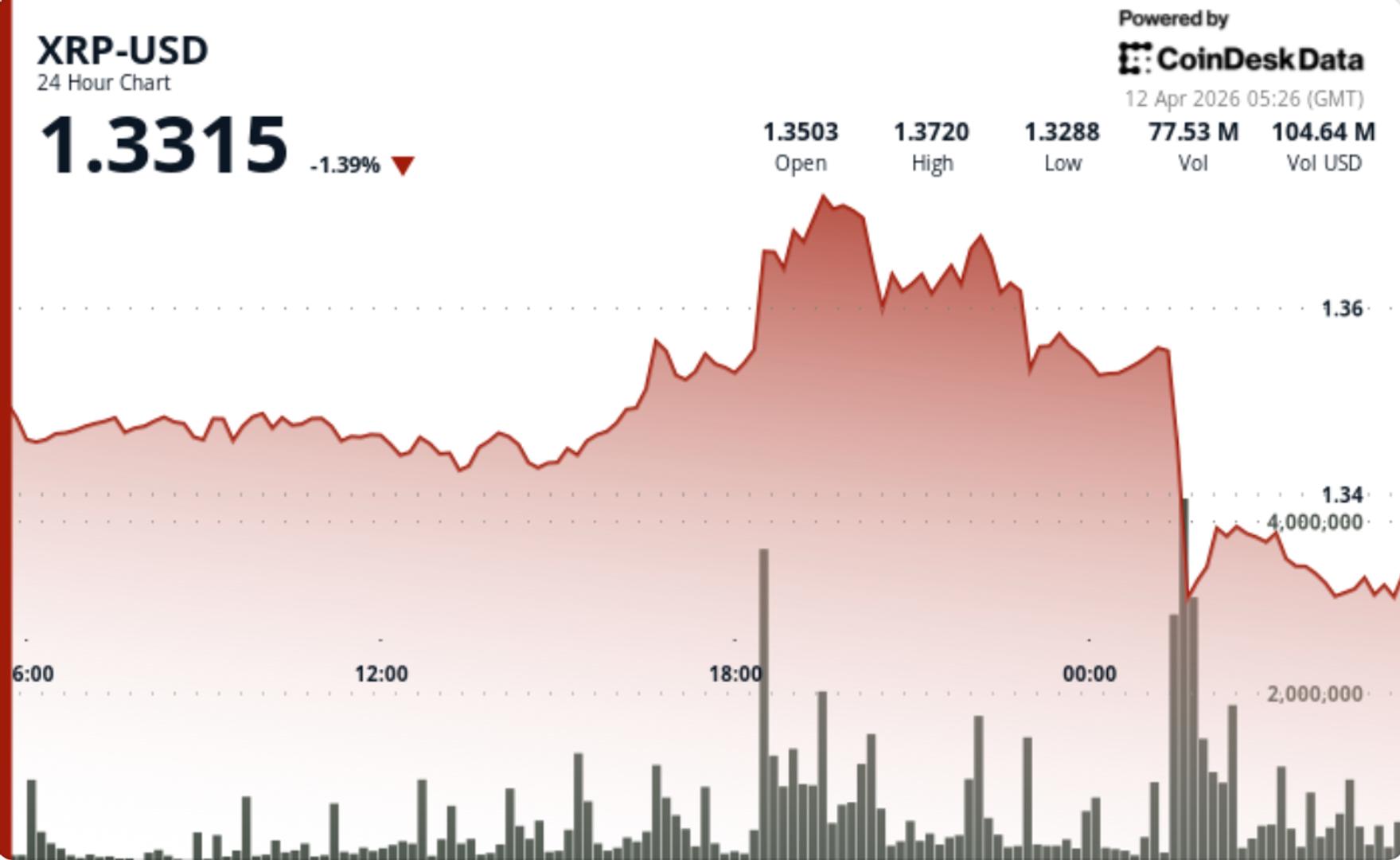
XRP has declined to $1.33 as Bitcoin's weakness continues to ripple through the broader cryptocurrency market, pulling down major digital assets. The pullback reflects ongoing market volatility and risk-off sentiment among investors seeking safer positions amid macroeconomic uncertainty.
Overview
The cryptocurrency market experienced significant headwinds on April 12, 2026, as XRP slid to $1.33, marking a notable decline that underscores the persistent weakness plaguing the sector's largest asset, Bitcoin. This price movement demonstrates the interconnected nature of cryptocurrency markets, where Bitcoin's performance continues to serve as a bellwether for the broader digital asset ecosystem. The decline in XRP, which trades as the sixth-largest cryptocurrency by market capitalization, reflects the cascading effect of Bitcoin's struggles on altcoin valuations. Investors across the market have grown increasingly cautious, with risk-off sentiment driving capital away from speculative positions and into more stable assets.
The relationship between Bitcoin and altcoins remains one of the most important dynamics in cryptocurrency trading and investment strategy. When Bitcoin weakens, institutional investors and retail traders alike tend to reduce their exposure to higher-risk digital assets, leading to coordinated selling pressure across the altcoin space. XRP's descent to $1.33 represents a critical price level that technical analysts have been closely monitoring, as breaks below psychological thresholds often trigger additional selling through stop-loss orders and momentum-based trading algorithms. This pattern has repeated numerous times throughout cryptocurrency's history, yet each cycle brings new participants and evolving market conditions that shape the intensity and duration of such downturns.
The broader implications of this market movement extend beyond simple price action. The weakness in XRP and other major altcoins suggests that institutional confidence in the sector remains fragile, potentially influenced by macroeconomic factors including interest rate expectations, inflation concerns, and regulatory developments. Market participants are interpreting these price movements as a signal that the recent optimism surrounding cryptocurrency adoption and technological breakthroughs may be facing headwinds. Understanding the mechanisms behind this decline requires examining both the technical factors driving Bitcoin's weakness and the fundamental developments affecting investor sentiment across the cryptocurrency space.
Background
Ripple's XRP has maintained a controversial yet persistent position within the cryptocurrency ecosystem since its inception. Unlike Bitcoin, which operates as a decentralized peer-to-peer cash system, XRP was designed primarily as a settlement and remittance token for the Ripple protocol, a distributed ledger designed to facilitate fast, low-cost international money transfers. This distinction has historically affected XRP's valuation dynamics and investor composition compared to other major cryptocurrencies. The token's connection to Ripple Labs, a company with significant holdings and governance influence over XRP's ecosystem, has also shaped its regulatory treatment and institutional adoption patterns throughout the cryptocurrency market cycle.
XRP reached its all-time high of approximately $3.84 in January 2018, during the initial cryptocurrency boom, before entering a prolonged bear market that lasted several years. The subsequent regulatory challenges, particularly the U.S. Securities and Exchange Commission's lawsuit against Ripple Labs beginning in December 2020, created significant uncertainty around XRP's legal status and utility. This legal battle lasted until July 2023, when a federal judge ruled that XRP itself was not a security, providing relief to the Ripple ecosystem and its supporters. Following this ruling, XRP experienced a recovery, climbing back toward higher price levels and attracting renewed institutional and retail interest in the token.
The recovery phase following the SEC lawsuit's resolution created optimism among XRP holders and supporters of the Ripple ecosystem. Institutional adoption of Ripple's solutions for cross-border payments increased during this period, with various financial institutions exploring or implementing xRapid, the blockchain-based payment service that utilizes XRP. Banks and money transfer services saw potential in the efficiency gains offered by Ripple's technology compared to traditional correspondent banking systems. However, the broader cryptocurrency market's exposure to macroeconomic headwinds, combined with Bitcoin's recent weakness, has tempered these optimistic narratives and brought XRP back to lower price levels. The current decline to $1.33 represents a pullback from higher levels, signaling that positive fundamental developments in the Ripple ecosystem have not been sufficient to insulate XRP from broader market weakness.
Historically, XRP has exhibited higher volatility than Bitcoin, with larger percentage swings during both bull and bear markets. This characteristic reflects the smaller market capitalization and lower trading volume compared to Bitcoin, creating an environment where larger trades can move the price more substantially. Additionally, the speculative nature of altcoin trading—where retail investors often chase price momentum and technical breakouts—has contributed to XRP's pronounced price swings. The current decline fits within this pattern, as the loss of positive momentum in Bitcoin has triggered capitulation selling among XRP traders who were betting on continued price appreciation.
Key Developments
The immediate catalyst for the current market weakness stems from Bitcoin's declining price action, which has broken through several key support levels in recent trading sessions. Bitcoin, trading at approximately $42,000 to $45,000 during this period, has faced selling pressure driven by multiple factors including rising bond yields, strengthening US dollar performance, and disappointing macroeconomic data. When Bitcoin's price momentum turns negative, traders and investors typically reduce their risk exposure across the board, beginning with smaller, more speculative positions in altcoins before extending selling pressure to larger holdings. This de-risking process has accelerated in recent days, with XRP and other major altcoins experiencing proportionally larger percentage declines than Bitcoin itself.
Technical analysis of XRP's price chart reveals that the token had been approaching a critical resistance level around $1.50 to $1.60 in recent weeks. The failure to break above this resistance level, combined with weakening trading volume and declining relative strength indicators, suggested that bullish momentum was fading even before Bitcoin's latest bout of weakness. This technical deterioration set the stage for a more substantial pullback, with the current decline to $1.33 representing a break of an intermediate support level that had held throughout the recent recovery phase. Technical traders who had positioned themselves for a breakout above resistance have likely capitulated, adding their selling to the supply pressure driving prices lower.
On-chain data provides additional context for understanding the current market dynamics. Network activity metrics, transaction volumes, and whale movements have all shown signs of reduced conviction among large XRP holders. Some analytics firms have reported increased transfers from institutional and large retail wallets toward exchanges, which often signals preparation for selling activity. These on-chain signals, combined with declining social media sentiment and reduced discussion of XRP in crypto-focused communities, suggest that enthusiasm for the token has dimmed considerably. The psychological impact of breaking below certain round number price levels, such as $1.50 or $1.40, cannot be underestimated in cryptocurrency markets, where retail investor participation and stop-loss order clustering create technical phenomena that self-reinforce price declines.
Regulatory developments in the cryptocurrency space, while less directly affecting XRP in recent weeks, continue to shape the broader market sentiment. Discussions around central bank digital currencies (CBDCs), which could potentially compete with or complement blockchain-based solutions like Ripple, have created some uncertainty about long-term use cases for tokens like XRP. Additionally, ongoing regulatory scrutiny in various jurisdictions regarding cryptocurrency market manipulation, custody standards, and consumer protection frameworks has created a general risk-off environment. Institutional investors, in particular, may be becoming more cautious about their cryptocurrency exposure pending clearer regulatory frameworks in key markets.
Market Impact
The decline in XRP and broader cryptocurrency weakness has ripple effects throughout the digital asset ecosystem and related industries. Cryptocurrency exchanges have experienced increased trading volumes as investors adjust their positions, though volatility-driven volume often creates stressed trading conditions. Portfolio managers overseeing cryptocurrency allocations have faced pressure to rebalance their holdings, particularly those that had been aggressively positioned for further cryptocurrency appreciation. The weakness also affects derivative markets, where leveraged traders betting on continued price increases may face margin calls and forced liquidations, creating additional selling pressure in spot markets.
For Ripple Labs and its ecosystem of partners, the price decline creates challenges in several dimensions. First, the lower XRP price reduces the attractiveness of the token as a medium of exchange within the Ripple payment protocol, though the company has consistently emphasized that XRP's price is not essential to its utility as a settlement mechanism. Second, venture capital and private equity investors who participated in Ripple's funding rounds may experience unrealized losses on their investments, potentially affecting the appetite for future funding rounds or acquisitions in the blockchain space. Third, developers and entrepreneurs building on the Ripple ecosystem may feel reduced enthusiasm and commitment, as declining token prices often correlate with diminished funding availability for projects built on particular blockchain platforms.
The broader cryptocurrency market has historically shown that when major assets like Bitcoin and XRP experience significant declines, the willingness of new investors to enter the space typically diminishes. Media coverage tends to become more negative, focusing on volatility and losses rather than adoption stories and technological breakthroughs. This negative feedback loop can persist for months or even years, as the cryptocurrency market experiences extended bear market periods. The current market decline, if it extends further or persists longer than traders expect, could trigger a significant reduction in new capital inflows to the sector and force several marginal blockchain projects to abandon their development plans due to funding constraints.
Retail investors who accumulated XRP during the recovery following the SEC lawsuit resolution now face significant unrealized losses, which may affect their willingness to participate in future cryptocurrency investments. Loss aversion is a well-documented behavioral finance phenomenon where investors feel losses more acutely than equivalent gains, creating a psychological barrier to re-entering the market after experiencing substantial drawdowns. This effect can have lasting consequences for cryptocurrency adoption, as negative first experiences often deter long-term participation. Conversely, the market weakness may create opportunities for patient, value-oriented investors who view the current prices as attractive entry points based on fundamental assessments of the Ripple protocol's utility and adoption trajectory.
Risks and Considerations
The current market environment presents multiple risks that could extend or intensify the decline in XRP and other cryptocurrency prices. Macroeconomic headwinds remain the most significant near-term concern, as central banks worldwide continue to navigate the challenging balance between controlling inflation and avoiding economic recession. Higher interest rates typically harm risk assets including cryptocurrencies, as the opportunity cost of holding non-yielding assets increases. Should central banks maintain their hawkish stance or surprise markets with additional rate increases, the downward pressure on cryptocurrency valuations could intensify substantially. Economic data releases in coming weeks will likely trigger significant volatility in cryptocurrency markets, particularly if the data surprises significantly in either direction.
Regulatory risks continue to pose a material threat to XRP and the broader cryptocurrency ecosystem. Proposed legislation in various jurisdictions could create operational challenges for cryptocurrency exchanges, custody providers, and other service providers essential to the cryptocurrency market infrastructure. In particular, discussions around imposing strict anti-money laundering and know-your-customer (KYC) requirements, while important for consumer protection, could reduce trading volumes and liquidity for certain cryptocurrencies. Additionally, if regulators in major markets move to restrict retail participation in cryptocurrency trading or impose harsh tax treatments, the demand side for XRP could contract significantly. The regulatory landscape remains fluid and unpredictable, creating ongoing uncertainty that risk-averse investors find unattractive.
Technical risks in the form of cascading liquidations and leverage-driven selling represent another dimension of downside risk. The cryptocurrency derivatives market has grown substantially, with significant open interest in leveraged long positions on both Bitcoin and major altcoins. Should a substantial decline trigger a cascade of liquidations, the selling pressure could far exceed what fundamental factors alone would suggest. Flash crash events and sudden liquidity evaporations are possible in cryptocurrency markets, particularly for tokens with moderate trading volumes like XRP. These technical phenomena can create short-term panic selling that overshoots fundamental valuations before buyers re-enter the market. Risk management and proper position sizing become critical for investors seeking to navigate this inherent volatility.
Competitive risks also merit consideration, as the blockchain and cryptocurrency space continues to evolve rapidly. Alternative payment and settlement solutions, both blockchain-based and traditional, continue to develop and improve. Financial institutions exploring cryptocurrency solutions may opt for competing protocols or central bank digital currencies rather than XRP-based solutions. The development of tokenized assets on other blockchain platforms, particularly those with larger developer communities and more established ecosystems, could gradually erode use cases that Ripple has targeted. Additionally, the emergence of synthetic XRP through wrapped tokens or competing cryptocurrencies offering similar functionality could reduce demand for the native token.
What to Watch
Investors and market participants should closely monitor Bitcoin's price action over the coming days and weeks, as the largest cryptocurrency's trajectory will likely determine the near-term direction for XRP and the broader market. Key support levels for Bitcoin in the $40,000 to $42,000 range and resistance levels around $45,000 to $48,000 will provide important signals about whether the current weakness represents a temporary pullback or the beginning of a more sustained bear market phase. Volume analysis on daily and weekly charts will help distinguish between capitulatory selling and organic rebalancing, with higher volumes often suggesting more conviction behind price moves. Should Bitcoin stabilize and begin recovering from current levels, XRP will likely benefit from renewed risk appetite and could reclaim higher price levels.
Macroeconomic data releases warrant close attention, particularly inflation reports, employment data, and federal funds futures that signal market expectations for interest rates. The Federal Reserve's commentary and economic projections will provide guidance on the likely trajectory of monetary policy, which has become an increasingly important driver of cryptocurrency valuations. Cryptocurrency market participants have demonstrated increasing sensitivity to macroeconomic data, with sharp reactions to unexpected developments. Calendar-based trading around major data release events has become increasingly common among sophisticated market participants.
Ripple-specific developments should be monitored for updates on institutional adoption, partnership announcements, and regulatory developments. Positive announcements regarding new financial institution partnerships or expanded use of Ripple's payment solutions could provide fundamental support for XRP prices. Conversely, any regulatory setbacks or negative developments in key markets could trigger further selling pressure. The company's quarterly reports and public communications regarding transaction volumes and ecosystem growth provide important fundamental metrics for assessing whether the token's use case is expanding or contracting.
Technical breakpoints on XRP's price chart represent important thresholds that traders will be monitoring closely. A break below $1.30 could trigger additional selling, while stabilization and recovery above $1.50 would signal renewed strength. Trading volume trends and the ability to hold support levels will provide important clues about the underlying supply-demand balance. Additionally, the performance of XRP relative to other major altcoins could indicate whether the weakness is specific to Ripple's ecosystem or part of a broader altcoin capitulation that affects the entire sector.
Conclusion
XRP's decline to $1.33 represents more than just a short-term price fluctuation; it reflects the complex interplay of technical factors, macroeconomic conditions, and market psychology that characterize cryptocurrency markets. The weakness in Bitcoin and broader risk-off sentiment among investors have created an environment where even projects with genuine utility and institutional adoption face significant headwinds. For XRP specifically, the challenge lies in demonstrating that the fundamental value proposition of the Ripple protocol and the XRP token—fast, efficient cross-border settlement—remains compelling despite current price weakness.
The current market environment presents both risks and opportunities depending on investment perspective and time horizon. Short-term traders face significant volatility and the risk of further downside if macroeconomic conditions deteriorate or technical support levels fail to hold. Long-term investors may view current prices as attractive entry points if they believe in the long-term utility of Ripple's technology and the expansion of cryptocurrency adoption for financial institutions worldwide. The dichotomy between these perspectives reflects the fundamental uncertainty that continues to characterize the cryptocurrency market despite significant development and institutional interest over the past several years.
Moving forward, the trajectory of XRP and the broader cryptocurrency market will likely depend on developments in three key areas: macroeconomic conditions and central bank policy, regulatory frameworks and institutional adoption, and technical market dynamics including the behavior of leveraged traders and sentiment shifts among retail investors. Participants should maintain disciplined risk management practices, avoid emotional decision-making during periods of volatility, and focus on fundamental assessments of token utility and ecosystem development rather than short-term price movements. As the cryptocurrency market matures, price discovery mechanisms will likely become more rational and less subject to extreme volatility, but for the foreseeable future, investors should expect continued periodic episodes of sharp declines and rapid recoveries as the market works through its evolutionary development phase.
Original Source
CoinDesk