Beaten-Down Treasury Stocks Surge as Bitcoin Breaches $78,000
Digital asset treasury companies experienced significant stock rallies following Bitcoin's surge past $78,000, reversing months of underperformance. The rebound reflects growing institutional acceptance and macro sentiment shift toward crypto assets as alternative wealth stores.
Overview
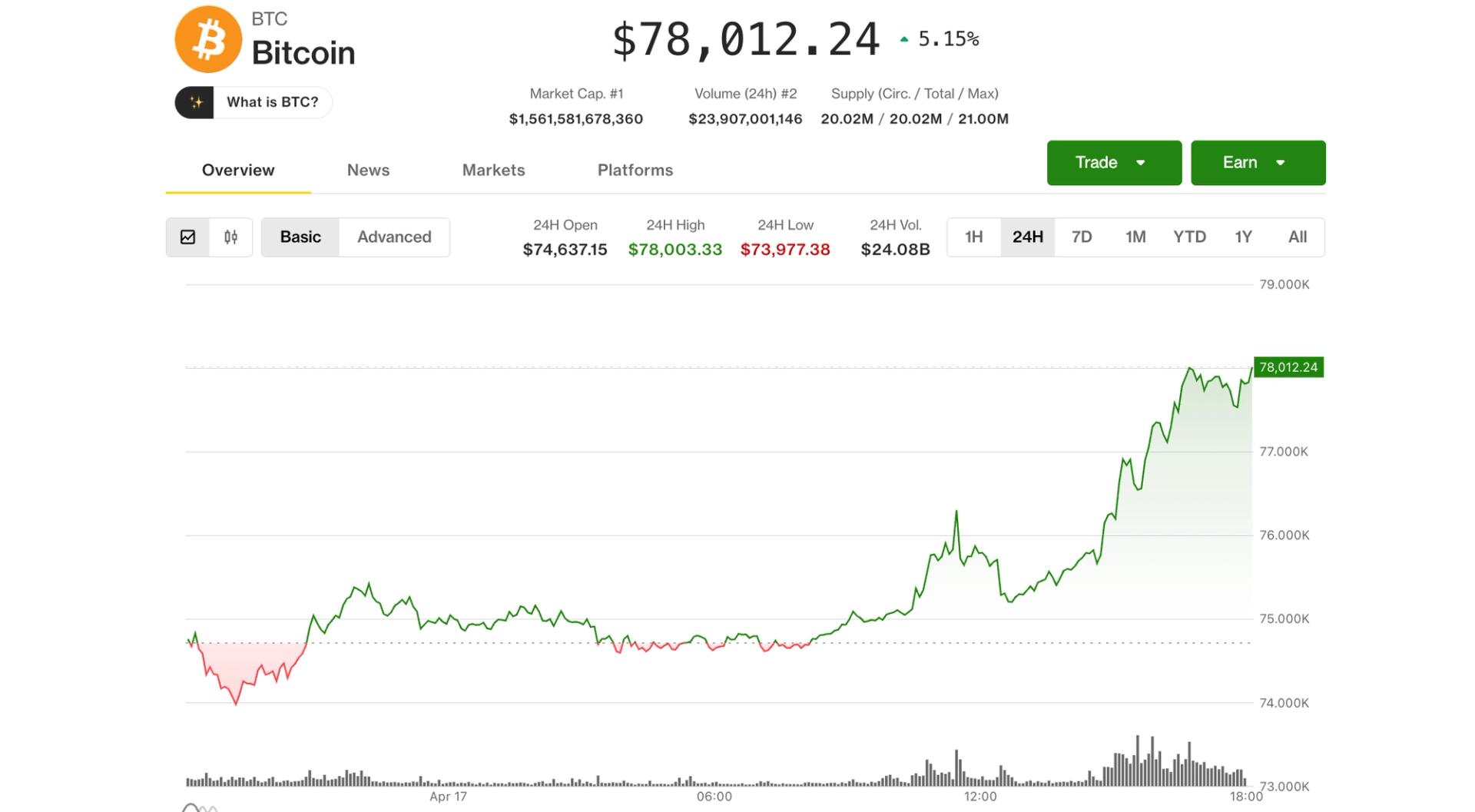
The cryptocurrency and digital asset sectors witnessed a pivotal turning point in April 2026 as Bitcoin surged past the $78,000 milestone, catalyzing a substantial rally in equities of companies holding significant cryptocurrency treasuries. This development marked a dramatic reversal for a cohort of stocks that had faced persistent headwinds throughout 2025 and early 2026, with names like MicroStrategy, Marathon Digital, Riot Blockchain, and other digitally-focused firms emerging as among the strongest performers in the broader market. The rally underscores a fundamental principle in crypto-adjacent equity markets: companies with substantial Bitcoin and cryptocurrency holdings benefit from a dual catalytic effect—both the rising asset value and expanding market sentiment around digital asset adoption.
The surge gained particular significance because it demonstrated renewed institutional confidence in the long-term thesis that companies should maintain cryptocurrency reserves as strategic treasury assets. After months of skepticism and redemption pressure, the market appeared to be re-evaluating these firms not merely as speculative plays but as legitimate treasury management strategies in an era of monetary expansion and currency debasement concerns. The $78,000 Bitcoin milestone served as both a technical breakthrough and a psychological turning point, signaling to broader markets that digital assets had established sufficient market maturity and mainstream acceptance to warrant serious institutional participation.
This market dynamic provides crucial insights into how traditional equity markets price companies with alternative asset holdings, and what conditions must align for such digital asset treasury strategies to outperform. The April 2026 rally offered a masterclass in momentum-driven market behavior while simultaneously validating long-term theses about cryptocurrency's role in corporate treasury management.
Background
The emergence of companies treating Bitcoin and other cryptocurrencies as legitimate treasury assets represented a significant departure from traditional corporate finance practices. Beginning with MicroStrategy's announcement of its first Bitcoin purchases in 2020, followed by Tesla's highly publicized $1.5 billion investment, the narrative shifted from viewing cryptocurrency as a speculative investment to considering it a viable alternative to traditional cash equivalents. This transition gained momentum as institutional investors increasingly recognized the limitations of cash holdings in an environment of persistent inflation and unprecedented monetary stimulus.
However, the path from this initial institutional adoption to consistent market recognition proved far from linear. Throughout 2021 and early 2022, cryptocurrency treasury holdings were celebrated and rewarded by markets; companies with large Bitcoin reserves saw their stocks surge alongside rising Bitcoin valuations. Yet the crypto market downturn of 2022, catalyzed by regulatory concerns, major exchange failures, and macroeconomic headwinds, created a challenging environment for cryptocurrency-holding companies. The bankruptcy of FTX, one of the world's largest cryptocurrency exchanges, sparked a broader reassessment of risk and legitimacy within the digital asset space, leading many institutional investors to question the wisdom of corporate Bitcoin holdings.
The subsequent period from mid-2022 through early 2026 witnessed a prolonged cycle of skepticism toward digital asset treasury names. Despite Bitcoin's recovery from its $16,000 lows in late 2022 to reach $60,000-plus levels by 2025, the stocks of major Bitcoin-holding companies substantially underperformed both the broader equities market and Bitcoin itself. This divergence puzzled many market observers and suggested that equity investors harbored lingering concerns about the prudence of cryptocurrency holdings, the volatility of digital assets, or the specific business strategies of these firms beyond their treasure holdings. The "beaten down" nature of these stocks at the time Bitcoin reached $78,000 meant that valuations had become extraordinarily depressed relative to their underlying asset holdings and long-term revenue prospects.
The environment that fostered this skepticism included macroeconomic considerations, regulatory uncertainty across major jurisdictions, and performance challenges at several prominent cryptocurrency companies. Banking sector turmoil in early 2023, cryptocurrency lending collapses, and ongoing regulatory debates about asset classification created an atmosphere where even sophisticated institutional investors remained cautious about direct or indirect cryptocurrency exposure. This backdrop made the April 2026 rally all the more significant, as it suggested that fundamental attitudes toward digital asset legitimacy and corporate treasury management had finally shifted.
Key Developments
The catalyst for the April 2026 rally centered on Bitcoin breaking through the $78,000 level, a milestone that arrived amid a confluence of favorable macroeconomic and geopolitical conditions. The breakthrough came after months of consolidation in the $65,000-$75,000 range, suggesting that institutional and retail demand had solidified at higher price levels. The breakout gained particular credibility from increased trading volumes and positive sentiment among major institutional participants, many of whom had substantially increased their cryptocurrency allocations in early 2026 following a series of favorable regulatory developments.
Regulatory developments in early 2026 provided crucial support for the rally. Multiple jurisdictions moved toward clearer frameworks for cryptocurrency custody, trading, and corporate holdings. The Securities and Exchange Commission (SEC), after years of resistance, signaled openness to expanding cryptocurrency investment vehicles and reducing barriers to institutional participation. Separately, major central banks began acknowledging the role of cryptocurrencies in portfolio diversification and international reserve arrangements, a significant shift from prior dismissiveness. These regulatory and institutional pivots removed a major psychological barrier that had constrained demand for cryptocurrency-holding equities.
The actual stock performance of digital asset treasury companies following the $78,000 Bitcoin level demonstrated remarkable acceleration. MicroStrategy, which had accumulated over 200,000 Bitcoin through a multi-year acquisition program despite years of market criticism, experienced a stock surge exceeding 40% in a matter of weeks. Marathon Digital, another major Bitcoin accumulator, similarly rallied substantially on the coattails of rising Bitcoin prices and improving sentiment toward the sector. Riot Blockchain and smaller-cap digital asset companies also participated in the rally, with many stocks gaining 20-50% in relatively brief timeframes.
The magnitude of these gains reflected not merely the mathematical effect of Bitcoin appreciation on company net asset values (NAV). Rather, the rallies suggested a compression of risk premiums that had previously attached to these equities. In other words, markets had been pricing in a discount for holding cryptocurrencies, and that discount was rapidly disappearing. The rally represented a reversion toward fundamentals where a company's stock price more closely tracked its underlying asset holdings plus its business operations. This normalization of valuations proved particularly beneficial for companies that had been most aggressive in accumulating Bitcoin when markets were depressed and skepticism was highest.
Market Impact
The rally in digital asset treasury stocks generated significant ripple effects throughout broader financial markets. The outperformance of Bitcoin-holding companies contributed to rotation flows that lifted other cryptocurrency-adjacent equities, including blockchain infrastructure firms, mining equipment manufacturers, and cryptocurrency exchange operators. The positive momentum created what market participants termed a "halo effect," where strength in one corner of the cryptocurrency ecosystem encouraged risk-taking across the entire sector.
From a portfolio perspective, the rally demonstrated the diversification benefits of cryptocurrency holdings within corporate treasuries. Investors who had maintained positions in beaten-down digital asset companies despite years of underperformance received validation for their conviction. This dynamic attracted new investment flows, as institutional allocators became increasingly comfortable with the cryptocurrency asset class and companies whose strategies aligned with digital asset adoption. The rally also had the effect of validating the long-term theses articulated by Bitcoin advocates within major corporations, potentially encouraging other companies to seriously evaluate cryptocurrency treasury strategies.
The impact on market structure and trading dynamics proved noteworthy as well. The concentration of trading activity in a relatively small number of heavily held stocks created conditions where relatively modest capital flows could generate substantial price movements. Options markets pricing on digital asset stocks reflected declining implied volatility following the rally's establishment, suggesting that traders expected continued stability and positive momentum. The rally therefore had self-reinforcing characteristics, where initial price moves attracted additional capital and created conditions for further appreciation.
Broader macroeconomic implications emerged as cryptocurrency market capitalization expanded significantly alongside stock price gains for Bitcoin-holding companies. The combined effect pushed total cryptocurrency market capitalization substantially higher, reaching levels not seen since the previous market peak. This expansion reflected both speculative capital flowing into digital assets and evidence of institutional adoption expanding. Central bank discussions about digital currencies, particularly regarding implications for international reserve arrangements, appeared to accelerate following the rally, suggesting that the cryptocurrency market's growing size and institutional character demanded serious policy consideration.
Risks and Considerations
Despite the compelling narrative of the April 2026 rally, substantial risks remained embedded in digital asset investments and companies whose treasuries depend heavily on cryptocurrency valuations. The historical volatility of Bitcoin and cryptocurrencies suggested that gains achieved during favorable market conditions could reverse rapidly if sentiment deteriorated. Companies that had accumulated large Bitcoin holdings during the skeptical period of 2022-2025 faced exposure to significant valuation swings, and their stock prices would move inversely if Bitcoin declined materially. The leverage in the appreciation story—where Bitcoin gains were amplified in company stock prices—worked both directions.
Regulatory risks persisted despite the improved environment in early 2026. While major jurisdictions had moved toward clearer frameworks, uncertainty remained regarding tax treatment of corporate cryptocurrency holdings, valuation standards for financial reporting, and potential restrictions on cryptocurrency activities. A major regulatory crackdown or policy reversal in a significant jurisdiction could rapidly undermine the improved sentiment. Additionally, the potential for negative developments within the cryptocurrency ecosystem—major exchange failures, technological vulnerabilities, or criminal activities—remained an enduring risk that could trigger sell-offs regardless of macroeconomic conditions.
From a valuation perspective, questions persisted about the sustainability of the rally and whether beaten-down digital asset stocks had become overvalued on the upswing. Some market observers argued that the rapid reversal of skepticism and the substantial price gains left limited margin for error. If Bitcoin failed to sustain levels above $75,000, or if macroeconomic conditions deteriorated, the enthusiasm could evaporate quickly. The concentration of gains in a relatively small number of heavily weighted stocks created additional tail risks, as significant capital flows out of these positions could generate rapid price declines.
Counterparty and custody risks also warranted consideration. While major custody solutions had improved substantially since the 2022 industry challenges, the risks of digital asset custody—technological vulnerabilities, operational failures, or exchange insolvency—remained relevant for companies holding substantial Bitcoin reserves. The concentration of custody arrangements at a limited number of providers created systemic dependencies that could prove problematic if major custody providers experienced difficulties.
What to Watch
Market participants closely monitoring the digital asset treasury sector identified several key developments to track in the weeks and months following April 2026. The first critical level involved Bitcoin's ability to sustain prices above $75,000-$78,000. A breakdown below these levels would likely trigger profit-taking in digital asset stocks and potentially expose some of the underlying vulnerabilities in the bullish thesis. Conversely, a move toward $80,000 or higher would reinforce positive momentum and potentially attract additional institutional capital.
Regulatory developments remained among the most significant variables to monitor. The SEC's stance on cryptocurrency investment vehicles, central bank decisions regarding digital currency frameworks, and international policy coordination efforts would substantially influence the long-term viability of cryptocurrency as a corporate treasury asset. Any major policy reversals or regulatory crackdowns would likely undermine the positive sentiment that had driven the April 2026 rally. Conversely, clearer regulatory frameworks and explicit institutional endorsement would likely attract sustained capital flows.
Corporate treasury management trends also merited close observation. Other major corporations might follow the lead of MicroStrategy and Marathon Digital by incorporating cryptocurrency into their treasury strategies. Evidence of broader adoption across the Fortune 500 would provide substantial validation of the digital asset thesis and could support continued equity rallies. Conversely, if corporate adoption stalled or other major companies chose to liquidate cryptocurrency holdings, it would signal that enthusiasm had peaked.
Macroeconomic conditions, particularly inflation rates, monetary policy trajectories, and currency debasement expectations, would significantly influence cryptocurrency demand and valuations. A shift toward tighter monetary policy or sustained low inflation could reduce the appeal of cryptocurrencies as inflation hedges, potentially undermining the fundamental thesis. Additionally, developments in traditional finance regarding interest rate dynamics, credit conditions, and equity market valuations would influence the relative attractiveness of alternative assets like Bitcoin.
Conclusion
The April 2026 rally in beaten-down digital asset treasury stocks, catalyzed by Bitcoin's surge past $78,000, represented a significant inflection point in the institutional acceptance and legitimacy of cryptocurrency holdings. The reversal of years of market skepticism toward companies like MicroStrategy and Marathon Digital validated the long-term thesis that cryptocurrencies could serve as legitimate corporate treasury assets in an era of monetary instability and institutional portfolio diversification. The rally's magnitude and breadth across the digital asset sector suggested that fundamental attitudes toward cryptocurrency had shifted materially among sophisticated institutional investors.
However, the sustainability of these gains and the long-term viability of digital asset treasury strategies remained contingent on multiple factors. Continued regulatory clarity, macroeconomic conditions that support alternative asset demand, and cryptocurrency market stability would all prove crucial for the strategy to succeed on a sustained basis. The rally demonstrated that substantial wealth could be created through conviction in cryptocurrency adoption, but it equally demonstrated the volatility and tail risks embedded in the asset class. For investors and corporate treasury managers, the April 2026 developments provided both validation of cryptocurrency's emerging role in institutional finance and a reminder of the substantial uncertainties that persist.
Looking forward, the divergence between Bitcoin's price action and the preceding market skepticism toward cryptocurrency-holding stocks offered a crucial lesson: market leadership and institutional adoption often arrive with extended lags, and patience with contrarian positions during periods of extended skepticism can generate substantial returns. The beaten-down names that rallied in April 2026 had endured years of criticism and underperformance, yet their fundamental theses—that Bitcoin would appreciate and cryptocurrencies would achieve institutional legitimacy—ultimately proved prescient. The question moving forward centers on whether this April 2026 rally represents the beginning of a sustained new paradigm for cryptocurrency adoption or a cyclical peak that will eventually give way to renewed skepticism. The answer to that question will substantially determine investment outcomes for cryptocurrency-holding equities and the broader digital asset sector for years to come.
Original Source
CoinDesk