Bitcoin Loses Steam Below $80K: Traders Turn Cautious Amid Market Pullback
Bitcoin has slipped below the $80,000 milestone, prompting a shift toward caution among cryptocurrency traders. The pullback reflects broader market concerns about regulatory headwinds, macroeconomic uncertainty, and profit-taking after a strong rally.
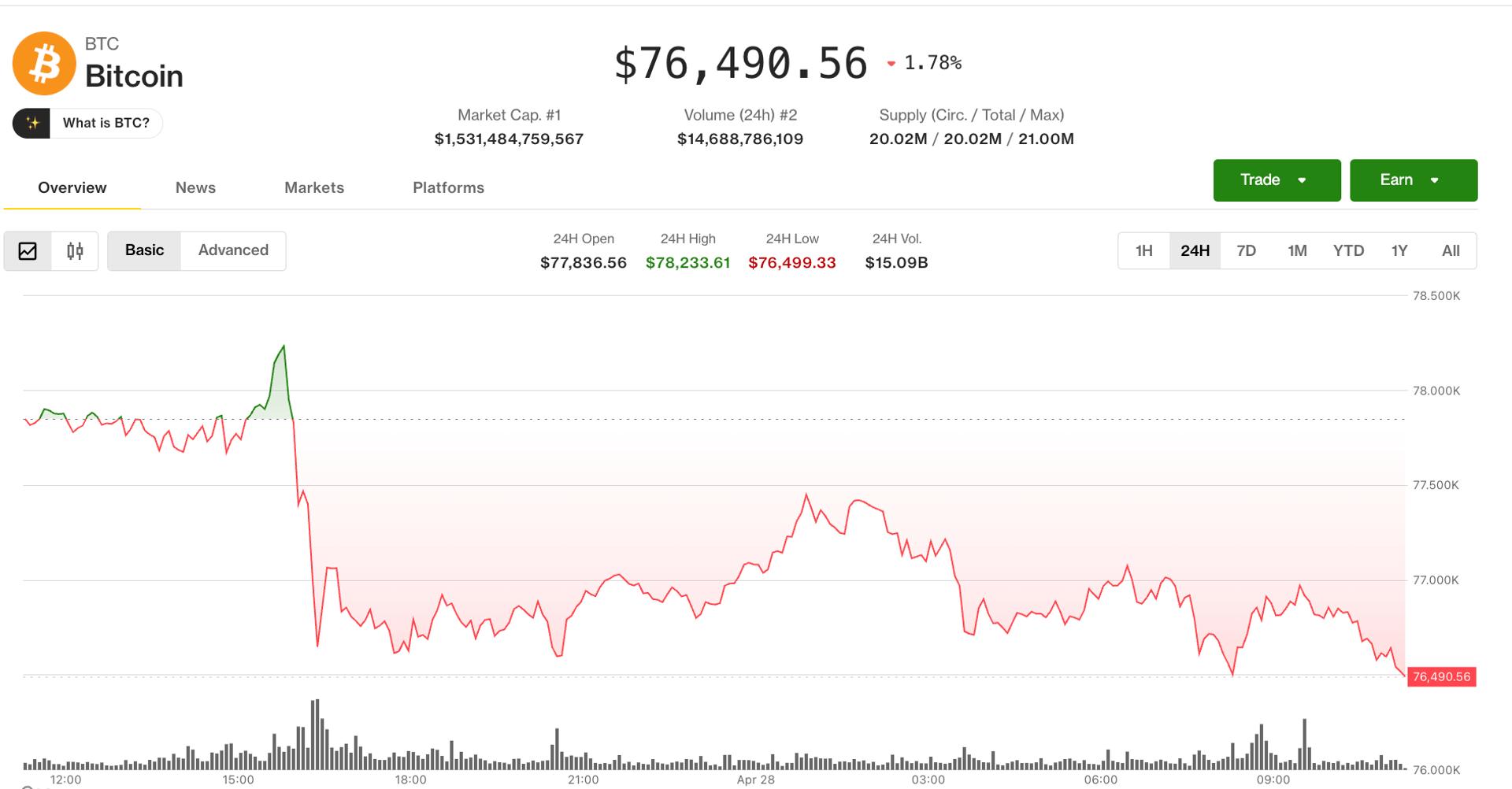
Overview
Bitcoin, the world's largest cryptocurrency by market capitalization, has retreated below the critical $80,000 threshold, triggering a notable shift in trader sentiment from optimism to caution. The digital asset, which peaked near $100,000 in early 2025 amid retail enthusiasm and corporate adoption, has faced increasing headwinds throughout 2026. This pullback represents a significant moment for cryptocurrency markets, as traders reassess their positioning and long-term outlook amid a complex macroeconomic backdrop.
The loss of momentum below $80,000 carries symbolic weight in crypto markets, where psychological price levels often influence trading behavior and sentiment. Many traders view this range as a critical support level, and its breach has prompted profit-taking and risk-reduction strategies across institutional and retail portfolios. Cryptocurrency exchanges have reported elevated trading volumes, indicating heightened volatility and potential capitulation selling as market participants reduce exposure to digital assets.
This market movement highlights the cyclical nature of cryptocurrency markets, where periods of euphoria are frequently followed by periods of consolidation and correction. The current environment differs markedly from the frenzied rally of 2024-2025, when mainstream adoption narratives and institutional inflows drove relentless buying pressure. Today's market conditions reflect a more mature, discerning approach to cryptocurrency investing, where macro factors, regulatory clarity, and fundamental metrics carry greater influence than hype cycles.
Background
Understanding the current bitcoin pullback requires examining the historical context of cryptocurrency price movements and the factors that propelled Bitcoin toward six-figure valuations in recent years. Bitcoin's journey from below $20,000 in 2022 to near $100,000 in early 2025 was driven by multiple converging factors: institutional adoption through corporate treasury diversification, the introduction of Bitcoin spot exchange-traded funds (ETFs) in the United States, and growing acceptance as a store of value amid inflationary concerns.
The 2024 halving event, in which Bitcoin's mining rewards decreased from 6.25 BTC to 3.125 BTC, also contributed to bullish sentiment. Historically, Bitcoin halvings have preceded periods of price appreciation, though this relationship is not guaranteed. Additionally, macroeconomic conditions changed dramatically during this period, with central banks shifting from aggressive rate-hiking cycles toward easing policies. These conditions created an environment favorable for risk assets like Bitcoin, which typically appreciate when real interest rates decline and inflation concerns loom.
Corporate adoption accelerated during this period, with companies including MicroStrategy, Tesla (in limited capacity), and various payment processors integrating Bitcoin into their operations or balance sheets. The advent of Bitcoin ETFs in 2024 democratized access to the asset, allowing traditional investors to gain exposure without directly managing cryptocurrency wallets or exchanges. This institutional infrastructure maturation was widely viewed as a secular shift toward mainstream acceptance, justifying higher valuations and continued investment.
However, this optimistic narrative has begun to unravel as 2026 progresses. Early indications suggest that much of the bullish thesis already priced into Bitcoin has been realized, leaving fewer near-term catalysts. Additionally, new challenges have emerged, including geopolitical tensions, cryptocurrency regulatory developments, and shifting macroeconomic expectations that have tempered enthusiasm across risk asset classes.
Key Developments
Several catalysts have contributed to Bitcoin's recent weakness and the shift toward trader caution. First and foremost, regulatory developments have created uncertainty across the cryptocurrency industry. Various governments have announced stricter compliance requirements for cryptocurrency exchanges, custodians, and trading platforms. The U.S. Securities and Exchange Commission (SEC) has intensified scrutiny of cryptocurrency derivatives markets, prompting exchanges to implement additional safeguards and restrict certain trading activities.
The European Union's comprehensive Markets in Crypto-Assets Regulation (MiCA) has forced exchanges and platforms to adopt stringent compliance protocols, raising operational costs and potentially limiting access to certain cryptocurrency services. These regulatory pressures have dampened retail participation and created uncertainty around future business models for cryptocurrency platforms. Traders worry that increasingly restrictive regulations could eventually restrict their ability to trade or hold digital assets, prompting defensive positioning.
Second, macroeconomic headwinds have emerged that complicate the bullish case for Bitcoin. Inflation persistence in various developed economies has led central banks to maintain higher-for-longer interest rate policies. This environment reduces the appeal of non-yielding assets like Bitcoin, particularly when Treasury bonds and money market instruments offer attractive real returns. The inverted yield curve in several economies has also sparked recession concerns, which historically pressure risk asset valuations, including cryptocurrencies.
Third, Bitcoin's correlation with traditional risk assets has strengthened significantly in recent months. During the early phases of institutional adoption, Bitcoin was lauded as an uncorrelated asset that could provide portfolio diversification benefits. However, sophisticated analysis increasingly demonstrates that Bitcoin moves in tandem with equity markets and other risk assets during periods of market stress. This correlation reduces the diversification benefits many institutional investors sought, leading some to reassess their allocation sizes.
Fourth, technical chart patterns have provided additional fuel for cautious sentiment. Bitcoin's failure to break above certain resistance levels in April 2026 has been interpreted by technical traders as a sign of weakening momentum. The formation of several bearish candlestick patterns and a decline in trading volume on strength indicators suggest that buyers are less committed than they were during the 2024-2025 rally. These technical signals, while not deterministic, influence algorithmic trading and leverage positions that can amplify price movements in either direction.
Finally, competition from alternative assets has intensified. Artificial intelligence-related assets, particularly AI tokens and blockchain projects focused on decentralized machine learning, have attracted investor interest and capital that might otherwise flow to Bitcoin. Additionally, traditional value stores like gold have strengthened as investors seek risk-free assets amid uncertainty. This shift in capital allocation suggests that investors are actively rotating away from speculative positioning toward either lower-risk assets or alternative growth narratives.
Market Impact
Bitcoin's pullback below $80,000 has had cascading effects across cryptocurrency markets and trading platforms. Altcoins, tokens other than Bitcoin, have generally declined more sharply than Bitcoin, reflecting their higher sensitivity to cryptocurrency sector sentiment. Ethereum, the second-largest cryptocurrency by market capitalization, has declined 15-20% alongside Bitcoin's move, while smaller-cap tokens have experienced even steeper losses. This typical pattern reflects how Bitcoin serves as a bellwether for cryptocurrency market health and trader risk appetite.
Liquidity has become a critical concern for traders managing large positions. As volumes have declined from the euphoric highs of 2024-2025, selling pressure from risk-averse traders and institutions has become more impactful. Several large trading positions built during the bull market have been forcibly liquidated as prices moved against leveraged traders. These liquidations have created a negative feedback loop, wherein automated liquidation orders trigger further price declines that trigger additional liquidations.
Funding rates on perpetual futures contracts, which represent the cost of maintaining leveraged positions, have shifted dramatically from positive to negative in many cases. Negative funding rates indicate that traders establishing short positions are being paid to hold their bearish bets, a clear sign of dominance by those betting on price declines. This environment creates a hostile backdrop for aggressive bulls and incentivizes risk reduction strategies.
Cryptocurrency exchanges have reported elevated inflows of Bitcoin, as traders consolidate holdings and transfer assets to custody providers. This pattern is consistent with capitulation dynamics, where smaller participants realize losses and exit positions. Conversely, on-chain data shows that long-term holders, often referred to as "hodlers" in cryptocurrency vernacular, have not significantly increased their selling pressure, suggesting that more sophisticated market participants maintain conviction in longer-term valuations.
Traditional financial media has increasingly covered the Bitcoin pullback, often interpreting it as evidence that the cryptocurrency bull market has definitively ended. These narratives, while potentially premature, have influenced retail investor behavior and created psychological pressure that encourages additional selling. Social media sentiment indicators, which measure the tone of discussions across platforms like Reddit and Twitter, have shifted notably negative, reflecting broad demoralization in retail communities.
Risks and Considerations
While current market conditions appear challenging for Bitcoin bulls, numerous risks and considerations complicate the bearish narrative. First, valuations may have become oversold relative to long-term fundamentals. Bitcoin's adoption as a store of value and medium of exchange continues to expand, albeit at a measured pace. The underlying technology has proven robust through multiple market cycles, and institutional infrastructure supporting Bitcoin ownership has matured substantially. Some analysts argue that current price levels reflect excessive pessimism and present compelling buying opportunities for long-term investors.
Second, geopolitical developments could rapidly shift market dynamics. Ongoing tensions between major powers, sanctions regimes, and capital controls in certain regions have driven individuals and institutions toward Bitcoin as a censorship-resistant alternative to traditional finance. Should geopolitical tensions escalate, flight-to-safety dynamics could paradoxically benefit Bitcoin as investors seek alternative value stores outside government control. This tail risk, while difficult to quantify, has supported institutional accumulation at current price levels.
Third, monetary policy pivots could rapidly change the macroeconomic backdrop. Should inflation decline more quickly than currently expected, central banks might accelerate interest rate cuts, immediately reducing the opportunity cost of holding non-yielding Bitcoin. Many traders who have turned cautious are positioned for this scenario, ready to quickly pivot toward optimism should macroeconomic data shift direction. This two-sided risk environment means that conviction levels remain fragile across the market.
Fourth, the emergence of central bank digital currencies (CBDCs) and increased blockchain adoption by traditional financial institutions introduces structural unknowns. Some interpret CBDC development as negative for Bitcoin, as it could reduce demand for decentralized alternatives. Others argue that CBDC development validates blockchain technology itself and could pave the way for broader cryptocurrency acceptance. This ambiguity creates interpretative challenges for fundamental analysis.
Fifth, regulatory clarity, while creating short-term uncertainty, could ultimately prove supportive for Bitcoin valuations. Clear regulatory frameworks would reduce tail risks associated with potential government crackdowns or restrictions. Several jurisdictions have signaled intent to develop comprehensive regulatory frameworks rather than bans, which could accelerate institutional adoption once uncertainty resolves. Patient capital is already positioning for this eventual regulatory clarity.
What to Watch
Market participants closely monitoring Bitcoin's price action and trading sentiment should focus on several key metrics and developments. First, Bitcoin's position relative to key technical support levels remains critical. The $70,000 level represents a significant support from the 2024 rally, and a breach of this level could trigger additional selling pressure and potentially cascade into the $60,000-$65,000 range. Conversely, Bitcoin's ability to stabilize above $75,000 and rebuild above $80,000 would signal renewed buying interest and potential reversal of bearish momentum.
Second, on-chain metrics warrant close monitoring. Metrics such as the MVRV ratio (market value to realized value), whale transaction volumes, and the number of long-term holders accumulating at current prices provide insights into whether smart money is using the dip to increase exposure. Historically, large-scale accumulation by sophisticated investors during bear sentiment has preceded significant rallies, making these metrics valuable leading indicators.
Third, macroeconomic data releases will heavily influence Bitcoin's trajectory. Upcoming inflation reports, employment data, and Federal Reserve communications will shape expectations for interest rate policy. Bitcoin tends to rally during periods of unexpected inflation or dovish central bank communications and declines during periods of hawkish guidance. Investors should monitor these releases closely for directional clues.
Fourth, regulatory developments in major jurisdictions, particularly the United States and European Union, will influence institutional demand. Announcements of clear regulatory frameworks, favorable policy toward Bitcoin mining, or official adoption by government entities could rapidly shift sentiment. Conversely, additional restrictions or enforcement actions could extend the current cautious period.
Fifth, cryptocurrency exchange inflows and outflows serve as proxies for institutional and retail market sentiment. Sustained inflows suggest that new buyers are entering the market, while sustained outflows suggest accumulation by long-term holders or withdrawal from the market. These flows provide a window into where smart money is positioning as price action develops.
Final, monitor correlations between Bitcoin and traditional risk assets. A decoupling wherein Bitcoin declines while equities rally would suggest that Bitcoin has become a risk-off asset, potentially attracting different capital flows. Conversely, if Bitcoin stabilizes while equities decline, it would suggest investors are beginning to view Bitcoin as a hedge, supporting longer-term valuations.
Conclusion
Bitcoin's pullback below $80,000 and the accompanying shift in trader sentiment reflects a natural consolidation following an exceptional multi-year rally and the maturation of cryptocurrency markets. The current environment, characterized by heightened caution and negative positioning, represents a significant transition from the euphoric bull market that dominated 2024-2025. However, this transition does not necessarily presage a catastrophic bear market or the failure of cryptocurrency as an asset class.
Instead, the current period likely represents a necessary repricing that screens for weak hands and leaves Bitcoin in the hands of more committed long-term investors. Regulatory clarity, when it arrives, should benefit rather than harm Bitcoin by reducing tail risks and encouraging institutional adoption. The underlying fundamentals supporting Bitcoin's value proposition—providing a decentralized store of value outside of traditional financial system control—remain intact and arguably more relevant given geopolitical tensions and monetary policy uncertainty.
Traders and investors should approach the current period with intellectual humility, recognizing that confidently predicting cryptocurrency price movements has proven extremely difficult historically. Those inclined toward pessimism should consider that extreme sentiment often precedes significant reversals, while those maintaining bullish conviction should respect risk management and position sizing given the volatile and uncertain macro backdrop. The next 12-24 months will be critical in determining whether Bitcoin and the broader cryptocurrency ecosystem mature into stable components of the global financial system or whether they remain relegated to speculative niches. Current price weakness provides an opportunity for patient investors to make this determination based on facts rather than emotions.
Original Source
CoinDesk