XRP Plunges Below $1.40 Support as Selling Pressure Intensifies
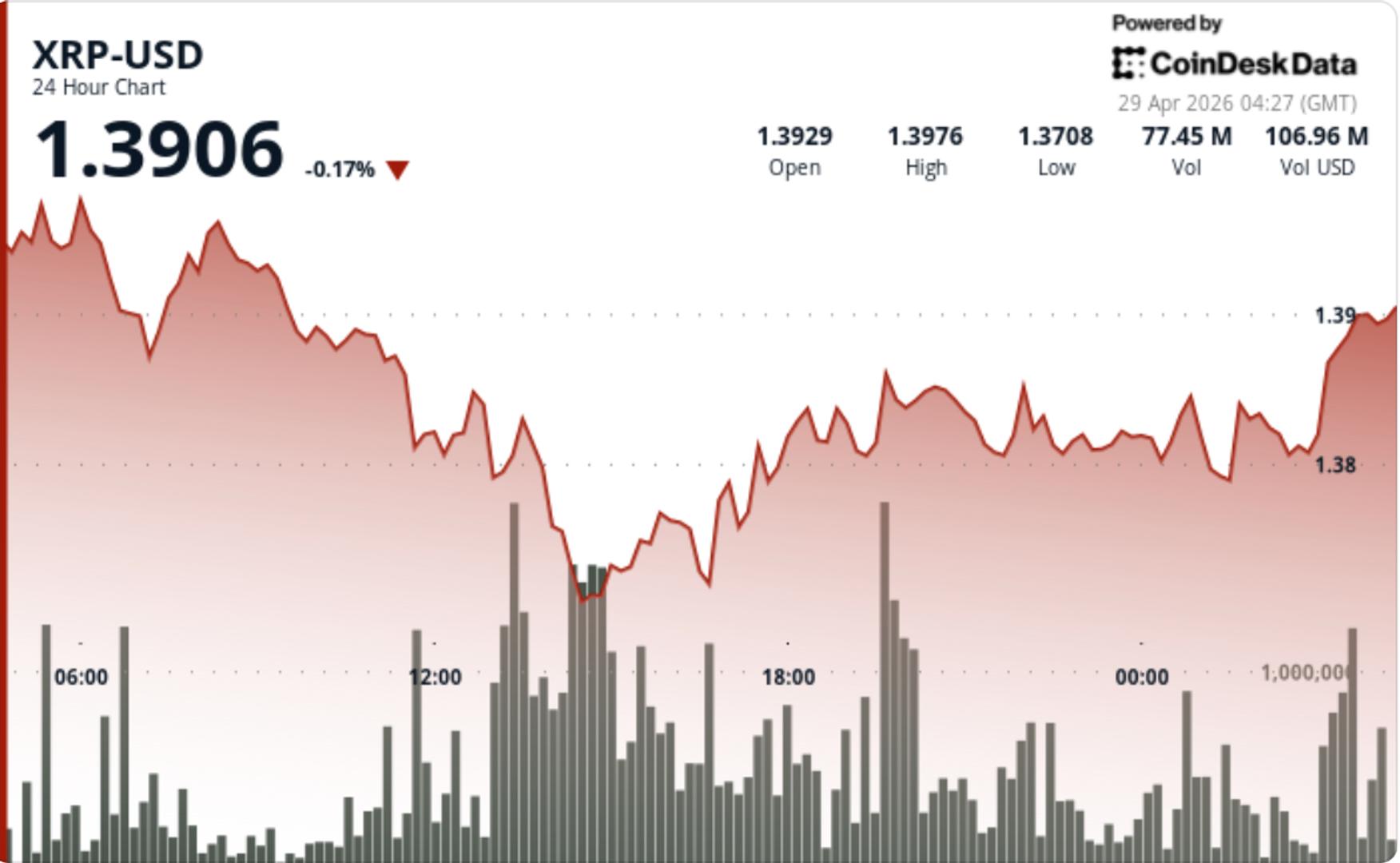
Ripple's XRP token dropped to $1.38 after breaking below the critical $1.40 support level amid increasing selling pressure. The decline reflects broader market uncertainty and technical weakness in altcoins following recent macro headwinds.
Overview
XRP, the digital asset associated with blockchain payments company Ripple, experienced a significant price decline on April 29, 2026, falling through the $1.40 support level to reach lows of $1.38 on the day. This breakdown represents more than a routine daily fluctuation—it signals a critical technical breakdown that has caught the attention of traders, investors, and analysts monitoring the cryptocurrency market. The breakdown below $1.40 is particularly significant as this level has served as a psychological and technical floor for the asset over the previous trading period. The move lower was accompanied by what traders describe as rising selling pressure, indicating that sellers have gained the upper hand in the XRP/USD pair following a period of relative stability at or near the support level.
The decline in XRP's price comes amid a broader market environment characterized by uncertainty and cautious sentiment. While Ripple continues to advance its technical infrastructure and pursue strategic initiatives, the cryptocurrency markets remain sensitive to macroeconomic conditions, regulatory developments, and shifts in investor risk appetite. The breakdown of $1.40 raises important questions about the near-term trajectory of XRP and whether the selling pressure represents a temporary capitulation or the beginning of a more sustained decline. Understanding the catalysts behind this move, the technical implications, and the potential paths forward is essential for stakeholders with exposure to the XRP token.
Traders focusing on technical analysis point to the significance of the $1.40 level breaking on an intraday basis, with the inability of buyers to defend this support suggesting that the balance of power has shifted decisively toward sellers. Volume analysis during the breakdown period will be crucial for determining whether this decline represents capitulation selling that could lead to a reversal, or whether it indicates the beginning of a more structural bear pressure. The velocity of the decline—the speed at which sellers pushed XRP lower—adds another layer of concern for bullish investors who had been relying on $1.40 as a floor.
Background
XRP's price history over the past several months provides important context for understanding the current breakdown below $1.40. The token had been trading in a relatively defined range, with $1.40 representing one of the key support levels that had been tested and defended multiple times by buyers. The establishment of this support level reflected a consensus among market participants about where institutional and retail demand converged. Prior to the April 29 breakdown, XRP had managed to hold above $1.40 through several minor sell-offs, suggesting that buyers viewed prices below this level as attractive entry points.
Ripple's XRP token has experienced a complex evolution since the company's founding in 2012. The asset gained significant attention and adoption over the years, particularly as Ripple pursued partnerships with financial institutions and pursued the development of the RippleNet ecosystem and its successor RippleX. However, XRP's price trajectory has been volatile, subject to both the broader sentiment in the cryptocurrency market and company-specific developments including regulatory scrutiny and partnership announcements. The $1.40 level that was broken during the April 29 sell-off had represented a point of equilibrium where the market had found relative balance between buyers and sellers.
Technical traders monitor specific price levels based on historical trading patterns, support and resistance dynamics, and broader market psychology. The $1.40 level for XRP had become a focal point in the technical analysis community because of its relevance in determining the short-to-medium term direction of the asset. When a major support level breaks, it often triggers additional selling pressure as traders with stops placed just below the level are forced out of positions, and as technical traders who relied on the support begin to exit their holdings. This cascading effect can accelerate price declines beyond what the initial selling pressure might suggest.
The broader cryptocurrency market context in late April 2026 included mixed signals regarding the strength of the crypto sector. Bitcoin and Ethereum, the two largest digital assets by market capitalization, had been experiencing their own technical challenges and volatility. Altcoins like XRP are particularly sensitive to shifts in overall risk appetite in the crypto market, as many investors rotate between major coins and alternative assets based on their perception of market conditions. The breakdown of XRP below $1.40 occurred during a period when broader market sentiment had grown more cautious, and this macro context likely contributed to the selling pressure.
Key Developments
The specific catalyst or catalysts for the breakdown of XRP through $1.40 on April 29 likely involved a combination of technical, fundamental, and sentiment-based factors. On the technical side, the break below this support level triggered what is known as a cascade of stops, referring to the automated stop-loss orders that traders and institutions place just below support levels to limit their losses. When XRP first broke below $1.40, these stops were likely triggered, leading to forced selling that accelerated the move lower.
From a fundamental perspective, any negative news regarding Ripple as a company, regulatory developments affecting XRP, or broader cryptocurrency market developments could have contributed to the selling pressure. Regulatory uncertainty remains a persistent factor affecting XRP's valuation, given the company's ongoing engagement with regulators in multiple jurisdictions. Additionally, developments in the broader macroeconomic environment—such as shifts in interest rates, inflation expectations, or overall financial market conditions—can affect the risk appetite of crypto investors and their willingness to hold altcoins like XRP.
Sentiment indicators, including on-chain metrics, social media activity, and derivatives positioning, may have also shifted in the days preceding the breakdown. Large traders and institutions often position themselves ahead of anticipated moves, and if sentiment indicators suggested that professional traders were reducing their bullish bets on XRP, this could have created an environment where the $1.40 support was more vulnerable to being breached. The breaking of the $1.40 level itself became a key development, as it shifted the technical narrative from one of consolidation and support to one of breakdown and renewed weakness.
Volume patterns during the breakdown will be a crucial factor in determining the sustainability of the lower prices. If the move through $1.40 occurred on notably elevated volume, this suggests strong selling conviction. Conversely, if the breakdown occurred on lighter volume, it might indicate that the move is less significant and more likely to be reversed through a subsequent relief rally. Volume analysis is particularly important in cryptocurrency markets where intraday volume spikes and whipsaw moves are not uncommon.
Another key development involves the behavior of adjacent price levels. Following the breakdown of $1.40, traders would be monitoring whether XRP found support near $1.38, or whether it continued lower to test other technical levels such as moving averages or previous area of support at lower prices. The ability to stabilize and hold above $1.38, the low referenced in the price action, would be a positive sign for bulls attempting to prevent further capitulation. However, if selling pressure persisted and pushed XRP decisively below $1.38, this would suggest that the technical breakdown is more severe.
Market Impact
The decline of XRP through $1.40 has several implications for the broader cryptocurrency market and for different participant groups. For retail investors holding XRP, the breakdown likely triggered stop losses and created emotional pressure to exit positions as prices moved below anticipated support levels. The move below $1.40 violated a technical assumption that many casual traders had made about where XRP's price would likely find support, leading to a realization of losses for positions established at higher prices.
For traders and technical analysts, the breakdown of $1.40 represents a shift in the technical picture that has important implications for short-term trading strategies. The break below this support level gives new credence to bearish technical scenarios in which XRP's price could continue lower toward additional support levels. This shift in the technical outlook can attract institutional traders who use algorithmic strategies and technical analysis to guide their trading. These institutional participants can magnify moves once major technical levels are broken.
For Ripple as a company, the decline in XRP's token price likely has reputational implications, even though the company itself does not benefit directly from XRP price appreciation in its immediate business operations. However, a prolonged decline in XRP could impact Ripple's fundraising efforts, employee compensation packages that include token allocations, and the broader ecosystem of developers and users relying on XRP for payments and liquidity purposes. The price of XRP also affects the economics of the RippleNet ecosystem, where transaction fees and settlement speeds are dependent on XRP's market conditions.
For Ripple's partners and those in the RippleNet ecosystem, a declining XRP price affects the token's utility as a bridge currency for cross-border payments. One of the theoretical advantages of XRP is its use as a vehicle for providing liquidity in corridors between different currencies. However, when XRP's price is declining sharply, this utility is reduced as counterparties may be reluctant to accumulate the token, and the price volatility becomes an additional transaction risk.
The broader altcoin market may also be affected by XRP's breakdown below $1.40. Major altcoins often move in correlation with each other, and a significant weakness in one large-cap altcoin can create negative sentiment for the entire altcoin sector. Investors worried about XRP might begin to question the strength of other altcoin projects, leading to broader reallocation away from alternative assets and back toward Bitcoin and Ethereum.
In terms of market structure and derivative implications, the move below $1.40 has consequences for the futures market and leveraged trading positions. Traders who had bullish leveraged positions in XRP futures would face margin pressure as prices declined, potentially forcing liquidations that further accelerate downward moves. Similarly, options markets with positions keyed to the $1.40 level would face rapid repricing as that technical support was breached.
Risks and Considerations
Several important risks and considerations emerge from the breakdown of XRP below the $1.40 support level. One primary risk is the potential for a cascade of further declines if additional technical support levels cannot be defended. When a major support level breaks, the psychological impact on the market is significant, and traders often begin to question whether the next lower support level is vulnerable as well. This can create a self-fulfilling prophecy where expectations of further declines lead to actual further declines as traders preemptively exit positions.
A related risk involves leverage and liquidations in the derivatives market. Leveraged long positions in XRP futures that were profitable or break-even when XRP was trading at or above $1.40 would move into loss territory or face liquidation risk as prices declined below this level. In periods of heightened volatility, these liquidation cascades can become self-reinforcing, pushing prices lower in a manner that exceeds what would occur from fundamental selling pressure alone. This represents a particular risk in the cryptocurrency market, where retail leverage is more accessible than in traditional financial markets.
Another consideration is the regulatory and legal environment surrounding XRP and Ripple. While Ripple's legal situation with the SEC has evolved, regulatory uncertainty remains a potential negative factor that could weigh on XRP sentiment and contribute to selling pressure. Any new regulatory developments or enforcement actions could amplify the weakness seen during this breakdown period. Conversely, any positive regulatory news could potentially trigger a recovery and reversal of the recent selling.
The risk of prolonged weakness is also significant. If the selling pressure that broke through $1.40 is driven by fundamental deterioration in Ripple's business prospects, adoption of RippleNet, or the overall cryptocurrency market environment, then the decline could extend well below current levels. Investors need to distinguish between technical breakdown-driven declines that may reverse quickly and fundamental declines that represent lasting changes in valuation.
There is also the risk of contagion to the broader market. If the weakness in XRP spreads to other large altcoins, and if this contributes to a broader risk-off sentiment in the cryptocurrency market, the declines could be more severe than they would be based on XRP-specific factors alone. Systemic risks in the cryptocurrency ecosystem, including potential issues with lending platforms or other financial infrastructure, could amplify declines during periods of market stress.
Finally, investors should consider the risk of false breakdowns and whipsaw moves. While the break of $1.40 appears significant, it is possible that sellers will exhaust and buyers will re-emerge to stabilize the price and push XRP back above the broken support level. In volatile cryptocurrency markets, such whipsaw moves are not uncommon, and traders should remain aware of this possibility when assessing the durability of the decline.
What to Watch
Several key metrics and developments warrant close monitoring in the coming hours, days, and weeks to understand whether the XRP breakdown is temporary or the beginning of a more significant decline. First, observe whether XRP can stabilize above $1.38 or whether it continues lower to test additional support levels. The ability of buyers to defend the $1.38 level in the near term would be an early sign of potential stabilization, while breaks below this level would suggest the selling pressure remains intact.
Monitor volume patterns during any recovery attempts. If XRP attempts to recover back toward $1.40, watch the volume accompanying this recovery. Lower volume recoveries suggest that buyers are not strongly committed to defending the broken support level, while higher volume would indicate more conviction among buyers. Similarly, watch the volume on the move lower—if volume continues to increase as prices decline, this suggests the selling pressure is intensifying.
Watch for technical formation patterns that develop following the breakdown. A classic pattern to monitor is whether XRP forms a double bottom or other reversal pattern that could indicate a bottom is forming. Alternatively, continued lower highs and lower lows following the breakdown would confirm an active downtrend. These patterns will provide technical traders with information about the likely direction and magnitude of future moves.
Pay attention to broader crypto market conditions. If Bitcoin and Ethereum stabilize or recover, this could provide a tailwind for XRP and support a potential reversal. Conversely, if Bitcoin and Ethereum continue lower, this would likely continue to weigh on XRP and other altcoins. The relative performance of XRP versus the broader market is important for understanding whether the breakdown is specific to XRP or part of a broader market deterioration.
Monitor any Ripple company announcements, partnerships, or regulatory developments that could provide fundamental catalysts for a recovery or further weakness. News regarding new payments corridors, enterprise partnerships, or favorable regulatory developments could trigger a rapid recovery, while adverse news could accelerate the decline.
Also watch the sentiment indicators across the cryptocurrency trading community, including social media activity, analyst commentary, and derivatives positioning. Sharp reversals in sentiment—such as aggressive short-covering or bullish repositioning—could signal that the market is shifting away from the bearish bias that drove the breakdown below $1.40.
Finally, observe on-chain metrics such as large transaction activity, whale wallet movements, and exchange inflows/outflows. If large holders are accumulating XRP at the lower prices created by the breakdown, this could indicate confidence among sophisticated investors and potentially signal a bottom. Conversely, if exchange inflows are accelerating (suggesting potential preparation for selling), this would signal additional pressure ahead.
Conclusion
The breakdown of XRP below the $1.40 support level on April 29, 2026, represents a significant technical development with implications for short-term price action and sentiment toward the asset. The decline to $1.38 and the accompanying selling pressure reflect a shift in the balance of power toward sellers in the XRP/USD pair. While the specific catalyst for the breakdown may be multifaceted—involving technical, fundamental, and sentiment factors—the immediate impact is clear: a key support level that had provided psychological comfort to bulls has been broken.
For traders and investors, the breakdown demands a reappraisal of near-term technical levels and the sustainability of positions established with the assumption that $1.40 would hold. The immediate focus should be on whether support can be established at $1.38 or other lower levels, and on whether the volume characteristics of the decline suggest exhaustion or sustained selling pressure. For longer-term investors in XRP, the breakdown may present a buying opportunity if they maintain conviction in Ripple's long-term prospects, or it may serve as a warning signal that warrants a more cautious approach.
The cryptocurrency market remains dynamic and subject to rapid sentiment shifts, and while the near-term technical picture has deteriorated with the break of $1.40, the medium and long-term trajectory will depend on both company-specific developments at Ripple and broader market conditions affecting the cryptocurrency sector. Investors and traders should maintain discipline, stick to their predetermined risk management rules, and avoid making emotional decisions based solely on short-term price action. The next few trading sessions will likely provide important clues about whether the selling pressure that broke through $1.40 represents a temporary weakness or the beginning of a more significant decline in the XRP token's valuation.
As with all cryptocurrency investments, risk management remains paramount, and position sizing should reflect individual risk tolerance and investment objectives. The breakdown below $1.40 serves as a reminder of the volatility inherent in cryptocurrency markets and the importance of having clear entry and exit strategies based on both technical and fundamental analysis. Whether this development ultimately proves to be a significant inflection point or a temporary setback will only become clear with the passage of time and the accumulation of additional data points.
Original Source
CoinDesk