NEAR Protocol Surges 12.3% as CoinDesk 20 Index Rallies Across the Board
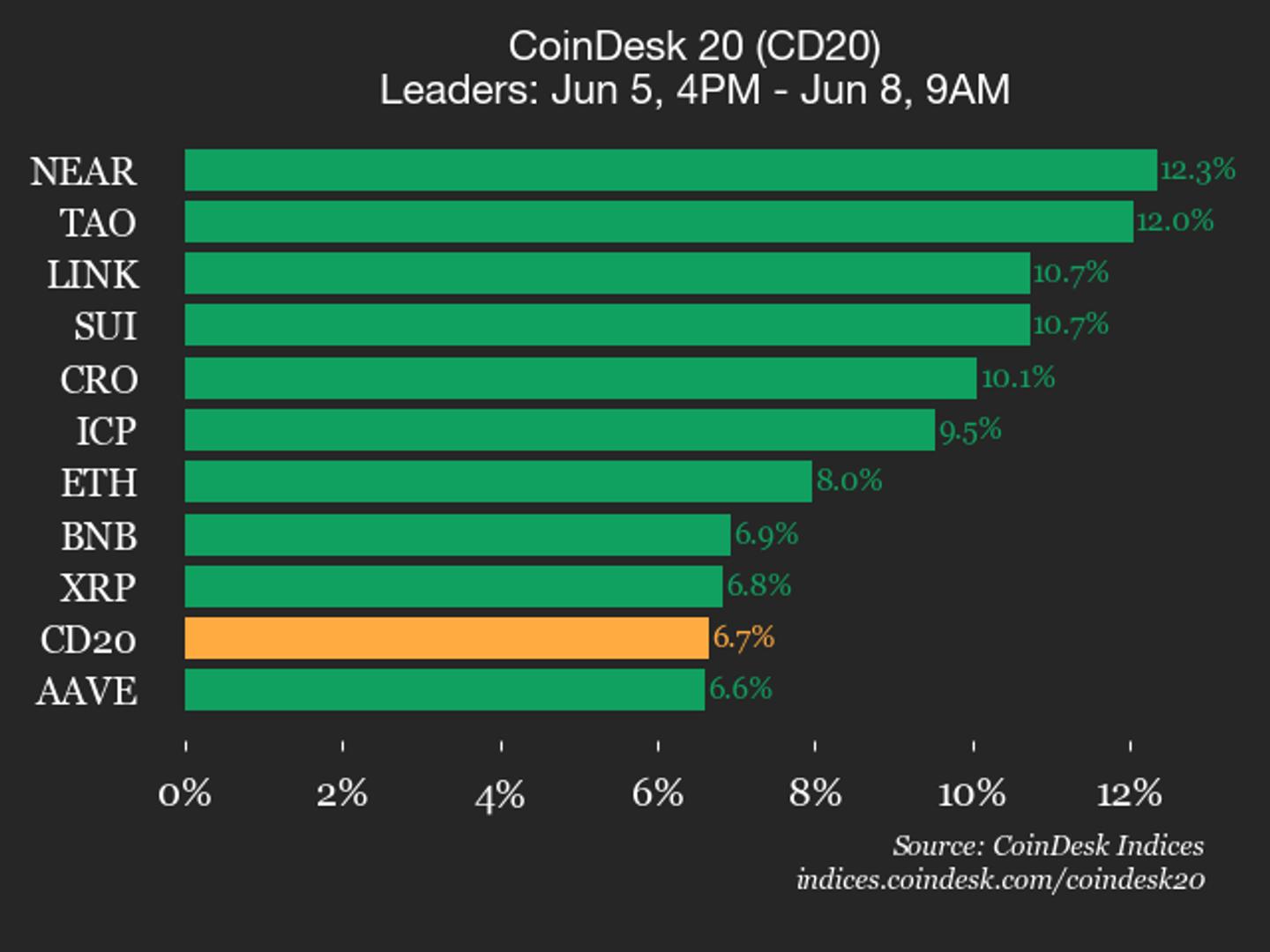
The CoinDesk 20 index demonstrated broad-based strength on June 8, 2026, with NEAR protocol leading gains at 12.3% as nearly all major crypto assets traded higher. The rally reflects growing institutional confidence and positive market sentiment across the digital asset ecosystem.
Overview
The cryptocurrency markets experienced a significant rally on June 8, 2026, with the CoinDesk 20 index—a benchmark tracking the largest and most liquid digital assets—posting gains across nearly all constituent holdings. NEAR Protocol emerged as a standout performer, recording a 12.3% increase in a single trading session, signaling renewed investor interest in layer-one blockchain solutions. This broad-based rally underscores shifting market dynamics and suggests that institutional and retail investors are increasingly confident in the digital asset space despite ongoing macroeconomic uncertainties.
The CoinDesk 20 index serves as a crucial barometer for the overall health of the cryptocurrency market. Unlike market-cap-weighted indices that can be skewed by extremely large positions in a handful of assets, the CoinDesk 20 provides a more balanced view of the ecosystem by including major coins and tokens across different blockchain categories and use cases. When nearly all constituents trade higher simultaneously, it typically indicates positive market momentum driven by sector-wide catalysts rather than isolated strength in individual projects.
NEAR's exceptional outperformance on this particular trading day raises important questions about what's driving renewed enthusiasm for the protocol and whether the gains signal a broader shift in market sentiment toward layer-one alternatives. The token's 12.3% appreciation suggests that market participants are re-evaluating NEAR's competitive positioning, technological developments, and growth prospects relative to other blockchain platforms.
Background
The NEAR Protocol represents one of the cryptocurrency ecosystem's most significant attempts to create a scalable, user-friendly layer-one blockchain capable of competing with established platforms like Ethereum. Launched in 2020, NEAR has positioned itself as a "sharded" blockchain—meaning it divides its network into parallel processing segments—to achieve high throughput and low transaction costs while maintaining decentralization and security.
The CoinDesk 20 index itself was designed to provide a more nuanced view of the cryptocurrency market compared to broader market-cap indices. Created with input from institutional investors, researchers, and market participants, the index includes assets that meet strict liquidity and listing criteria while spanning various blockchain categories including payment tokens, smart contract platforms, decentralized finance (DeFi) primitives, and infrastructure projects. The index is rebalanced periodically to reflect changing market dynamics and ensures that no single asset dominates the weighting in a way that would distort the overall index performance.
NEAR's inclusion in the CoinDesk 20 reflects its established position among the top-tier blockchain platforms. The protocol has accumulated significant developer activity, hosting thousands of decentralized applications (dApps) and attracting billions of dollars in total value locked (TVL) across DeFi platforms and other applications built on its network. The project has also benefited from substantial venture capital funding, including investments from major firms like Pantera Capital, Electric Capital, and a16z.
Over the past several years, NEAR has competed fiercely with other layer-one platforms to attract developers and users. While Ethereum maintained dominance as the leading smart contract platform despite high gas fees, other chains including Solana, Avalanche, Polygon, and Cosmos have each captured portions of developer mindshare and user activity. NEAR's emphasis on usability—through features like account abstraction that reduce friction for new users—has differentiated its positioning.
Key Developments
The 12.3% single-day gain for NEAR on June 8, 2026, likely reflects one or more significant positive catalysts in the broader ecosystem. While the specific triggers aren't identified in the headline alone, several structural factors could be contributing to renewed enthusiasm for the protocol.
First, the performance of the CoinDesk 20 index as a whole suggests broader market strength and increased risk appetite among investors. When nearly all major digital assets trade higher in concert, it typically indicates that macro tailwinds or positive news sentiment is lifting all boats. This could stem from improved macroeconomic data, dovish central bank commentary, or major institutional adoption announcements affecting the sector broadly.
Second, NEAR's outperformance relative to the broader index suggests that investors are identifying specific strengths or catalysts unique to the protocol. This could include announcements regarding major partnerships, technological upgrades, validator incentive programs, or ecosystem growth metrics. The protocol has consistently pursued a strategy of attracting developer interest through grants and accelerator programs, and any announcements regarding expanded funding for ecosystem development could trigger buying interest.
Third, the cryptocurrency market has been increasingly sensitive to regulatory developments. Any positive regulatory clarity or statements from policymakers regarding blockchain technology could disproportionately benefit assets like NEAR that are explicitly designed for mainstream adoption. The protocol's emphasis on user-friendly features and its backing by well-known venture capital firms make it relatively attractive from a regulatory perspective compared to projects with more ambiguous positioning.
Fourth, competition among layer-one platforms creates a dynamic environment where market share shifts can generate substantial trading activity. If NEAR demonstrates superior performance metrics—such as transaction throughput, cost, or user growth—relative to competing platforms, this could trigger tactical allocation shifts from portfolio managers and quantitative traders. Any such comparative advantages would likely be highlighted in ecosystem reports or data dashboards that market participants monitor closely.
Finally, the broader context of crypto market cycles cannot be ignored. The digital asset space has experienced several major booms and busts over its relatively short history. If markets are entering a new expansion phase driven by technological progress, mainstream adoption, or macroeconomic tailwinds, assets like NEAR that offer meaningful improvements over earlier-generation blockchains would likely benefit disproportionately.
Market Impact
The broad rally across the CoinDesk 20 index has several important implications for participants across the cryptocurrency ecosystem. For traders and investors, the positive momentum may signal an opportune environment for portfolio rebalancing, with particular strength in layer-one platforms potentially offering attractive risk-reward profiles for growth-oriented allocations.
For the NEAR Protocol specifically, a 12.3% single-day gain represents significant momentum that could trigger increased institutional attention. Large asset managers and institutional trading desks monitor intraday performance patterns and volatility metrics to identify assets experiencing positive technicals. If NEAR successfully maintains these gains and builds on the momentum, it could attract inflows from funds that previously remained on the sidelines or preferred to hold exposure through indirect vehicles like cryptocurrency-focused ETFs or mutual funds.
The rally also has important implications for the broader layer-one blockchain ecosystem. When any major platform experiences substantial gains, it often triggers narrative shifts and discussions about competitive dynamics. If NEAR is outperforming, market participants will naturally ask whether the protocol is gaining ground relative to competitors like Solana or Avalanche. Such comparisons can create positive feedback loops, with outperformance attracting more attention, which attracts more developers and users, which generates more positive performance.
For cryptocurrency exchanges and trading venues, increased volatility and trading activity around NEAR and other major digital assets translate directly to increased transaction fees and trading volumes. Many exchanges use intraday momentum as a signal for which assets to feature prominently, potentially creating additional tailwinds for protocols experiencing strong performance.
The performance of the CoinDesk 20 index also impacts investors who hold basket products or diversified cryptocurrency portfolios. A broad rally across nearly all holdings in such a portfolio would generate positive returns for fund investors and could trigger inflows into new cryptocurrency investment vehicles. This represents a potential virtuous cycle where market strength attracts new capital, which generates further strength.
Risks and Considerations
While the 12.3% gain for NEAR and the broad rally across the CoinDesk 20 index appear positive on their face, several important risks and considerations deserve attention from market participants.
First, single-day volatility in cryptocurrency markets can be both dramatic and ephemeral. A 12.3% move in one day, while significant, does not necessarily indicate sustained momentum or represent a permanent shift in market valuation. Cryptocurrency markets remain relatively immature compared to traditional equity or bond markets, and intraday moves can be driven by relatively small amounts of capital given the markets' still-limited size and depth. Investors should be cautious about interpreting single-day moves as indicators of fundamental changes in asset valuations or market structure.
Second, the cryptocurrency market remains subject to regulatory risk at both the national and international level. While some jurisdictions have embraced blockchain technology, others have signaled hostility or proposed restrictive regulations. Changes in regulatory stance by major economies like the United States, European Union, or China could rapidly reverse positive sentiment and trigger sharp sell-offs. Investors in assets like NEAR should monitor regulatory developments carefully.
Third, the competitive landscape among layer-one blockchains remains intense and fast-moving. NEAR's current advantages—such as sharding, account abstraction, and developer experience—may not persist if competing platforms implement similar features or if new technologies emerge that obsolete current architectures. The transition from Proof-of-Work to Proof-of-Stake consensus mechanisms, for example, has already shifted competitive dynamics across the ecosystem, and future technological transitions could have similar impacts.
Fourth, cryptocurrency valuations remain highly speculative and disconnected from traditional fundamental valuation frameworks. While NEAR Protocol is a functioning blockchain with active users and developers, traditional metrics like price-to-earnings ratios or cash flow multiples don't readily apply. Valuation is instead driven largely by sentiment, narrative, and expectations about future adoption and utility. This makes the digital asset space more prone to bubble dynamics and speculative excess.
Fifth, security risks continue to pose challenges for blockchain protocols. While NEAR has maintained a strong security record, no system is perfectly invulnerable to attacks or technical failures. A significant security incident affecting NEAR or another major CoinDesk 20 constituent could rapidly reverse positive sentiment and trigger sharp declines.
Sixth, the macroeconomic environment remains uncertain. Interest rate cycles, inflation dynamics, and economic growth trajectories all impact risk appetite and investor willingness to hold volatile digital assets. A shift toward higher rates or recession risks could rapidly reverse positive sentiment in cryptocurrencies regardless of protocol-specific developments.
What to Watch
For investors, traders, and ecosystem participants monitoring NEAR and the broader CoinDesk 20 index, several key metrics and developments warrant close attention in the coming weeks and months.
First, technical momentum indicators will be crucial. Did NEAR's 12.3% gain establish new technical support levels, or does it represent a false breakout that will reverse? Technical analysts will monitor key price levels, moving averages, and volatility metrics to assess whether the momentum is sustainable.
Second, on-chain metrics provide crucial insights into actual usage and network health. Total value locked (TVL) in DeFi applications on NEAR, transaction volume, active developer accounts, and other on-chain metrics can reveal whether the price appreciation reflects actual growth in network utility or is purely speculative. Platforms like DeFi Pulse, DefiLlama, and Messari provide detailed tracking of these metrics.
Third, venture capital and institutional adoption signals deserve monitoring. Major announcements regarding venture capital investments in NEAR-based projects, partnerships between NEAR and established institutions, or listings on major trading venues could provide additional catalysts for sustained momentum.
Fourth, the performance of competing layer-one platforms provides important context. Is NEAR's 12.3% gain a sign that investors are shifting preference toward NEAR specifically, or is it simply part of a broad market rally where Solana, Avalanche, and Polygon gained similarly? Understanding relative performance is crucial for assessing whether a structural shift in competitive dynamics is occurring.
Fifth, regulatory developments at major jurisdictions including the United States, European Union, Singapore, and Dubai should be monitored closely. Positive regulatory clarity could extend the current momentum, while negative developments could reverse it rapidly.
Sixth, developer activity metrics such as GitHub commits, developer funding commitments, and new project launches on NEAR provide leading indicators of ecosystem health. Sustained developer momentum would support the narrative that the price appreciation reflects genuine ecosystem growth.
Conclusion
The CoinDesk 20 index's broad-based rally on June 8, 2026, with NEAR Protocol leading gains at 12.3%, represents a significant positive development for the cryptocurrency market. The index's strong performance across nearly all constituents suggests that macro tailwinds and positive sentiment are lifting the entire sector, while NEAR's outperformance indicates that investors are identifying specific strengths or catalysts in the layer-one blockchain platform.
The significance of this rally should not be overstated, however. Single-day price moves in cryptocurrency markets, while noteworthy, do not necessarily indicate sustained momentum or fundamental improvements in asset valuations. Market participants should carefully monitor the metrics and developments outlined above to assess whether the June 8 rally represents the beginning of a new bull cycle or a tactical bounce within a longer consolidation phase.
For developers, users, and projects within the NEAR ecosystem, the positive price action and market attention may create opportunities to attract capital and expand development activity. Ecosystem participants should leverage this momentum to advance the protocol's technological roadmap, improve developer tools and documentation, and expand adoption among mainstream users and institutional participants.
For the broader cryptocurrency industry, the performance of the CoinDesk 20 index and specific outperformers like NEAR will influence regulatory attitudes, institutional investor positioning, and mainstream adoption patterns. As digital assets mature and integrate more deeply into traditional financial systems, the performance and stability of platforms like NEAR become increasingly important not just for traders and speculators, but for the broader financial ecosystem and economy.
Ultimately, NEAR's success will depend on its ability to translate market attention and capital inflows into sustained technological progress, developer growth, and mainstream adoption. The protocol's emphasis on user-friendly features and institutional-grade infrastructure positions it well for this challenge, but execution will ultimately determine whether the June 8 rally marks the beginning of a new growth phase or represents a temporary peak in attention and valuation.
Original Source
CoinDesk