Bitcoin Cash Leads CoinDesk 20 Lower as Market Corrects
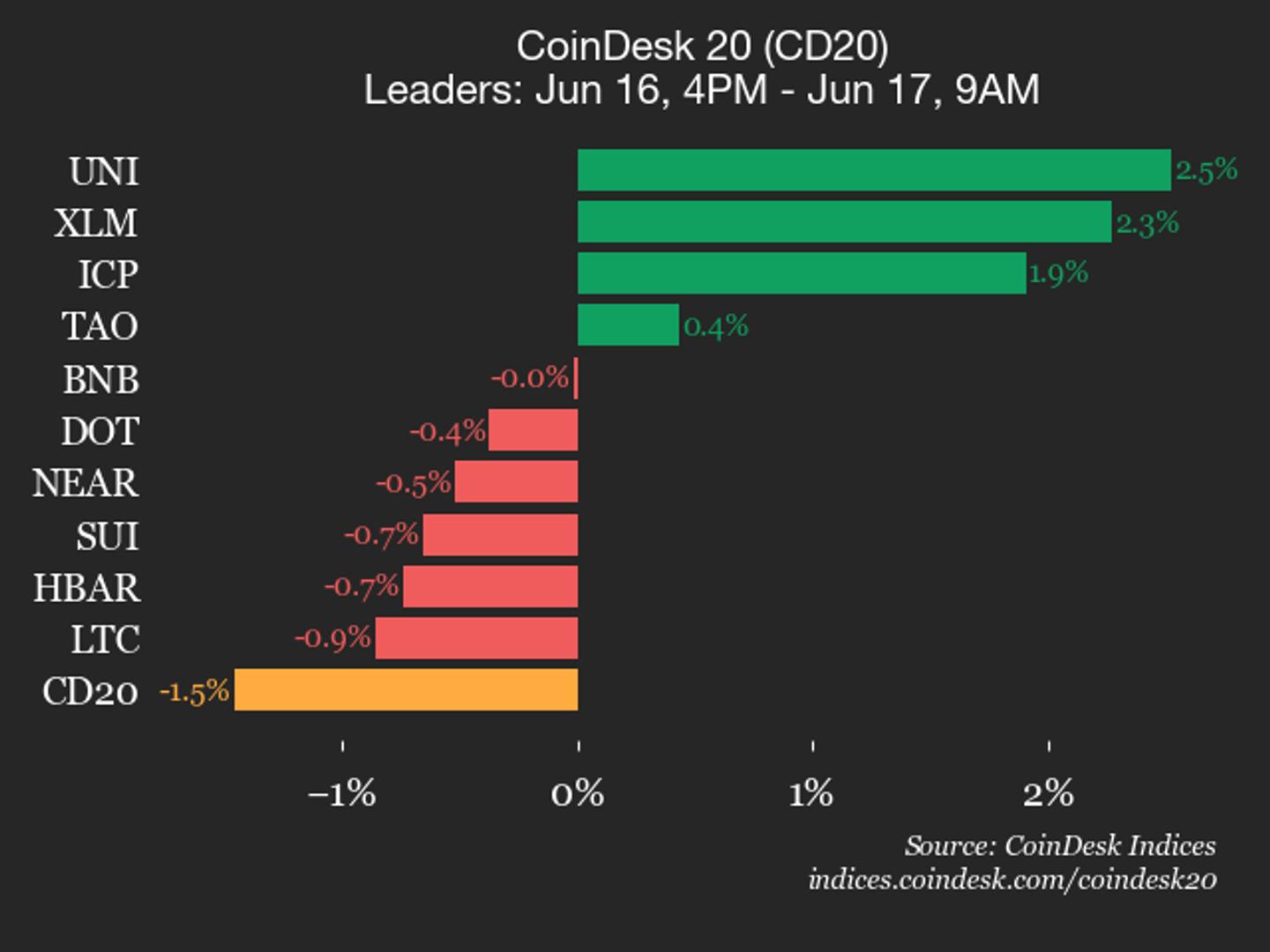
Bitcoin Cash (BCH) dropped 3.1% on June 17, 2026, emerging as the weakest performer in the CoinDesk 20 index and dragging the broader cryptocurrency benchmark lower. The decline reflects ongoing market volatility and shifting investor sentiment in digital assets.
Overview
The cryptocurrency market continued its pattern of selective weakness on June 17, 2026, with Bitcoin Cash (BCH) registering the steepest declines among major digital assets tracked by the CoinDesk 20 index. The 3.1% drop in BCH led the broader index lower, underscoring the divergent performance dynamics currently characterizing the digital asset space. This downward movement occurred against a backdrop of mixed signals across the crypto ecosystem, where certain assets maintained resilience while others succumbed to profit-taking pressure and reduced institutional demand.
The CoinDesk 20 index, which represents the performance of the 20 largest digital assets by market capitalization and adjusted volume, serves as a critical benchmark for understanding broader market trends in the cryptocurrency sector. When a single asset like Bitcoin Cash emerges as the clear laggard, it often reflects specific headwinds affecting that particular cryptocurrency rather than a systemic market failure. However, the fact that BCH's weakness was sufficient to pull the entire index lower indicates that the asset maintains meaningful weight in the broader crypto market and its movements have outsized influence on sentiment.
As of the June 17 close, traders and market analysts were dissecting the implications of Bitcoin Cash's underperformance, examining whether the weakness represented a temporary correction in an otherwise stable asset or the beginning of a longer-term deterioration in investor confidence. The cryptocurrency's performance raised questions about the health of the Bitcoin Cash ecosystem, the competitive pressures it faces from other blockchain platforms, and the broader trajectory of cryptocurrency valuations in a market that has demonstrated both resilience and volatility throughout 2026.
Background
Bitcoin Cash emerged in 2017 as a hard fork from the Bitcoin blockchain, created to address ongoing debates within the Bitcoin community about optimal block size parameters and transaction throughput. The fork resulted in two distinct cryptocurrencies: the original Bitcoin (BTC) and Bitcoin Cash (BCH), with supporters of each version claiming their variant represented the true vision of cryptocurrency envisioned by Satoshi Nakamoto. Bitcoin Cash implemented larger block sizes (initially 8 MB, subsequently increased to 32 MB) to enable faster and cheaper transactions compared to Bitcoin's 1 MB blocks.
Over nearly a decade of operation, Bitcoin Cash has established itself as a significant player in the cryptocurrency ecosystem, consistently ranking among the top 20 digital assets by market capitalization. The asset has attracted a dedicated community of developers, merchants, and users who view it as superior to Bitcoin for everyday payment transactions. Bitcoin Cash has secured listings on virtually all major cryptocurrency exchanges, institutional custody providers, and derivative trading platforms, ensuring liquidity and accessibility for market participants globally.
The CoinDesk 20 index has tracked digital assets across multiple categories and use cases, including large-cap cryptocurrencies like Bitcoin and Ethereum, blockchain-based platforms offering smart contract functionality, and specialized assets serving specific protocol purposes. Bitcoin Cash's inclusion in this index reflects its established market presence and relevance to cryptocurrency ecosystem participants. However, the asset's performance relative to its peers has varied considerably over different market cycles, with Bitcoin Cash sometimes outperforming larger competitors during periods of enthusiasm for payment-focused cryptocurrencies and sometimes underperforming during eras emphasizing smart contract platforms and decentralized finance applications.
The broader context for June 2026 cryptocurrency markets involved an environment of moderate recovery following earlier volatility, with Bitcoin maintaining relatively strong price levels after the significant market events of the preceding quarters. Ethereum and other smart contract platforms had demonstrated relative strength as the decentralized finance sector continued attracting development resources and user engagement. Meanwhile, payment-focused cryptocurrencies had faced headwinds as market participants increasingly focused on assets offering differentiated capabilities rather than alternatives to existing payment networks.
Key Developments
The 3.1% decline in Bitcoin Cash on June 17, 2026, occurred within a session that produced mixed results across the cryptocurrency complex. While some major digital assets maintained relative stability or posted modest gains, Bitcoin Cash's weakness proved sufficiently pronounced to influence the overall index. The decline likely reflected a combination of technical factors, including chart-based selling pressure at resistance levels and the triggering of automated trading algorithms, alongside fundamental considerations related to the asset's competitive positioning.
Technical analysis of Bitcoin Cash's price action suggested the asset had encountered resistance in the mid-range trading channel where it had stabilized over the preceding weeks. When resistance levels are tested repeatedly without successful breakout, market psychology often shifts from optimism to caution, triggering profit-taking among traders who had accumulated positions during previous rallies. The 3.1% decline represented a meaningful pullback without constituting the type of catastrophic collapse that might indicate broader ecosystem concerns, suggesting instead a normalization of price levels after periods of strength.
Fundamental developments affecting Bitcoin Cash included ongoing discussions about the asset's use case and competitive advantages relative to other cryptocurrencies. As blockchain technology has matured and specialized platforms have emerged to serve payment, smart contract, and other use cases, Bitcoin Cash's original value proposition of enabling faster and cheaper transactions than Bitcoin has faced competition from multiple quarters. Layer 2 scaling solutions for Bitcoin have demonstrated the ability to enable rapid, inexpensive transactions on the Bitcoin network itself, potentially reducing the differentiation Bitcoin Cash previously offered. Simultaneously, newer blockchain platforms designed specifically for payment use cases had attracted developer attention and user adoption.
The June 17 decline also occurred within a broader pattern of investor sentiment that has increasingly emphasized innovation and differentiation over simply being a fork of an existing asset. Cryptocurrency market participants in 2026 have shown greater selectivity in capital allocation, favoring assets offering unique technical advantages, demonstrated user adoption, or meaningful protocol developments. Bitcoin Cash, while possessing a substantial user base and an active development community, has faced the perception of being primarily a variant of Bitcoin rather than an entirely distinct innovation. This perception, whether or not fundamentally justified, influences how institutional and retail investors classify and allocate capital to different digital assets.
Market Impact
The weakness in Bitcoin Cash and its consequent pull on the broader CoinDesk 20 index created ripple effects throughout cryptocurrency markets. Indices function as psychological anchors for market participants, and when a major benchmark moves lower, it can influence broader market sentiment and trigger cascading effects as traders reassess portfolio allocations and risk exposures. The 3.1% decline in the index's largest laggard was sufficient to pull the entire CoinDesk 20 lower, indicating that the index's weighting system and market capitalization calculations resulted in Bitcoin Cash representing a meaningful proportion of total index value.
For portfolio managers tracking the CoinDesk 20 index through passive or semi-passive strategies, the index decline necessitated rebalancing decisions to maintain target allocations. Investors with overweight positions relative to the index faced pressures to either add to losing positions to bring them back to benchmark weights or accept the underweight and maintain their portfolio construction. These mechanical effects, while sometimes overlooked in narrative analysis of cryptocurrency markets, can amplify price movements and contribute to downward momentum once it has been established.
The June 17 performance metrics also carried implications for institutional investors evaluating cryptocurrency exposure as an asset class. When leading benchmark indices decline, it reinforces narratives about cryptocurrency volatility and challenges the story that digital assets have achieved sufficient maturity to serve as stable portfolio holdings. Conversely, the fact that the decline was concentrated in a single asset rather than systemic across the cryptocurrency complex suggests underlying market health and rational pricing mechanisms at work—markets discriminating between assets based on their individual characteristics rather than moving in unison based on broad sentiment shifts.
Options markets and derivatives trading platforms that offer exposure to the CoinDesk 20 index or to Bitcoin Cash specifically also experienced impacts from the June 17 price action. Traders holding long positions or bullish options strategies faced mark-to-market losses, while those with short positions or bearish strategies realized gains. The volume of derivative trading activity typically increases during periods of notable price movements, as both opportunistic traders seeking to profit from volatility and hedging activity from concerned long-term holders interact with the market simultaneously.
Risks and Considerations
Bitcoin Cash faces structural headwinds that extend beyond the normal fluctuations characterizing cryptocurrency assets. The emergence of competing solutions to the problems Bitcoin Cash was designed to address has created an increasingly crowded competitive landscape. Bitcoin's Lightning Network, a layer 2 scaling solution developed by the original Bitcoin community, offers the ability to process transactions with speed and cost profiles comparable to Bitcoin Cash, potentially without requiring users to hold an entirely distinct cryptocurrency. This technical solution to Bitcoin's scaling limitations has reduced one of the primary value propositions driving Bitcoin Cash adoption.
Additionally, newer blockchain platforms designed with payment functionality as a core design principle have emerged, offering different technical approaches and development ecosystems compared to Bitcoin Cash. These platforms operate from their inception with parameters optimized for transaction throughput and cost minimization, avoiding the compromises inherent in fork-based approaches that must maintain Bitcoin compatibility while extending functionality. The competitive pressure from these alternatives, combined with the inherent network effects favoring the larger and more established Bitcoin, creates a challenging environment for Bitcoin Cash to expand its market share.
The risk exists that Bitcoin Cash's market position gradually erodes as users and developers migrate to competing solutions that they perceive as offering superior value propositions. This type of slow-motion market-share loss does not typically manifest in single-day price movements like the June 17 decline but rather accumulates over months and years as ecosystem participants make individual decisions to allocate time and resources toward competing projects. However, the potential for such long-term structural headwinds increases the relevance of short-term declines like the 3.1% drop, as they remind investors that adoption and usage are not guaranteed properties of any cryptocurrency but rather must be continuously earned through technical excellence and user satisfaction.
Exchange dynamics and liquidity considerations also merit examination. Bitcoin Cash trades on virtually all major cryptocurrency exchanges, providing users with abundant options for buying and selling the asset. However, liquidity for BCH compared to Bitcoin or Ethereum remains lower on most trading platforms, potentially amplifying price movements during periods of elevated trading activity or significant directional positioning changes. Market participants with substantial holdings face higher transaction costs and greater market impact when executing large positions compared to what they would encounter with more liquid assets, potentially influencing institutional participation levels and broader price discovery mechanisms.
What to Watch
Market observers should monitor Bitcoin Cash's technical price action in coming days and weeks to determine whether the June 17 decline represents a temporary correction or the beginning of a more extended downtrend. If Bitcoin Cash stabilizes near recent support levels and recovers a portion of the lost ground, it would suggest the decline was primarily technical and sentiment-driven rather than indicative of fundamental deterioration. Conversely, if weakness extends and new support levels are breached, it could signal a shift in investor preferences away from the asset.
Developments within the Bitcoin Cash development community warrant attention, particularly progress on scaling improvements, merchant adoption initiatives, and protocol enhancements that might reinvigorate investor interest. The Bitcoin Cash community has periodically proposed network upgrades and improvements aimed at broadening the asset's functionality and appeal. The technical execution and market reception of such developments could materially influence investor sentiment and relative valuations. Similarly, announcements regarding major merchant adoption or business integration efforts would represent positive catalysts potentially reversing the recent weakness.
Broader cryptocurrency market trends will significantly influence Bitcoin Cash's path forward. The asset typically participates in rallies driven by positive sentiment across the cryptocurrency complex but may underperform during periods when investors exhibit increased selectivity regarding which assets to hold. Monitoring the relative performance of Bitcoin, Ethereum, and other major assets will provide context for understanding whether Bitcoin Cash weakness reflects asset-specific factors or represents part of a broader cryptocurrency market correction.
Regulatory developments affecting the cryptocurrency industry broadly could also meaningfully impact Bitcoin Cash. Clarification regarding regulatory treatment of certain cryptocurrency use cases or exchanges could enhance or diminish demand for different assets. Policy developments in major jurisdictions where Bitcoin Cash maintains significant adoption would be particularly relevant for the asset's medium-term trajectory.
Conclusion
The 3.1% decline in Bitcoin Cash on June 17, 2026, represents a meaningful but not extraordinary pullback within the context of cryptocurrency market volatility. The weakness sufficient to pull the broader CoinDesk 20 index lower underscores the continuing relevance of Bitcoin Cash as a significant digital asset, even as its market position faces ongoing competitive pressures. The decline likely reflects a combination of technical factors, including profit-taking at resistance levels and the influence of automated trading systems, alongside broader questions about Bitcoin Cash's long-term competitive positioning relative to alternative solutions to cryptocurrency payment challenges.
Bitcoin Cash's history as a fork of Bitcoin provides it with inherited network effects and security properties, but also creates the perception that it remains primarily a variant of an existing asset rather than a unique innovation. As the cryptocurrency ecosystem matures and investors apply increasingly sophisticated frameworks for evaluating different digital assets, positioning becomes increasingly important. Assets offering clear differentiation, demonstrated utility, and engaged developer communities tend to outperform those without these characteristics, irrespective of their historical significance or technical specifications.
The June 17 market action reminds investors that past success and large market capitalization provide no guarantee of future performance in the rapidly evolving cryptocurrency sector. Market participants should approach cryptocurrency valuations with clear-eyed assessments of competitive dynamics, adoption trends, and technical fundamentals rather than relying on historical precedent or established rankings. Bitcoin Cash's journey from high-profile fork to the current market environment illustrates how competitive advantage in cryptocurrency markets can be neither guaranteed nor maintained without sustained innovation and user engagement.
As June 2026 progresses, Bitcoin Cash's ability to stabilize and recover from the recent decline, combined with developments within its ecosystem and the broader cryptocurrency market context, will determine the asset's trajectory in coming months. Investors holding or considering positions in Bitcoin Cash should monitor technical levels, competitive developments, and broader cryptocurrency sentiment indicators to inform their allocation decisions. The asset's performance will continue to serve as a barometer for how the broader market evaluates payment-focused cryptocurrencies and assets that have faced mounting competitive pressures in an increasingly sophisticated digital asset ecosystem.
Original Source
CoinDesk