Stellar (XLM) Outperforms as CoinDesk 20 Index Declines Amid Market Volatility
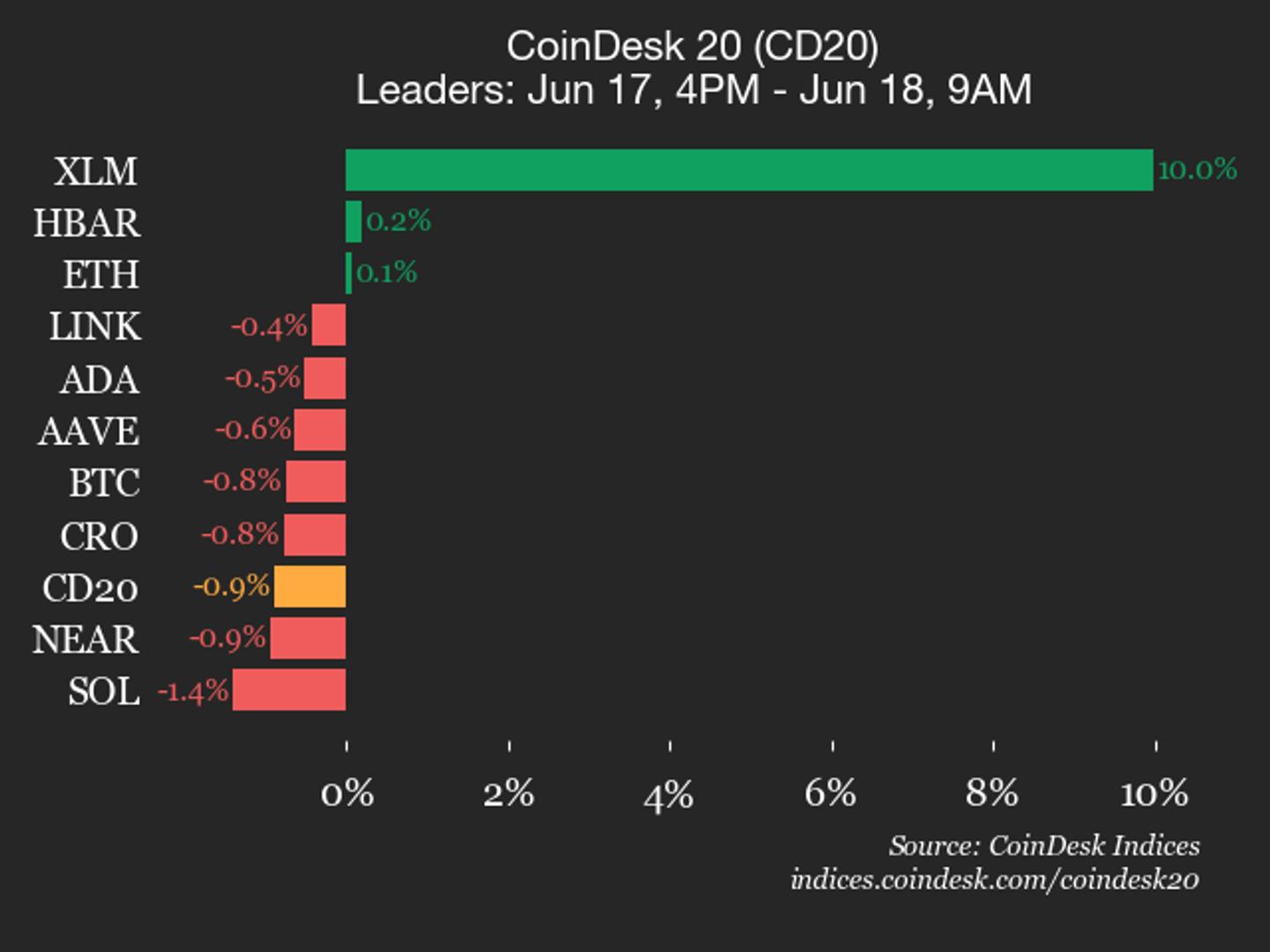
Stellar (XLM) surged 10% while the broader CoinDesk 20 index retreated, highlighting divergent performance among major cryptocurrencies. The movement underscores individual asset strength amid broader market uncertainty and shifting investor sentiment toward enterprise-grade blockchain platforms.
Overview
The cryptocurrency market experienced a notable divergence on June 18, 2026, with Stellar (XLM) emerging as a significant outperformer while the broader CoinDesk 20 index declined. The XLM surge of 10% represents a meaningful move in a volatile market environment, signaling renewed investor interest in Stellar's platform despite headwinds affecting the wider digital asset ecosystem. The CoinDesk 20 index, which tracks the 20 largest cryptocurrencies by market capitalization (excluding stablecoins), serves as a key barometer of institutional and retail sentiment toward major blockchain assets. This performance divergence raises important questions about market composition, investor strategy rotation, and the underlying fundamentals driving individual token valuations in the current market cycle.
The CoinDesk 20 index decline reflects broader market pressures that have been present throughout 2026, including macroeconomic headwinds, regulatory uncertainty, and shifting capital flows. However, XLM's exceptional performance demonstrates that certain cryptocurrencies continue to attract capital despite these challenging conditions. This selective strength in the market suggests that investors are actively differentiating between various blockchain platforms based on perceived utility, technological advancement, and real-world adoption metrics rather than treating the cryptocurrency market as a monolithic asset class.
The timing of this performance update is significant given the current market environment. Major cryptocurrencies have been subject to increased scrutiny from regulators worldwide, while institutional adoption continues to mature. In this context, XLM's 10% jump indicates that markets may be reacting positively to specific developments or recognizing the unique value proposition that Stellar brings to the blockchain ecosystem, particularly in cross-border payments and financial inclusion initiatives.
Background
The CoinDesk 20 index was established as a comprehensive benchmark for tracking the performance of the largest cryptocurrencies by market capitalization (excluding stablecoins). The index is weighted by market cap and rebalanced regularly to ensure it remains representative of the top digital assets in the ecosystem. Major components of the index typically include Bitcoin, Ethereum, Solana, Polkadot, Cardano, and other prominent blockchain platforms. By excluding stablecoins like USDC and USDT, the index focuses on assets that exhibit genuine price discovery and market volatility, making it a better indicator of genuine market sentiment and investor positioning.
Stellar (XLM) is a blockchain platform founded in 2014 by Jed McCaleb and Joyce Kim, designed specifically to facilitate fast, low-cost cross-border payments and financial inclusion for underbanked populations worldwide. Unlike some competitors that prioritize complex smart contract functionality, Stellar emphasizes simplicity, speed, and interoperability with existing financial infrastructure. The Stellar network uses its own consensus mechanism and has developed a robust ecosystem of financial institutions, payment providers, and anchor organizations that facilitate real-world use cases. XLM, the native asset of the Stellar network, serves multiple functions including transaction fees, incentive mechanisms, and acting as a bridge asset for currency conversions.
Historically, XLM has experienced multiple cycles of adoption and price appreciation driven by partnerships with major financial institutions, central bank digital currency (CBDC) exploration, and growing recognition of its utility in emerging markets. The token's positioning as a settlement asset rather than purely a speculative vehicle has attracted institutional interest, particularly from organizations focused on international remittances and financial inclusion. In recent years, Stellar has expanded its ecosystem to include developer tools, enterprise solutions, and partnerships with organizations like the Stellar Development Foundation to drive adoption in underserved markets.
The broader cryptocurrency market in June 2026 has been characterized by cautious optimism mixed with lingering regulatory concerns. After significant growth in late 2025, the market has consolidated with many major assets trading within established ranges. However, this consolidation has created opportunities for assets with strong fundamentals and clear use cases to differentiate themselves from the broader index. The CoinDesk 20 index decline likely reflects profit-taking, macro concerns, and reallocation of capital, while XLM's strength suggests that investors recognize specific catalysts or opportunities within the Stellar ecosystem.
Key Developments
Stellar's 10% price appreciation on June 18, 2026, appears to have been driven by multiple convergent factors. First, increased enterprise adoption has continued to accelerate, with financial institutions exploring Stellar's network for faster, cheaper settlement of cross-border transactions. Several major payment networks and remittance corridors have begun utilizing Stellar infrastructure, particularly in regions where traditional banking infrastructure remains limited or expensive. These developments provide genuine utility-based demand for XLM tokens, distinguishing Stellar from projects that rely primarily on speculative interest.
Second, the cryptocurrency market has begun to normalize expectations around regulatory frameworks globally. As governments establish clearer rules for digital asset operation, platforms like Stellar that have always emphasized compliance and institutional integration find themselves in advantageous positions. Regulatory clarity removes uncertainty premiums from token valuations and allows investors to focus on fundamental metrics such as transaction throughput, cost efficiency, and real-world adoption. Stellar's consistent emphasis on working with regulators and building compliant solutions positions it favorably in this evolving landscape.
Third, technical developments within the Stellar ecosystem continue to enhance network capabilities. Improvements to transaction processing speed, expanded smart contract functionality (while maintaining the platform's simplicity-first philosophy), and enhanced interoperability with other blockchain systems make Stellar increasingly attractive to developers and enterprises. These technical enhancements translate into better real-world utility, which eventually drives token demand from both transactional and investment perspectives.
The CoinDesk 20 index decline, conversely, reflects several market headwinds affecting the broader cryptocurrency ecosystem. Macroeconomic factors including inflationary pressures, central bank policy considerations, and geopolitical tensions continue to create uncertainty in risk asset markets. Additionally, some of the largest components of the CoinDesk 20 index face their own specific challenges including scaling debates, competitive pressures from emerging platforms, or regulatory scrutiny. The index decline also suggests some profit-taking after recent gains and potential reallocation of capital toward assets perceived as having stronger fundamental drivers.
Market Impact
The performance divergence between XLM and the CoinDesk 20 index carries several important implications for cryptocurrency markets and investors. Most significantly, it demonstrates that the cryptocurrency market is increasingly differentiated rather than moving as a unified asset class. This maturation of market behavior suggests that investors are conducting genuine fundamental analysis and making selective allocation decisions rather than treating cryptocurrencies as a homogeneous category. For professional investors and institutions, this divergence validates the case for active cryptocurrency portfolio management rather than passive index-tracking approaches.
For Stellar specifically, the price strength validates the long-term positioning of the platform within the broader blockchain ecosystem. Rather than competing primarily on technical innovation or maximum functionality, Stellar has chosen to compete on reliability, simplicity, and real-world utility in payments and financial inclusion. The current market environment appears to reward this strategy, as investors increasingly seek assets with clear use cases and demonstrable traction rather than speculative technology bets. The 10% appreciation likely attracts renewed attention from investors who had dismissed Stellar as less exciting than other platforms, potentially creating a momentum factor that could sustain strength in the near term.
The broader index decline reflects market consolidation and potential reallocation of risk capital. This environment typically favors assets with strong fundamentals and clear differentiation, which aligns perfectly with Stellar's positioning. As risk-on sentiment cycles through the cryptocurrency market, assets like XLM that combine reasonable valuations with genuine utility may continue to attract capital flows. The index decline also creates opportunities for selective entry by institutional investors who have been awaiting more attractive valuations and reduced volatility.
From a portfolio perspective, XLM's strength suggests that cryptocurrency allocations should maintain exposure to proven platforms with real-world utility rather than concentrating entirely on the largest assets by market cap. While the CoinDesk 20 index decline indicates near-term challenges, the differential performance of XLM demonstrates that opportunities exist for investors willing to conduct deeper analysis and identify platforms with strong fundamental drivers. This reinforces the case for diversification across multiple blockchain platforms rather than concentration in the few largest assets.
Risks and Considerations
Despite XLM's strong recent performance, several risks and challenges merit consideration from an investment perspective. First, cryptocurrency markets remain highly volatile and sentiment-driven, particularly in the shorter term. The 10% appreciation could reverse quickly if macroeconomic conditions deteriorate, regulatory concerns emerge, or investor sentiment shifts. The broader CoinDesk 20 decline demonstrates that even major, established cryptocurrencies face significant headwinds, and XLM is not immune to these broader market pressures. Investors should avoid extrapolating short-term outperformance into long-term positioning without careful analysis of underlying fundamentals.
Second, competition within the payments and cross-border settlement space has intensified significantly. Multiple blockchain platforms now offer similar functionality to Stellar, and traditional financial institutions are developing their own solutions for faster payments. While Stellar has first-mover advantages and established partnerships, maintaining market share requires continuous innovation and sustained investment in ecosystem development. The Stellar Development Foundation and the broader community must continue demonstrating that XLM-based solutions provide superior value compared to competing approaches, whether blockchain-based or traditional financial technology solutions.
Third, regulatory uncertainty remains a significant risk factor. While Stellar has positioned itself as compliance-first, changes in cryptocurrency regulation could impact demand for XLM or limit the utility of Stellar-based solutions. Additionally, regulation of stablecoins and payment systems could affect the demand for bridge assets like XLM that facilitate currency conversions. Investors should monitor regulatory developments carefully and recognize that Stellar's regulatory advantages could shift if policy landscapes change unexpectedly.
Fourth, technology competition and obsolescence present ongoing risks. While Stellar's simplicity-first approach provides current advantages, emerging blockchain technologies could eventually offer superior performance, lower costs, or enhanced functionality. The pace of technological change in blockchain systems is rapid, and maintaining technological relevance requires sustained investment and community engagement. Investors should evaluate whether Stellar's technical roadmap adequately addresses potential future competitive threats.
What to Watch
Looking forward, several key metrics and developments warrant monitoring for investors and market observers tracking XLM and the broader cryptocurrency market. First, transaction volume and enterprise adoption metrics should be tracked closely. If the 10% appreciation reflects genuine increased utility driving demand, we should observe corresponding increases in transaction volumes on the Stellar network, expansion of financial institution partnerships, and growing use of XLM as a settlement asset. Fundamental improvements in usage metrics would validate the investment case and suggest the price appreciation reflects real underlying demand rather than speculation.
Second, regulatory developments at both national and international levels will significantly impact the cryptocurrency market and Stellar specifically. Clear regulatory frameworks establishing digital asset treatment, payment system rules, and institutional participation guidelines could provide tailwinds for platforms like Stellar that emphasize compliance. Conversely, restrictive regulations could create headwinds regardless of individual platform strengths. Investors should maintain awareness of regulatory developments in major markets including the United States, European Union, Singapore, and Asia-Pacific regions where Stellar has significant activity.
Third, competitive dynamics within the payments and settlement space should be monitored. Traditional financial institutions continue developing real-time payment and settlement solutions through conventional banking channels, while other blockchain platforms compete with Stellar. Tracking developments in competing systems, evaluating their adoption traction, and assessing Stellar's relative advantages will provide important context for future price movements. Additionally, central bank digital currency (CBDC) developments could impact demand for bridge assets like XLM, creating both opportunities and risks depending on how CBDCs are designed and deployed.
Fourth, technical developments and ecosystem expansion within Stellar merit close attention. The Stellar Development Foundation's roadmap, improvements to transaction processing, and expansion of smart contract capabilities while maintaining simplicity-first principles will determine whether Stellar maintains competitive relevance. Additionally, new partnerships, integrations with existing financial infrastructure, and expansion into new geographic markets all provide indicators of whether Stellar's growth trajectory can sustain. Investors should evaluate whether the ecosystem is attracting sufficient developer and institutional interest to support long-term growth.
Conclusion
The CoinDesk 20 index performance update showing Stellar's 10% appreciation amid broader index decline encapsulates the current state of cryptocurrency markets—increasingly sophisticated, differentiated, and driven by fundamental analysis rather than pure sentiment. XLM's outperformance validates Stellar's strategic positioning as a reliable, utility-focused platform for payments and financial inclusion, while the broader index decline reflects macro headwinds and temporary market consolidation. The divergence demonstrates that patient investors willing to conduct deep analysis and identify assets with genuine use cases can identify outperformance opportunities even in challenging market conditions.
For the cryptocurrency market broadly, XLM's strength suggests that the industry has matured beyond treating digital assets as undifferentiated speculation. Institutional investors, developers, and financial institutions are increasingly evaluating cryptocurrencies based on technical merit, real-world utility, competitive positioning, and regulatory alignment. Assets that excel in these dimensions, like Stellar, can generate sustainable appreciation and attract institutional capital even as broader indices face pressure from macro concerns and profit-taking.
Looking ahead, investors should monitor transaction volume growth, enterprise adoption expansion, regulatory developments, and competitive dynamics to assess whether XLM's recent strength reflects fundamental improvement or speculative momentum. The next phase of cryptocurrency market development will likely continue to reward projects with demonstrated utility, institutional adoption, and clear differentiation, while challenging projects that rely primarily on technological novelty without real-world applications. Stellar's continued success depends on executing its vision of becoming the essential infrastructure for cross-border payments and financial inclusion, while navigating an increasingly competitive landscape and evolving regulatory environment. For patient, fundamental-focused investors, the current market environment presents both opportunities and risks worthy of careful ongoing analysis and deliberate portfolio positioning.
Original Source
CoinDesk