Bitcoin Retreats to $64K as Market Sentiment Shifts
Bitcoin pulled back from monthly highs as bearish pressure reasserted control over the cryptocurrency market. The sell-off reflects renewed volatility and profit-taking despite earlier bullish momentum that had driven prices higher in recent sessions.
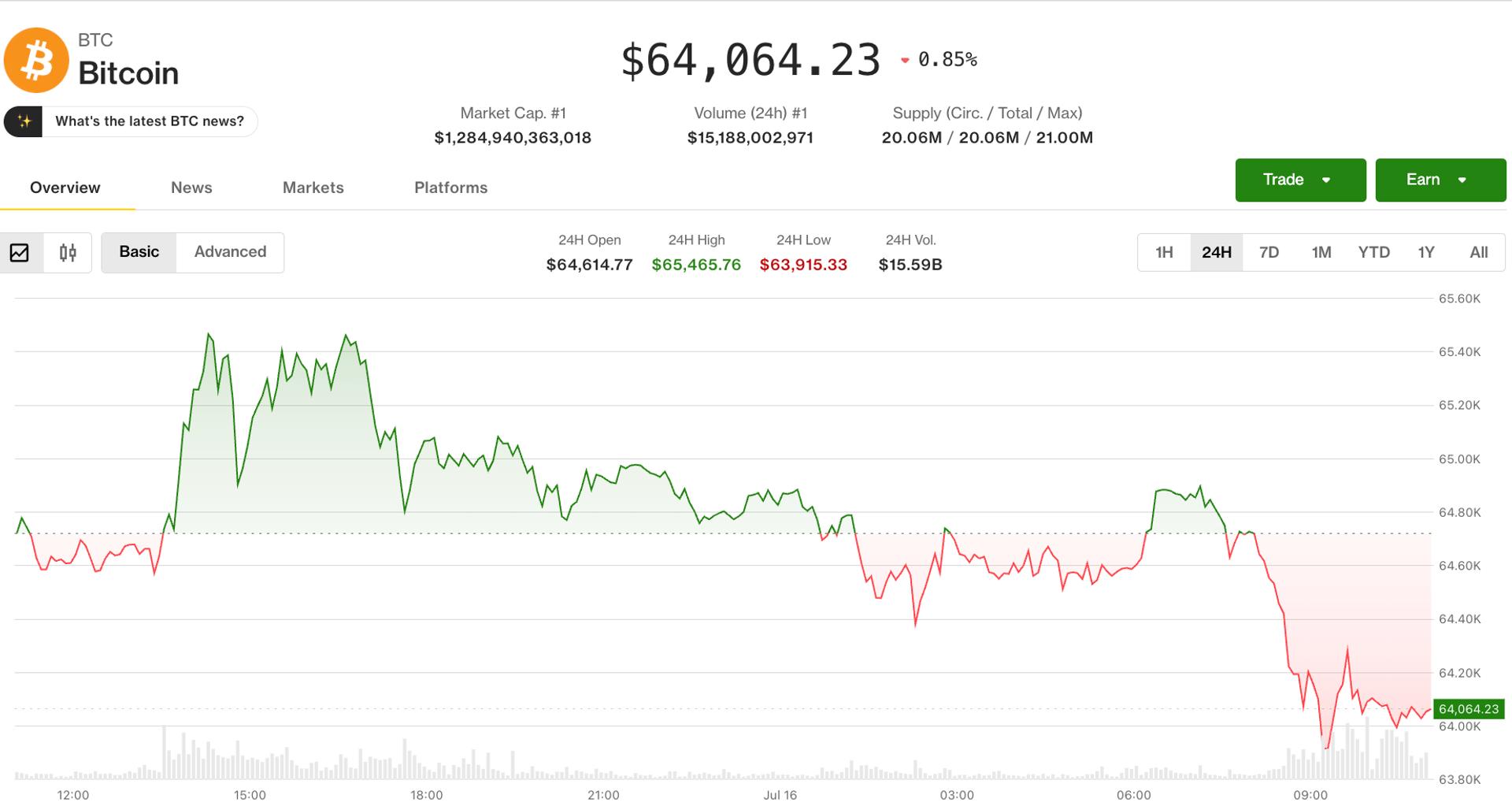
Overview
Bitcoin experienced a notable pullback on July 16, 2026, retreating to approximately $64,000 after reaching monthly highs earlier in the trading period. This reversal signals a shift in market sentiment as bears have reasserted control over the cryptocurrency's price action, challenging the bullish momentum that had characterized recent trading sessions. The pullback, while not unprecedented for Bitcoin, represents an important inflection point for market participants who have been monitoring the asset's trajectory throughout the month. The move serves as a reminder of the ongoing volatility that characterizes cryptocurrency markets, where rapid directional shifts can occur as sentiment changes and profit-taking opportunities emerge.
The $64,000 level represents a critical support zone that traders and analysts have been closely monitoring. Bitcoin's failure to maintain its monthly highs and subsequent retreat to this lower price point has sparked renewed discussions about the strength of the current bull case and whether the cryptocurrency has exhausted its near-term upside potential. Market participants are now reassessing their positions, with some taking profits from earlier gains while others are positioning for either a continuation of the decline or a potential bounce from support levels. The technical dynamics at play suggest that the cryptocurrency market remains in a state of flux, with structural support and resistance levels playing significant roles in determining future price movements.
This pullback comes amid a broader period of consolidation in the digital asset space, where macroeconomic factors, regulatory developments, and shifts in institutional sentiment continue to influence trading behavior. The cryptocurrency market's sensitivity to external catalysts means that Bitcoin's price movements often reflect not just technical factors but also broader market conditions that extend beyond the crypto ecosystem itself. Understanding the context surrounding this recent pullback requires examining the technical, fundamental, and sentiment-driven factors that have contributed to this directional change.
Background
Bitcoin's path to the monthly highs that preceded this pullback reflects a complex interplay of factors that have shaped cryptocurrency market dynamics throughout 2026. The leading digital asset has experienced periods of both strength and weakness as investors attempt to reconcile optimistic long-term narratives with near-term uncertainty regarding regulatory frameworks, macroeconomic conditions, and global financial stability. The move to monthly highs represented the culmination of recent bullish activity, suggesting that market participants had developed sufficient conviction to push the cryptocurrency higher despite persistent headwinds that have characterized the broader macroeconomic environment.
Historically, Bitcoin has demonstrated a pattern of rapid reversals when technical resistance levels are tested without sufficient follow-through volume. The monthly highs that preceded the current pullback were no exception to this pattern, as the initial enthusiasm that drove prices higher gradually gave way to profit-taking and renewed risk aversion. Market participants who had accumulated positions at lower levels began to realize gains, creating selling pressure that overwhelmed the initial bullish impulse. This cyclical pattern of accumulation, enthusiasm, profit-taking, and consolidation has characterized Bitcoin's price action throughout its history and remains evident in current market dynamics.
The broader cryptocurrency ecosystem has also experienced shifts in sentiment that have implications for Bitcoin's price trajectory. Developments in altcoin markets, regulatory announcements affecting the digital asset space, and changing perceptions regarding the role of cryptocurrency in global financial systems all contribute to the sentiment environment in which Bitcoin trades. The interconnectedness of these factors means that Bitcoin's pullback cannot be understood solely through technical analysis but must also be contextualized within the broader landscape of cryptocurrency market developments and macroeconomic conditions.
Institutional involvement in Bitcoin markets has grown significantly since the inception of spot exchange-traded funds and continued development of cryptocurrency infrastructure. This institutional participation has introduced new dynamics to Bitcoin price discovery, as large market participants increasingly use technical analysis, options markets, and derivative instruments to manage their exposure. The pullback to $64,000 may reflect profit-taking by institutional investors who have benefited from the move to monthly highs and are now reassessing their positions based on technical and fundamental considerations.
Key Developments
The immediate catalyst for Bitcoin's pullback to $64,000 appears to be a confluence of technical factors and sentiment shifts that triggered profit-taking among recent buyers. The monthly highs that Bitcoin achieved earlier in the trading period attracted significant attention from technical analysts and trading algorithms, suggesting that these levels had been identified as potential resistance zones. When buying pressure failed to overcome this resistance with conviction, it signaled to market participants that the bull case may be overextended, triggering a wave of selling that pushed prices lower. The mechanical nature of algorithmic trading and stop-loss orders likely amplified this directional move, as automated systems reacted to break-throughs in key technical levels.
Market participants have noted that the pullback coincides with a period of elevated options expiry activity and potential rotation of capital from bullish positions to hedged or neutral stances. The cryptocurrency derivatives market, which has grown substantially in recent years, can significantly influence spot price movements as traders adjust their hedging and leverage exposure. Liquidations in highly leveraged positions can accelerate directional moves, creating the sort of sharp pullback that has been observed in the recent price action. The interplay between spot and derivatives markets remains a critical factor in understanding short-term Bitcoin price movements.
Volume patterns during the pullback have provided additional insights into the strength of selling pressure. Analysis of trading volume across major cryptocurrency exchanges suggests that the move lower was accompanied by meaningful volume, indicating that this was not merely a technical snap-back but represented genuine selling interest. This distinction is important because high-volume reversals often carry more significance than low-volume moves, suggesting that the market consensus regarding Bitcoin's near-term direction may have genuinely shifted. Market participants have interpreted these volume dynamics as evidence that bears have indeed reasserted control, at least in the near term.
Regulatory and macroeconomic developments occurring around the time of the pullback deserve consideration as potential contributing factors. The cryptocurrency market remains sensitive to announcements from major regulatory bodies, central banks, and financial authorities. Any hints of tighter regulatory frameworks or concerns about financial stability in traditional markets can quickly translate into cryptocurrency selling pressure. Similarly, macroeconomic data regarding inflation, employment, and monetary policy decisions influence the attractiveness of risk assets like Bitcoin, which are sensitive to changes in real interest rates and risk appetite.
Market Impact
The pullback to $64,000 has immediate implications for various market participants including retail investors, institutional players, and derivative traders. For retail investors who entered positions near the monthly highs, the pullback represents either a painful unrealized loss or an opportunity to add to positions at lower prices, depending on their conviction regarding Bitcoin's longer-term prospects. Institutional investors, many of whom operate with more sophisticated risk management frameworks, may be using this pullback as an opportunity to rebalance or adjust exposure in accordance with their predetermined allocation strategies. The pullback thus creates dynamics of shifting capital allocation that influence price discovery and near-term volatility.
The broader cryptocurrency ecosystem has experienced spillover effects from Bitcoin's pullback, as altcoins typically demonstrate even greater sensitivity to Bitcoin price movements. The cryptocurrency market's structure means that Bitcoin often serves as a leading indicator for broader digital asset sentiment, and pullbacks in Bitcoin typically precede correlated selling pressure in altcoin markets. This correlation has implications for the overall market capitalization of the cryptocurrency sector and the relative standing of individual altcoin projects. Some market participants use Bitcoin pullbacks as opportunities to diversify into other digital assets, while others reduce exposure to the entire sector as Bitcoin's performance raises concerns about broader risk appetite.
Trading volumes across major cryptocurrency exchanges have reflected the increased activity associated with the pullback. Higher volume levels suggest that market participants are actively repositioning, taking profits, and adjusting hedges rather than passively holding positions. This elevated activity creates temporary opportunities for sophisticated traders while potentially creating challenges for retail participants attempting to exit positions during periods of price stress. The relationship between volume and price movement remains critical to understanding market health and the sustainability of directional moves in either direction.
The pullback has also influenced cryptocurrency options and futures markets, where prices of call options have declined while put options have increased in value. This shift in options pricing reflects changing perceptions of downside risk and reduced expectations regarding near-term price strength. Traders using options to gain leveraged exposure or to hedge existing positions have benefited or suffered depending on their positioning, creating additional nuance in how market participants are responding to the pullback. The derivatives market's reaction to spot price movements often provides leading indicators of sentiment shifts among sophisticated traders.
Risks and Considerations
One of the principal risks facing Bitcoin in the current environment is the potential for further capitulation if critical support levels are broken. The $64,000 level represents important technical support, but if selling pressure intensifies and this level is decisively breached, the next significant support zone exists considerably lower, potentially opening the door for more substantial losses. Cascade liquidations in leveraged positions could accelerate such a move, creating a scenario where technical support levels are broken with conviction. Market participants should remain cognizant of these potential worst-case scenarios and manage their exposure accordingly.
Macroeconomic risks represent another significant consideration that could exacerbate Bitcoin's pullback or trigger a more substantial decline. Should concerns about economic growth, financial stability, or inflation escalate, traditional risk assets and Bitcoin could experience simultaneous selling pressure. The cryptocurrency's positioning as a risk asset means that it often declines when broader market risk appetite evaporates, a dynamic that has been evident during previous periods of financial stress. Additionally, central bank policy decisions regarding interest rates and monetary conditions can significantly influence the attractiveness of non-yielding assets like Bitcoin.
Regulatory risks remain an ongoing concern for the cryptocurrency market, and announcements regarding new regulatory frameworks could trigger rapid shifts in market sentiment. The regulatory landscape for cryptocurrency continues to evolve across major jurisdictions, and uncertainty regarding the direction of regulation can introduce volatility into price discovery. Some market participants remain concerned that restrictive regulatory approaches could limit institutional adoption or create compliance challenges that reduce the attractiveness of digital assets. Conversely, clarity regarding regulatory frameworks could remove uncertainty and potentially provide support for prices.
Technical risks related to network security, developer involvement, and consensus mechanism stability also warrant consideration. Bitcoin's security model depends on sufficient mining activity and distribution of hash power across the network. Changes in mining economics or energy costs could influence the security posture of the network. Additionally, software updates and protocol changes require careful consideration to ensure that they do not introduce unintended consequences. While Bitcoin has demonstrated remarkable technical stability throughout its history, the possibility of technical issues cannot be entirely dismissed, and such issues could trigger sharp market reactions if they undermine confidence in the asset's reliability.
What to Watch
Market participants should closely monitor Bitcoin's ability to maintain support at key technical levels, including the $64,000 zone and any lower support areas that may be tested. Breaking these levels decisively could accelerate selling pressure and create self-reinforcing downside momentum. Conversely, if Bitcoin maintains support and begins to establish a floor near $64,000, it could signal that bears have exhausted their immediate selling pressure and that buyers may be positioned to defend this level. The technical behavior at these critical zones will provide important signals regarding the likely direction of future price movements.
Macroeconomic data releases deserve close attention, particularly reports on inflation, employment, and consumer spending that could influence central bank policy expectations. Should economic data surprise to the downside and increase the probability of interest rate cuts, this could theoretically support risk assets like Bitcoin by reducing real rates. Conversely, strong data that prompts market expectations of maintained higher-for-longer rates could create headwinds for Bitcoin and other risk assets. Traders should remain attuned to the Federal Reserve's communications and market expectations regarding future monetary policy paths.
Regulatory announcements and legislative developments affecting the cryptocurrency sector merit careful observation. The cryptocurrency community should monitor ongoing discussions in major jurisdictions regarding digital asset regulation, taxation, and institutional participation frameworks. Clarity or restriction regarding these matters could meaningfully influence market sentiment and price trajectories. Additionally, developments regarding Central Bank Digital Currencies (CBDCs) warrant attention, as these initiatives could have implications for the competitive positioning of decentralized cryptocurrencies like Bitcoin.
Options market indicators provide valuable signals regarding trader sentiment and expectations for future volatility. The relationship between implied volatility in options markets and realized volatility in spot markets can indicate whether traders are positioned for additional directional movement or range-bound consolidation. Additionally, monitoring the put/call ratio and levels of skew in options pricing can reveal changing sentiment among sophisticated traders and hedge fund managers.
Conclusion
Bitcoin's pullback to $64,000 following monthly highs represents an important market development that reflects the ongoing volatility and sentiment shifts characteristic of cryptocurrency markets. The reassertion of bearish control suggests that profit-taking and risk reduction have overwhelmed the initial bullish impulse that drove prices higher. However, the broader context of Bitcoin's long-term trajectory and the structural factors supporting cryptocurrency adoption remain important considerations that should inform investment decisions alongside near-term technical dynamics.
The current pullback, while potentially frustrating for recent buyers, represents a natural part of market cycles and should not be interpreted as invalidating longer-term bull cases for Bitcoin or the broader cryptocurrency ecosystem. Markets require periods of consolidation and profit-taking to establish sustainable trends, and the pullback may simply represent a necessary pause before the next leg of any move higher. Alternatively, if the pullback proves to be the beginning of a more substantial correction, it will have provided important early signals that traders could use to adjust their exposure.
Investors and traders should approach the current market conditions with both conviction regarding their longer-term views and flexibility regarding near-term position management. Technical support levels should be respected as important zones that may determine subsequent price movements, while macroeconomic and regulatory developments should continue to inform the broader investment thesis. The cryptocurrency market remains relatively young compared to traditional financial markets, and volatility should be expected as the asset class continues to mature and attract increasing attention from participants with varied time horizons and risk tolerances.
As Bitcoin continues to consolidate near $64,000, the path forward will likely depend on the interplay between technical factors, macroeconomic conditions, regulatory developments, and shifts in market sentiment. Participants should remain vigilant in monitoring these various dimensions of the market environment and adjust their strategies accordingly. The current pullback, while notable, should be contextualized within the longer-term narrative of cryptocurrency adoption and Bitcoin's evolving role in global financial systems. Whether this pullback represents a temporary consolidation or the beginning of a more substantial correction will be revealed through subsequent price action and the fundamental factors that continue to shape the cryptocurrency market landscape.
Original Source
CoinDesk