Bitcoin's Most Popular Call Option Plummets $10K Amid Market Volatility
The most actively traded Bitcoin call option has declined by $10,000, reflecting broader market uncertainty and shifting investor sentiment. This significant price movement signals potential changes in options markets positioning and may indicate traders are reassessing bullish Bitcoin bets amid macroeconomic headwinds.
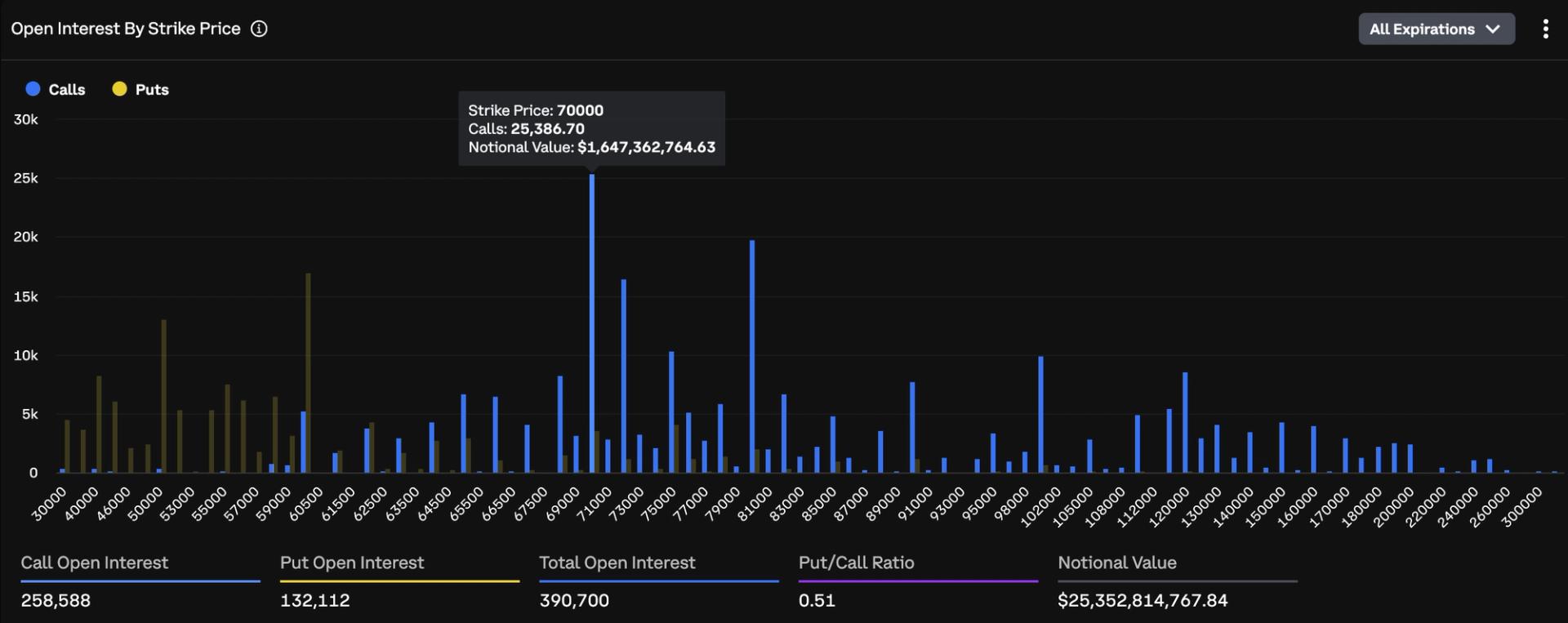
Overview
The cryptocurrency derivatives market has experienced a notable shift as Bitcoin call options—contracts that give holders the right to purchase Bitcoin at a predetermined price—have declined substantially in value. The most popular Bitcoin call option, which serves as a barometer for bullish sentiment among institutional and retail traders, has slipped by approximately $10,000 in recent trading sessions. This downturn represents a significant reversal from earlier optimism and suggests that market participants are re-evaluating their bullish positioning on the world's largest cryptocurrency.
Call options typically represent speculative bets on price appreciation, making their performance a crucial indicator of market sentiment and expectations. The $10,000 decline is particularly notable given Bitcoin's price stability relative to the magnitude of the options depreciation, pointing to shifts in implied volatility, time decay, and broader portfolio rebalancing dynamics. This movement has captured the attention of options traders, risk managers, and cryptocurrency analysts who monitor derivatives markets as leading indicators of directional conviction.
The timing of this decline is significant, coinciding with increased regulatory scrutiny, macroeconomic uncertainty, and a cooling of momentum that characterized Bitcoin markets earlier in 2026. Market participants are increasingly questioning whether the recent rallies in cryptocurrency markets are sustainable or merely temporary rebounds within a larger consolidation pattern. Understanding the factors behind this options depreciation provides critical insight into professional investor positioning and future price trajectories.
Background
Bitcoin's derivatives markets have grown exponentially over the past several years, evolving from niche trading venues to major financial infrastructure utilized by hedge funds, institutional asset managers, and sophisticated retail traders. Options markets, in particular, have become increasingly important for hedging, speculation, and capturing exposure to Bitcoin's price movements with leveraged positions. The most popular Bitcoin call option referenced in this market movement typically refers to the most actively traded strike price and expiration date combination across major platforms like the Chicago Mercantile Exchange (CME), Deribit, or other established derivatives exchanges.
Call options derive their value from multiple factors, collectively known as the Greeks: delta (sensitivity to underlying price), gamma (acceleration of delta changes), theta (time decay), vega (sensitivity to implied volatility), and rho (interest rate sensitivity). When a call option loses $10,000 in value while Bitcoin's spot price remains relatively stable, this typically indicates declining implied volatility expectations, negative time decay as expiration approaches, or shifts in broader market sentiment. Professional options traders analyze these dynamics to identify mispricing and hedging opportunities.
The history of Bitcoin call options reveals patterns of extreme sentiment swings. During bull markets, call options surge in value as traders rush to establish bullish positions with leveraged exposure. Conversely, during periods of uncertainty or downward pressure, implied volatility contracts, and options lose value more rapidly than would be justified by spot price movements alone. The current environment appears to reflect this latter dynamic, where deteriorating sentiment is collapsing option valuations faster than fundamental price declines would suggest.
Historically, major declines in popular Bitcoin call option values have preceded periods of consolidation, profit-taking, or renewed selling pressure. The correlation between options depreciation and subsequent spot price weakness is not perfectly reliable, but it has proven more accurate than random chance for predicting near-term weakness. This makes current options market signals worthy of serious consideration for portfolio managers and directional traders alike.
Key Developments
Several significant developments have contributed to the $10,000 decline in Bitcoin's most popular call option values. First, implied volatility contraction has accelerated in recent weeks as uncertainty metrics decline. When traders expect lower future volatility, the premium they're willing to pay for options decreases, causing option values to deteriorate even if spot prices remain stable. This volatility crush is particularly damaging to long option positions, as both time decay and vega erosion work against option holders simultaneously.
Second, the approach of expiration for popular monthly and quarterly Bitcoin option contracts has introduced time decay pressure into the market. Options lose value as they approach expiration if prices don't move in the direction traders anticipated. This theta decay accelerates in the final weeks before expiration, compressing option values rapidly. The specific timing of the $10,000 decline likely corresponds to major option expiration windows when dealers and market makers adjust hedges, potentially causing temporary but sharp price movements in the options markets.
Third, significant portfolio rebalancing and forced liquidations among cryptocurrency hedge funds have created selling pressure in options markets. Several high-profile cryptocurrency investment firms reported losses or restructuring in mid-2026, potentially forcing redemptions and forced liquidations of derivative positions. When large portfolio positions are unwound quickly, options markets experience friction and slippage, causing rapid value destruction. Market participants with substantial call option holdings may have been forced to capitulate and close positions at unfavorable prices.
Fourth, macroeconomic developments including Federal Reserve communications, inflation data, and geopolitical tensions have dampened appetite for speculative cryptocurrency bets. When broader market uncertainty increases, traders tend to reduce tail-risk exposure and avoid leveraged positions. Call options represent leveraged bullish bets, making them the first positions to be trimmed when risk appetite declines. Statements suggesting higher-for-longer interest rates or renewed inflation concerns have particularly impacted options sentiment.
Finally, technical breakdown in Bitcoin spot prices at key resistance levels has triggered algorithmic selling and stop-loss execution in derivatives markets. When Bitcoin failed to sustain levels above certain psychological price points, technical traders capitulated, creating cascading liquidations in leverage products. This technical weakness in spot markets typically precedes deterioration in options valuations, as traders acknowledge that bullish thesis may have failed.
Market Impact
The $10,000 decline in Bitcoin call option values carries substantial implications for broader cryptocurrency markets and investor positioning. Most immediately, this represents a significant loss for investors who hold these options as speculative bets or hedge positions. Depending on portfolio size, some institutional investors may have suffered meaningful losses, potentially triggering forced rebalancing or margin calls at their prime brokers. This pain creates feedback loops where selling begets more selling as positions are unwound.
The depreciation also reflects a reversal of sentiment among professional traders. Earlier in 2026, Bitcoin call options were accumulating value and demand as traders positioned for continued appreciation. The current reversal indicates that these same traders are abandoning bullish bets, covering short positions, or shifting capital to other investments. This rotation away from Bitcoin derivatives can itself become a headwind for Bitcoin spot prices, as options-hedging programs may require selling underlying Bitcoin to remain neutral.
For options dealers and market makers—primarily major investment banks and cryptocurrency exchanges—the volatile movement creates both challenges and opportunities. Dealers who had accumulated long call option positions during the earlier enthusiasm have suffered mark-to-market losses. Conversely, dealers and traders who positioned for options depreciation through short calls, call spreads, or other bearish options strategies have profited handsomely. This creates winners and losers within the dealer community, potentially affecting liquidity provision in coming weeks.
The broader derivatives market structure is affected as well. When popular options contracts experience sharp value erosion, retail and institutional participation in options markets often declines. Traders become more cautious about entering new positions when recent positions have suffered losses. This reduced participation can lead to wider bid-ask spreads, reduced liquidity depth, and slower execution for large orders. These friction costs then get passed along to all options market participants, creating a self-reinforcing cycle of reduced engagement.
From a market microstructure perspective, the $10,000 decline may indicate that options market participants expect lower absolute Bitcoin prices in coming weeks or months. If spot Bitcoin prices were expected to appreciate, call options would retain or gain value despite time decay. The magnitude of depreciation suggests traders are not only neutral but mildly bearish, expecting either modest price declines or extended consolidation at current levels.
Risks and Considerations
Several important risks and considerations emerge from analyzing this options market movement. First, options market signals can be unreliable indicators of future spot price movements. Historical correlation between options sentiment and subsequent spot price action is imperfect; markets regularly surprise traders by moving contrary to options positioning. Some traders may have abandoned bullish bets prematurely, only to watch Bitcoin rally sharply and deliver superior returns to those who remained positioned. Extrapolating too much certainty from options movements can lead to incorrect directional bets.
Second, the $10,000 decline may reflect dealer and hedge activity rather than genuine sentiment change among directional traders. Options market movements are heavily influenced by hedging dynamics, rebalancing requirements, and dealer portfolio management. A seemingly significant bearish signal in options markets might actually reflect technical hedging adjustments by dealers who accumulated exposure while providing liquidity. Distinguishing between genuine directional sentiment and technical dealer activity requires sophisticated analysis that most market participants cannot perform.
Third, volatility is likely to remain elevated as Bitcoin markets reassess their fundamental thesis and price targets. While falling implied volatility has contributed to options depreciation, realized volatility—actual price movements—could spike higher if new information or catalysts emerge. If volatility increases sharply, option values could rebound quickly, punishing traders who capitulated at the lows. This creates an asymmetric risk/reward dynamic where further options depreciation seems possible but reversal risk remains substantial.
Fourth, regulatory and institutional adoption developments could rapidly shift options market sentiment. If major institutions announce Bitcoin purchases, regulatory approvals, or corporate treasuries expand cryptocurrency holdings, bullish sentiment could reverse sharply. Call options would then appreciate rapidly, creating losses for traders who exited positions during the current weakness. Timing the market bottom in options, as in all assets, remains notoriously difficult.
Finally, systemic financial stress could cause options markets to behave unexpectedly. In scenarios of broader market turmoil or cryptocurrency exchange failures, options market liquidity could disappear entirely, trapping traders in positions they cannot exit. The leverage inherent in options positions means that tail-risk scenarios can produce outsized losses for options-leveraged investors. Current complacency in options markets reflects normal functioning, but this assumption could be violated if systemic stress emerges.
What to Watch
Market participants and observers should monitor several key indicators in coming weeks to understand whether the Bitcoin call options decline represents a significant reversal or temporary noise. First, track Bitcoin spot price action relative to major technical levels and moving averages. If Bitcoin stabilizes above recent support levels and begins trending higher, call options will likely recover value and the current weakness may prove to be a buying opportunity. Conversely, if Bitcoin breaks down through key technical support, call options depreciation will likely accelerate.
Second, monitor implied volatility indices like the Crypto Volatility Index or options-derived metrics. If implied volatility continues contracting, options will likely depreciate further regardless of spot price direction. If implied volatility stabilizes or increases, options could recover value even if spot prices remain flat. Understanding the volatility component of options depreciation is essential for predicting future movements.
Third, observe options flow indicators and term structure shifts across major derivatives exchanges. If dealers and professional traders begin accumulating call options again, this would signal renewed bullish conviction. Professional options activity often precedes spot price movements by weeks or months, making options flows valuable leading indicators. Tools that track smart money options activity—particularly options purchases by sophisticated traders—can provide valuable early signals.
Fourth, pay attention to macroeconomic catalysts including Federal Reserve decisions, inflation data, employment reports, and other economic indicators. These broader economic forces significantly impact risk appetite and cryptocurrency valuations. Major economic surprises could rapidly reverse current bearish sentiment in options markets, creating both opportunities and risks for traders with established positions.
Finally, track Bitcoin spot price levels and technical formation. Key resistance levels (particularly $65,000, $70,000, and all-time highs) and support levels (recent lows around $58,000-$60,000) will be important to monitor. Options markets typically react sharply to spot price breaks through significant technical levels, so watching these price action dynamics will help predict options market movements.
Conclusion
The $10,000 decline in Bitcoin's most popular call option represents a significant reversal in sentiment among professional traders and an important warning signal for directional investors. While options depreciation alone is not deterministic for future spot price movements, it does reflect reduced bullish conviction and suggests that traders are repositioning away from leveraged long bets. This sentiment shift could presage weakness in Bitcoin spot prices, though predictions based solely on options movements should be viewed with appropriate skepticism.
The cryptocurrency derivatives market has matured substantially in recent years, growing from a niche trading venue to a major financial infrastructure. This maturation means options signals now carry weight in broader cryptocurrency markets, influencing both professional and retail investor behavior. The $10,000 call option decline sends a clear message: professional traders are less convinced about near-term Bitcoin appreciation, and some are actively hedging bullish risk.
For investors and portfolio managers, the current environment suggests caution and selective opportunism. Call options appear expensive relative to recent valuations and forward expectations, making new call positions speculative bets on rapid appreciation. Conversely, the weakness in call values may represent attractive entry points for traders with sufficiently long time horizons and conviction in Bitcoin's ultimate bullish thesis. The key is matching position sizing and time horizon to individual risk tolerance and investment objectives.
Looking forward, Bitcoin and cryptocurrency markets will likely remain volatile as participants navigate macroeconomic uncertainty, regulatory developments, and technical formations. Options markets, with their sensitivity to volatility and sentiment, will continue to provide early signals of directional conviction shifts. The current weakness in call options should prompt careful analysis rather than panic, with traders distinguishing between temporary noise and genuine trend reversals. As with all derivatives markets, success requires disciplined risk management, technical analysis, and understanding of market microstructure dynamics that drive rapid price movements in leveraged instruments.
Original Source
CoinDesk