XRP Triangle Breakout Eyes $1.35 as 4% Surge Signals Technical Momentum
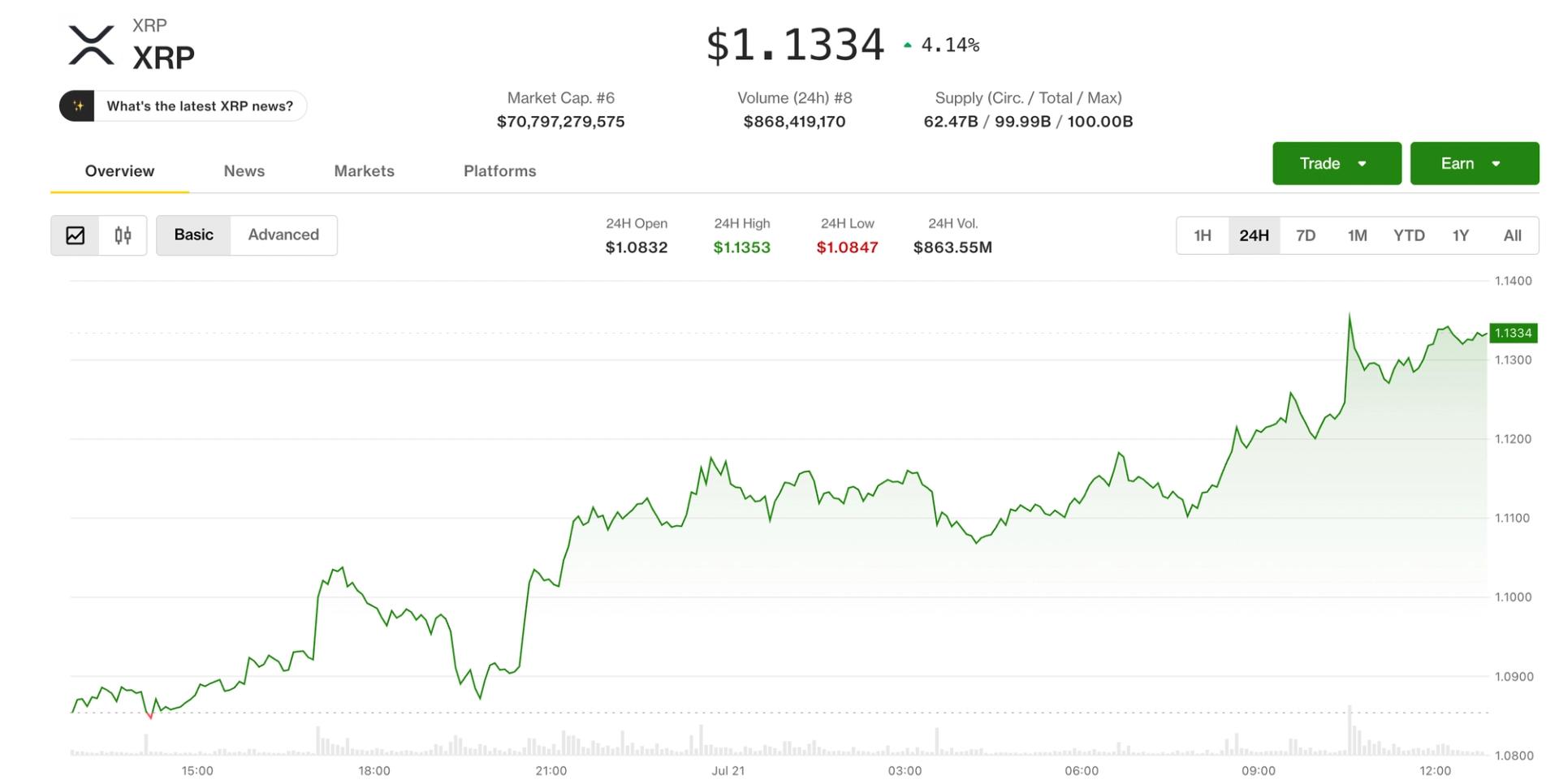
XRP surged 4% as traders identified a triangle breakout pattern suggesting potential upside to $1.35. The technical setup, combined with broader market dynamics, has attracted increased attention from institutional and retail traders watching key resistance levels.
Overview
The cryptocurrency markets have witnessed renewed interest in XRP, the native token of the Ripple blockchain, as the digital asset surged approximately 4% amid active technical chart formations. Traders and technical analysts have focused their attention on what appears to be a triangle breakout pattern, a well-recognized chart formation that often precedes significant price movements in traditional and digital asset markets. The identified technical setup suggests potential upside movement toward the $1.35 price level, a figure that has taken on significance as both a psychological and technical resistance point for XRP holders and market participants.
This price action arrives during a period of broader consolidation in the cryptocurrency sector, where many assets have been oscillating within established trading ranges. XRP, which has long maintained a complex relationship with regulatory frameworks and traditional finance integration efforts, continues to attract a diverse cross-section of market participants. The convergence of technical factors, market sentiment, and institutional interest has created an environment where seemingly incremental price movements can attract outsized analytical attention and trading volume.
The triangle breakout scenario outlined by technical analysts represents more than just a mathematical chart pattern. It embodies broader questions about market direction, institutional adoption of blockchain technology, and the effectiveness of technical analysis as a predictive tool in increasingly sophisticated digital asset markets. Understanding the mechanics of this pattern, the factors driving XRP's current trajectory, and the broader implications for the cryptocurrency ecosystem requires examining multiple dimensions of market behavior and fundamental developments.
Background
XRP's history as a digital asset is intertwined with Ripple's mission to facilitate cross-border payments and international settlements through blockchain technology. Unlike Bitcoin, which operates on a purely decentralized consensus model, and many other tokens that emerged during the 2017 initial coin offering (ICO) boom, XRP was designed with institutional partnerships and practical payment applications in mind. This distinction has shaped how the token is perceived within both traditional finance circles and the broader cryptocurrency community, creating a unique market dynamics profile that differs substantially from pure speculative digital assets.
The regulatory landscape surrounding XRP has been particularly complex and consequential for price movements. The U.S. Securities and Exchange Commission (SEC) initiated legal proceedings against Ripple in late 2020, alleging that XRP was sold as an unregistered security rather than a utility token. This legal uncertainty created a significant overhang on XRP's market performance for several years, as institutional investors remained cautious about holding an asset subject to potential regulatory restrictions. The eventual resolution of this dispute, which resulted in a significant partial victory for Ripple, marked a potential inflection point for the asset's positioning and market acceptance.
Over the past several years, XRP has experienced considerable volatility, with multiple boom-and-bust cycles characteristic of the broader cryptocurrency market. The token reached all-time highs exceeding $3 during previous market cycles, but also experienced extended periods of underperformance as regulatory uncertainty persisted. The current price action, which sees XRP consolidating in a mid-range position with apparent technical break attempts, reflects the market's attempt to determine a sustainable valuation in light of resolved regulatory questions and maturing market infrastructure. Understanding this historical context is essential for interpreting current technical formations and anticipating potential future price movements.
Ripple's continued development of products such as On-Demand Liquidity (ODL) and ongoing partnerships with financial institutions represent the fundamental narrative underpinning XRP's long-term value proposition. These developments exist somewhat independently from short-term technical price formations, yet they provide the foundational thesis that enables institutional participation in XRP markets. The interaction between technical trading dynamics and fundamental business development creates a complex environment where multiple analytical frameworks must be integrated to develop coherent market perspectives.
Key Developments
The identification of the triangle breakout pattern represents a significant technical development in XRP's recent price action. Triangle formations occur when price consolidation creates a distinctive geometric pattern characterized by converging trend lines—typically a rising lower boundary and a falling upper boundary that suggest decreasing volatility and imminent significant movement. Technical analysts interpret triangle patterns as moments when accumulated trading pressure requires resolution in directional movement. The emergence of this pattern in XRP's chart has catalyzed increased attention from technical traders who utilize such formations as decision points for entry and exit positions.
The specific breakout direction toward the $1.35 level carries multiple layers of significance. This price point represents not merely a number on an exchange display, but a confluence of technical levels including previous resistance formations, Fibonacci retracement levels, and psychological round numbers that accumulate meaning through market psychology and historical price discovery. The fact that traders anticipate breakout movement toward this specific level rather than downward suggests a broadly constructive technical sentiment among chart-focused market participants. This perception can become self-fulfilling as traders place buy orders at anticipated support levels and set profit targets aligned with identified resistance.
The 4% price appreciation that triggered the current market discussion represents meaningful movement within the context of recent XRP price action, yet remains modest compared to the dramatic swings common in earlier cryptocurrency market cycles. This suggests markets are processing the technical setup with discipline rather than euphoria. The moderate nature of the current move makes the triangle breakout setup arguably more significant—it implies that serious technical traders are positioning ahead of anticipated larger moves rather than simply reacting to momentum. This distinction between anticipatory positioning and reactive buying has meaningful implications for the sustainability of any subsequent price movement.
Beyond pure chart patterns, several fundamental developments have coincided with current price action. Ripple's continued expansion of institutional partnerships, announcements regarding blockchain infrastructure upgrades, and ongoing regulatory clarity developments create a backdrop of improving sentiment toward XRP relative to the extended period of regulatory uncertainty. Additionally, broader cryptocurrency market developments, including movements in dominant cryptocurrencies like Bitcoin and Ethereum, typically cascade to influence altcoins like XRP. The current timing of the triangle breakout pattern within this broader market context suggests multiple factors are aligning to support potential upside movement.
Market Impact
The triangle breakout setup and potential movement toward $1.35 carries implications across multiple segments of the cryptocurrency market ecosystem. For retail traders, the technical setup offers a relatively clearly-defined risk/reward framework—traders can establish positions with predetermined stop-loss levels below the triangle formation, with profit targets aligned to identified resistance levels. This clarity attracts participation from individual traders who may lack sophisticated market intelligence but can execute disciplined technical trading strategies. The accumulation of many retail positions, while individually modest in size, can contribute to directional momentum when aligned across a common thesis.
Institutional investors monitoring XRP as a potential holding or speculative position likely view the technical setup through a different lens than retail traders, yet often reach similar conclusions about directional bias. Institutions with sophisticated technical analysis teams recognize triangle patterns and often deploy capital ahead of anticipated breakout moves. Large institutional orders can provide the liquidity and momentum necessary to move prices toward identified targets. Additionally, institutions increasingly recognize technical analysis not as a fundamental analytical approach but as a practical tool for understanding when other market participants are likely to act, effectively positioning ahead of predictable trading behavior.
The potential rally toward $1.35 would also impact XRP's relative valuation metrics and market capitalization positioning within the broader cryptocurrency landscape. Currently, XRP maintains a position within the top ten cryptocurrencies by market capitalization, yet lags substantially behind Bitcoin and Ethereum. A successful breakout to $1.35 would increase XRP's market value and potentially shift it higher in market capitalization rankings, potentially attracting additional attention from institutional funds with mandates to hold positions in top-ranked cryptocurrencies. This dynamic creates a reinforcing cycle where technical success breeds fundamental attention and investment flow.
For Ripple as a company, while the price of XRP is independent of corporate value creation, strong XRP performance typically improves the company's ability to attract talent, partners, and capital. Additionally, Ripple maintains substantial XRP holdings and uses the token for various institutional incentive programs, so strong performance benefits the organization. The connection between token price performance and organizational success, while imperfect, remains psychologically and strategically meaningful in the cryptocurrency sector.
The broader market impact extends to alternative cryptocurrencies and decentralized projects competing with Ripple's vision for cross-border payments and settlement infrastructure. Success in XRP creates validation for the blockchain-based payments narrative and potentially encourages capital flows toward related projects and use cases. Conversely, technical failure of the identified breakout would create opportunities for competing technologies and projects to gain market share and narrative momentum.
Risks and Considerations
While the technical setup appears constructive to many traders, significant risks could prevent the anticipated move to $1.35 from materializing. Technical analysis carries inherent limitations as a predictive framework—patterns that appeared historically to precede significant moves can fail, particularly in markets characterized by changing dynamics, regulatory shifts, or unexpected macro events. The triangle formation is a probabilistic indicator rather than a guarantee, and markets regularly surprise participants by moving in directions contradictory to established technical formations. Traders implementing strategies based on this pattern accept the risk of whipsaw moves that could trigger stop-loss levels before pushing higher.
Regulatory developments remain a persistent wild card for XRP. While the SEC resolution provided clarity, other regulatory regimes globally continue to evolve their approach to cryptocurrency tokens and blockchain-based assets. Unexpected regulatory announcements from major markets such as Europe, Asia, or alternative U.S. regulatory agencies could rapidly deteriorate sentiment toward XRP despite positive technical setups. The crypto sector's history demonstrates that regulatory uncertainty can override technical factors, creating sharp downward moves regardless of chart patterns or trader positioning. Current positioning could make XRP particularly vulnerable to unexpected negative regulatory news, as traders holding triangle breakout positions would rapidly liquidate on unfavorable developments.
Broader macroeconomic factors also present meaningful risks to XRP and the wider cryptocurrency market. Interest rate expectations, currency movements, and traditional financial market volatility can impact capital flows into speculative digital assets. If macroeconomic conditions deteriorate or central banks signal unexpected tightening, flight-to-safety dynamics could trigger substantial cryptocurrency selling regardless of technical factors. The triangle breakout setup assumes relatively stable macro conditions and market risk appetite continuation—material shifts in these factors could disrupt the anticipated technical trajectory.
Manipulation and market structure risks remain concerns within digital asset markets, despite maturation of exchange infrastructure and regulatory oversight. Cryptocurrency exchanges, while substantially more robust than in earlier market cycles, still lack some safeguards present in traditional securities markets. Large concentrated positions or wash trading could theoretically disrupt expected technical outcomes. While outright manipulation appears less prevalent than in earlier cryptocurrency eras, the possibility remains meaningful enough to warrant caution when assigning high confidence to technical patterns in inherently less-regulated markets.
The liquidity profile at identified price targets also merits consideration. While $1.35 appears as a mathematically clean target based on chart analysis, actual execution of large sell orders at this level could create unexpected resistance that stalls momentum. Conversely, if actual buyer demand proves insufficient at anticipated price levels, rally moves could peter out short of identified targets. The interaction between technical positioning and actual market liquidity often creates disappointed expectations among traders, particularly in lower-volume periods.
What to Watch
Market participants monitoring XRP should focus attention on several key technical levels and developments likely to determine whether the identified triangle breakout successfully reaches $1.35. The immediate resistance level above current prices represents the first critical threshold—if buying pressure fails to decisively break through overhead resistance, the entire bullish technical scenario falters. Conversely, a decisive break above resistance would validate the pattern and likely attract additional buying from technical traders with standing buy orders in the region. The level of volume accompanying any breakout attempt carries meaningful significance—volume confirmation of breakout moves substantially increases the probability of sustained directional movement.
The $1.35 price level itself requires monitoring as a potential resistance point, even should the breakout attempt prove successful initially. This level likely contains significant seller interest given its prominence in technical analysis—many traders will preemptively place sell orders in anticipation of this resistance, potentially creating a ceiling on upside momentum. If the rally reaches $1.35 and stalls despite strong momentum, alternative technical theories suggesting the breakout failed and price reversals are imminent would gain credence. Monitoring how price interacts with this level—does it pierce cleanly through, consolidate at this level, or roll over—provides crucial information about the actual strength of the technical setup.
Broader cryptocurrency market movements and Bitcoin price action merit close attention, as XRP and the altcoin sector typically follow directional signals from Bitcoin. If Bitcoin consolidates or declines during a potential XRP rally attempt, the cryptocurrency's upside potential could be capped regardless of technical factors. Conversely, if Bitcoin rallies while XRP executes the anticipated breakout, synergistic momentum could propel XRP beyond anticipated targets. Integrating XRP analysis into broader market context avoids the analytical error of evaluating individual asset technical patterns in isolation.
Regulatory announcements and Ripple corporate developments deserve monitoring alongside technical factors. Any unexpected legal challenges, regulatory restrictions, or material business setbacks could rapidly invalidate technical positioning regardless of chart pattern validity. Subscribing to Ripple announcements, SEC regulatory updates, and major cryptocurrency news sources helps market participants stay informed of developments likely to matter substantially to XRP valuations. The interaction between technical momentum and fundamental information often creates the most impactful price moves, when positive technical trends coincide with positive business developments.
Volume profile analysis and order book data provide technical traders with additional tools for monitoring breakout authenticity. If the anticipated breakout toward $1.35 occurs accompanied by unusually heavy volume concentration, this validates buyer commitment. Conversely, if breakout moves occur on relatively light volume, skepticism about sustainability seems warranted. Most professional trading platforms and analysis services provide volume profile data enabling this monitoring, and traders serious about executing strategies around this setup should incorporate such analysis into decision frameworks.
Conclusion
The triangle breakout pattern identified in XRP's recent price action represents a meaningful technical setup with potential implications for near-term price direction. The convergence toward the $1.35 level suggests multiple technical factors are aligning around this target, and the apparent constructive technical sentiment among chart-focused traders indicates meaningful capital positioned ahead of anticipated breakout moves. However, the pattern remains a probabilistic framework rather than a guarantee, and traders implementing strategies based on this analysis accept meaningful risks of failure, particularly given broader market uncertainties and regulatory considerations surrounding the cryptocurrency sector.
The broader context for XRP, including resolved regulatory uncertainty surrounding the SEC lawsuit, continued institutional partnership development, and maturation of blockchain-based payment infrastructure, provides a fundamental backdrop that complements the technical setup. This convergence of technical and fundamental factors creates what market participants often describe as an optimal risk/reward environment for accumulating positions or executing near-term trading strategies aligned with anticipated upside movement. Nevertheless, investors should implement rigorous risk management protocols given the inherent volatility and regulatory uncertainties surrounding digital assets.
For traders and investors monitoring XRP, the current environment offers opportunities to establish positions with clearly-defined risk parameters, while remaining vigilant about developments that could rapidly alter technical or fundamental outlooks. The identified triangle breakout toward $1.35 represents the type of technical opportunity that attracts consistent attention in the evolving cryptocurrency markets, where pure chart analysis and fundamental developments interact to drive price discovery. Success in executing strategies aligned with this thesis likely requires integrating technical discipline with flexibility to adjust positioning based on unexpected regulatory, macro, or market structure developments that characterize the dynamic cryptocurrency trading environment.
Original Source
CoinDesk