Bitcoin Options Expiration: $6B Countdown to May 29 Showdown
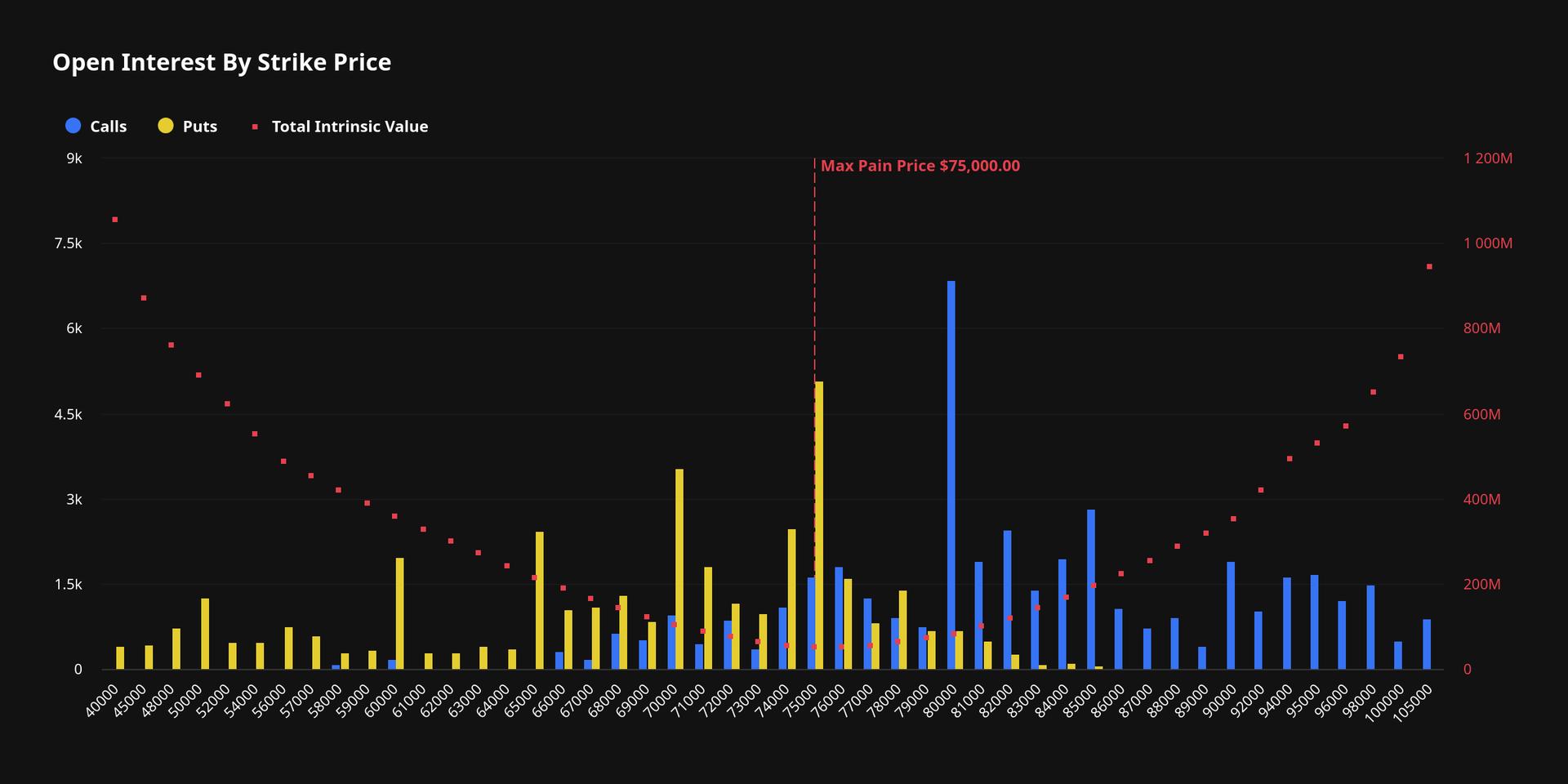
As $6.25 billion in Bitcoin options expire on May 29, traders are aggressively positioning in $82,000 calls while the market navigates a max pain level near $75,000. The concentrated call wall at $80,000 suggests institutional players are preparing for significant price movement, creating a critical juncture for BTC ahead of the deadline.
Overview
The cryptocurrency derivatives market is bracing for a pivotal moment as $6.25 billion in Bitcoin options expire on May 29, 2026, creating one of the most closely watched expirations in recent history. Market participants, particularly institutional traders and sophisticated retail investors, are positioning heavily in call options struck at $82,000, signaling bullish sentiment despite macro headwinds and regulatory uncertainties. The concentration of open interest at specific strike prices—particularly the $82,000 calls and the substantial call wall near $80,000—suggests that both professional traders and market makers are preparing for elevated volatility and potentially significant price discovery in the coming days.
This options expiration carries particular significance because of the sheer notional value at stake. With $6.25 billion in notional exposure expiring within a single week, every $1,000 move in Bitcoin's price between now and May 29 translates to substantial gains or losses across the derivatives ecosystem. The concentration of positioning at specific strikes indicates that this expiration will likely prove pivotal not just for options traders, but for the broader Bitcoin market, which often experiences unusual price action around major expiration dates.
The narrative surrounding this expiration also reflects broader market dynamics: the tension between fundamental bullish factors—increasing institutional adoption, corporate balance sheet accumulation, and emerging positive regulatory developments—and bearish technical factors, including profit-taking pressure and macro uncertainty. The $82,000 call pilup suggests that traders believe Bitcoin has the potential to push significantly higher before month-end, yet the concentration of max pain near $75,000 indicates that dealers and market makers may be positioning for a more modest outcome that maximizes pain for leveraged traders.
Background
Understanding the May 29 expiration requires context on how options markets function and why expiration dates matter for spot price discovery. Unlike spot trading, where buyers and sellers simply exchange assets at the current market price, derivatives markets allow traders to express views about future prices by purchasing the right (but not the obligation) to buy or sell Bitcoin at predetermined prices called strike prices. Options expire on specific dates, at which point they either generate cash settlements (for cash-settled contracts) or trigger physical delivery of the underlying asset.
The concept of max pain, sometimes called the max loss for option sellers, refers to the strike price at which option holders collectively suffer the greatest loss at expiration. Conversely, it's the price that maximizes profit for market makers and large option sellers who are typically short calls and long puts. Max pain occurs where the open interest on calls and puts is most balanced in a way that causes the broadest portfolio loss—typically resulting in price weakness as market makers delta-hedge their positions in the spot market leading up to expiration.
Historically, Bitcoin options expirations have been catalysts for notable price moves, as the massive notional value tied up in these derivatives creates incentives for various market participants to influence price action. When expiration dates approach, particularly with concentrated positioning, traders observe increased volatility in the spot market as dealers rebalance their hedges. The gamma effect—the accelerating hedging activity required as options move closer to being in-the-money—becomes more pronounced as expiration nears, potentially amplifying whatever price movement is already underway.
The $6.25 billion figure is substantial when considered against Bitcoin's typical daily trading volumes. While Bitcoin exchanges typically facilitate $20-40 billion in daily spot and derivatives volume combined, the fact that this volume is concentrated in expiring options means that the dealers and traders managing this exposure must engage in significant hedging activity. This hedging often manifests as spot market purchases or sales, providing a source of demand or supply that can meaningfully impact Bitcoin's price trajectory.
Key Developments
The specific positioning observed by market analysts reveals a striking concentration of bullish bets at $82,000. This strike price, while $7,000-10,000 above Bitcoin's price range in early-to-mid May 2026, represents the accumulated conviction of traders who believe Bitcoin will experience a substantial rally before month-end. The volume of call options at this strike has grown substantially in recent days, indicating that traders are adding exposure near the May 29 deadline—a strategy that signals belief in either a breakout move or a squeeze higher driven by technical factors and momentum.
Contemporaneously, a substantial call wall has emerged near the $80,000 level, where massive open interest in call options creates a resistance zone of significant psychological and technical importance. When call options are held at a particular strike, market makers typically sell calls and then delta-hedge by short-selling Bitcoin in the spot market—meaning the presence of call walls often corresponds with downward price pressure. However, as expiration approaches and these options move closer to being in-the-money, dealers must cover their short hedges, potentially creating rapid price appreciation. This dynamic creates the possibility of a "gamma squeeze," wherein accelerating dealer buying as price rises triggers additional upward momentum.
The max pain level near $75,000 tells a different story. If Bitcoin expires at $75,000, a substantial portion of the $82,000 calls would expire worthless, generating significant losses for option holders but substantial gains for the dealers and market makers who sold these calls. This suggests a bifurcated market: bullish directional traders are betting on higher prices through call purchases, while dealers and sophisticated hedgers are positioning for mean reversion and max pain at $75,000. This tension creates the preconditions for extreme volatility, as each move brings different player classes into and out of the money.
Trading activity in the options market has intensified significantly in the days leading up to May 29. Professional traders have noted elevated put/call ratios and unusual implied volatility patterns, suggesting that market participants are preparing for a significant event. The concentration of new call flow at $82,000 is noteworthy because it suggests that traders are willing to pay premium for upside exposure, indicating bullish conviction despite Bitcoin's inability to break decisively above the $78,000-$79,000 range that has characterized much of May 2026.
Market Impact
The direct market impact of this options expiration will unfold over multiple timeframes. In the immediate term (now through May 28), dealers managing short call exposure will likely be net sellers of Bitcoin spot to hedge their positions, creating downward price pressure. This hedging dynamic can persist even if spot traders are bullish, because dealers must mechanically manage their exposure according to delta-neutral risk management principles. Market participants tracking dealer delta hedging flows have noted increased selling pressure that some analysts attribute to this expiration risk management.
The path to the May 29 expiration carries significant implications for Bitcoin's technical setup and sentiment. If Bitcoin appreciates toward $82,000 as expiration approaches, bullish traders will be rewarded, call wall resistance will be overcome (triggering gamma buying from dealers), and momentum could extend higher. Conversely, if Bitcoin fails to appreciate and instead declines toward $75,000 (max pain), bearish traders and dealers will profit, and this could establish downward momentum carrying into June. The mechanism through which expiration occurs may be as important as the final price level, as the emotional experience of traders impacts their subsequent risk appetite.
The $6.25 billion expiration also creates systemic implications beyond options markets. Major cryptocurrency exchanges and derivatives platforms will experience elevated volatility and potentially increased margin liquidations if price moves sharply. If traders are heavily leveraged long ahead of expiration, an unexpected decline toward $75,000 could trigger cascading liquidations that accelerate any selloff. Conversely, a squeeze higher could liquidate short positions and fund long bets. These liquidation cascades create feedback loops that magnify initial price moves, potentially resulting in exaggerated volatility around the May 29 expiration date.
Institutional traders and quantitative funds are also monitoring this expiration closely because of its potential to create profitable trading opportunities. Some sophisticated market participants deliberately position into large expirations to profit from the volatility and mean reversion patterns that often characterize these events. This activity can create a self-fulfilling prophecy, where positioning itself influences price, which then validates the initial thesis and creates additional momentum. The interplay between speculative positioning and institutional hedging creates complex market dynamics that are difficult to predict precisely.
Risks and Considerations
One significant risk is the potential for disorderly price action in the days immediately before and after May 29. Options expirations, particularly those involving substantial notional value like this $6.25 billion figure, occasionally coincide with unusual spot price moves that appear disconnected from fundamental news or broader market trends. This happens because the mechanical hedging and gamma effects can overwhelm normal price discovery processes. Traders relying on technical analysis or conventional valuation metrics may find these predictions invalidated by derivative-driven volatility.
Another consideration is the leverage and margin risk embedded in the options positions themselves. If traders have financed their options purchases through margin loans, an adverse price move could force liquidations that cascade through the derivatives market. Some market participants have been known to deploy leverage on top of leverage, using options to gain additional leveraged exposure, which creates dangerous risk amplification. A sharp move in either direction could trigger margin calls and forced selling that deepens price moves.
There is also the possibility of execution risk and liquidity challenges if price moves sharply during the final hours before expiration. While Bitcoin derivatives markets are typically liquid, extreme volatility can create bid-ask spreads that widen significantly, making it difficult for traders to execute large orders at expected prices. This is particularly problematic for dealers attempting to unwind hedges or traders attempting to exit positions during chaotic markets. Some exchanges have historically experienced matching engine delays or temporary liquidity crises during major options expirations, creating additional execution uncertainty.
Regulatory risk is another factor worth monitoring. Various regulatory bodies are increasingly scrutinizing cryptocurrency derivatives markets, and concentrated positions in expiring options could potentially attract regulatory attention, particularly if volatility becomes disruptive to market stability. Additionally, the tax treatment of options positions varies by jurisdiction, and traders should be aware of their reporting obligations. For international traders, cross-border clearing and settlement risks also merit consideration, particularly if positions are spread across multiple exchanges or jurisdictions.
A final consideration is psychological and behavioral risk associated with large expirations. The fact that max pain sits substantially below the strike prices receiving bullish positioning creates the potential for emotional reactions if the market fails to deliver the expected bullish outcome. Traders who have made aggressive bullish bets could experience forced liquidations or panic selling if prices decline toward max pain, creating negative feedback loops that magnify selloffs.
What to Watch
Market participants should closely monitor implied volatility levels in the days leading up to May 29. Implied volatility reflects market expectations about future price swings; elevated IV suggests traders anticipate significant volatility around expiration. If IV remains elevated or increases further, it suggests growing expectations for disruptive price moves. Conversely, declining IV would suggest that options traders are becoming less concerned about volatility and that max pain is less likely to be a relevant concern.
The spot price action near the $80,000 call wall deserves close monitoring because this technical level could prove decisive. If Bitcoin approaches and breaks through $80,000, gamma effects could kick in aggressively and accelerate upside momentum. Conversely, if Bitcoin repeatedly fails to break above $80,000, it might indicate that dealer selling and max pain dynamics are reasserting control, signaling potential downside toward $75,000.
Traders should also track put/call ratios and positioning data from major derivatives exchanges, which some platforms publish regularly. Significant changes in positioning ratio in the days before expiration could signal important trader sentiment shifts. If previously bullish traders become nervous and shift toward protective puts, or if new bearish traders enter with puts, the broader market implications could shift dramatically.
Broader Bitcoin market developments should not be ignored, as even large options expirations can be overridden by meaningful fundamental news. Regulatory developments, major institution announcements, or macroeconomic events could provide narrative catalysts that override pure derivative mechanics. Finally, monitoring post-expiration trading dynamics will be important for understanding whether the resolution of this expiration sets up momentum in a particular direction or resets the market to a neutral state where new catalysts become determinative.
Conclusion
The May 29 Bitcoin options expiration, with $6.25 billion in notional value expiring and concentrated positioning in $82,000 calls alongside a substantial call wall at $80,000, represents a critical juncture for the cryptocurrency markets. The setup creates genuine tension between bullish directional traders positioning for higher prices and dealers/hedgers preparing for max pain around $75,000. This expiration will likely prove pivotal both for immediate price discovery and for establishing technical patterns and momentum that carry into June 2026.
The outcome of this expiration will hinge on multiple interacting factors: the balance between dealer hedging and bullish trader conviction, the severity of gamma effects as price approaches key strikes, the stability of margin conditions across derivatives exchanges, and the absence of disruptive regulatory or fundamental news. While no one can predict the precise price level Bitcoin will reach on May 29, the concentrated positioning and substantial notional value at stake virtually guarantee that this week will include notable volatility and potentially pivotal price moves.
For traders and investors monitoring this situation, the key is to maintain appropriate risk management, avoid over-leveraging into this high-uncertainty event, and recognize that expirations can generate unusual price action disconnected from fundamental valuations. Market participants should prepare for volatility, monitor key levels and implied volatility indicators closely, and remain flexible in their positioning as market conditions evolve. Whether Bitcoin ultimately expires near max pain at $75,000 or surges toward the $82,000 bullish thesis, the consequences will likely reverberate through derivative markets and spot price discovery throughout late May and beyond.
Original Source
CoinDesk