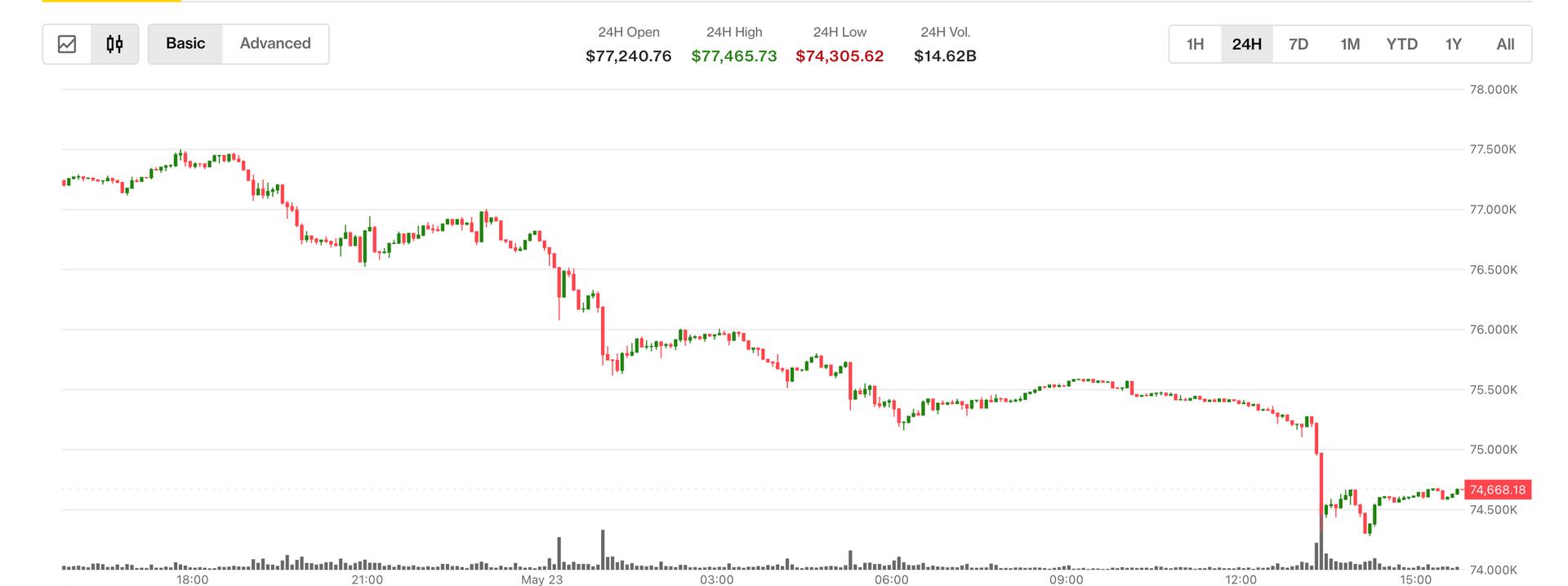
Bitcoin Plummets to $74,300 as Spot ETFs Face $2.26B Exodus
Bitcoin has dropped to $74,300 amid significant investor outflows from spot Bitcoin ETFs, which have bled $2.26 billion in capital over a two-week period. The decline reflects growing concerns about market consolidation and regulatory pressures affecting institutional crypto adoption through traditional investment vehicles.
Overview
Bitcoin has experienced a significant price correction, falling to $74,300 and triggering widespread concern across the cryptocurrency market. Compounding this bearish price action, spot Bitcoin exchange-traded funds (ETFs) have suffered substantial outflows, with investors withdrawing approximately $2.26 billion in just two weeks. This dual pressure—combining technical price weakness with institutional capital flight—represents a critical moment for the digital asset class and raises important questions about the sustainability of the spot ETF narrative that has dominated crypto discussions since their regulatory approval in 2024.
The convergence of these negative signals has rattled both retail and institutional investors who were banking on spot ETFs as a proven bridge to mainstream adoption. Rather than serving as a steady source of new capital flowing into Bitcoin, these products have instead become channels for rapid capital exit, suggesting that the initial enthusiasm surrounding spot Bitcoin ETFs may have been overstated or that broader market conditions have shifted unfavorably. The $2.26 billion outflow figure is particularly noteworthy given that it occurred over just a 14-day window, indicating that the pace of withdrawal has accelerated considerably compared to earlier patterns observed in 2024 and early 2025.
Market analysts and institutional observers have begun reassessing their frameworks for understanding Bitcoin price discovery and the role of ETFs in the ecosystem. The current situation underscores the complexity of cryptocurrency markets, where multiple factors—including macroeconomic conditions, regulatory developments, technical price dynamics, and shifts in institutional sentiment—all interact to create price movements that are often difficult to predict or explain in real time.
Background
The launch of spot Bitcoin ETFs represented a watershed moment for cryptocurrency adoption in traditional finance. In January 2024, following years of regulatory deliberation, the U.S. Securities and Exchange Commission (SEC) approved spot Bitcoin ETFs, a decision that was widely anticipated to unlock massive institutional capital inflows into the digital asset. Companies including Blackrock, Grayscale, Fidelity, and other traditional financial institutions rushed to launch or convert their offerings, creating a competitive landscape where institutional-grade Bitcoin exposure became readily available through mainstream brokerage accounts.
The initial response to spot Bitcoin ETF launches was extraordinarily positive. Billions of dollars flowed into these products during their first months of operation, and many market participants cited ETF inflows as a key driver of Bitcoin's rally from around $42,000 in late 2023 to the $64,000-$70,000 range by mid-2024. The narrative became increasingly common: spot ETFs were democratizing Bitcoin access, removing friction from the investment process, and channeling long-term capital from pension funds, endowments, and other institutional actors into the asset class.
However, the subsequent 12-18 months have revealed a more nuanced reality. While spot ETFs did attract significant capital, the inflows were not as sustained or monotonic as many optimists had predicted. Instead, these products have exhibited the same volatility and directional sensitivity as the underlying Bitcoin price, meaning that as Bitcoin experienced corrections or periods of weakness, ETF investors proved willing to exit their positions rapidly. This pattern suggests that spot ETFs, rather than creating a permanent or structural demand floor, instead simply amplified existing market cycles and investor sentiment shifts.
The broader context also matters significantly. By May 2026, Bitcoin had experienced a multi-month rally driven by expectations regarding central bank policy, the upcoming halving event (which occurred in April 2024), and general institutional enthusiasm. However, over the course of 2025 and into 2026, a more challenging macroeconomic environment emerged, with persistent inflation in some sectors, mixed signals from central banks regarding interest rate policy, and increasing regulatory scrutiny in major jurisdictions including the United States and European Union.
Key Developments
The $2.26 billion outflow from spot Bitcoin ETFs over two weeks represents the largest institutional-scale exit from the product category since their launch. Daily trading volumes in spot Bitcoin ETFs have increased substantially during this period, with reports indicating that some of the largest players—including hedge funds and some institutional investors who had positioned themselves heavily in Bitcoin through ETF vehicles—initiated sizable redemptions. The outflow data, tracked by Grayscale and other observers, shows a consistent pattern of redemptions rather than sporadic withdrawals, suggesting coordinated or at least synchronized investor behavior.
Simultaneously, Bitcoin's price action has been characterized by sharp intraday volatility and a breakdown of technical support levels that had previously held firm. The drop to $74,300 represents a decline of approximately 11-13% from Bitcoin's peak during the current cycle, and the speed of the move caught many leveraged traders off-guard. Options markets recorded elevated liquidation volumes, with Bitcoin futures trading on major exchanges like CME and derivatives-focused platforms experiencing substantial forced closures as price levels violated predetermined stop-loss levels.
One notable development has been the divergence in behavior between different categories of spot Bitcoin ETF investors. Grayscale's Bitcoin Mini Trust (BTC) and other products targeting retail investors have experienced less outflow pressure, while institutional-focused products have seen larger redemption requests. This pattern indicates that professional investors and institutional allocators are pulling capital, while retail investors may be holding positions or viewing the dip as an accumulation opportunity. This divergence is significant because institutional capital has historically been cited as the key mechanism through which spot ETFs would create structural demand for Bitcoin.
Regulatory news has also contributed to the negative sentiment. Reports of increased regulatory scrutiny regarding cryptocurrency market structure, including investigations into potential market manipulation and manipulation-adjacent behavior in Bitcoin derivatives markets, have weighed on investor sentiment. Additionally, discussions within regulatory agencies about potential new rules governing cryptocurrency custody and trading have added uncertainty to the outlook for institutional Bitcoin adoption through traditional vehicles.
Market Impact
The combined impact of the $2.26 billion ETF outflow and the 11-13% price decline has been substantial across the broader cryptocurrency ecosystem. Bitcoin dominance—the percentage of total cryptocurrency market capitalization held by Bitcoin—has declined slightly as traders have rotated capital into alternative cryptocurrencies or fiat positions. Ethereum, Solana, and other major altcoins have experienced outsized declines compared to Bitcoin in percentage terms, suggesting that the selling pressure has been broad-based rather than selective.
Crypto-exposed traditional finance instruments have also suffered. Companies with large Bitcoin holdings on their balance sheets, including certain microcap public companies and private investment vehicles, have seen their share prices decline in sympathy with Bitcoin's price weakness. Mining companies, particularly those with high leverage relative to their operating cash flows, have experienced significant drawdowns as the combination of lower Bitcoin prices and ongoing operational expenses creates pressure on mining economics.
The impact extends to cryptocurrency-focused financial services companies as well. Crypto lending platforms, decentralized finance (DeFi) protocols that feature Bitcoin-based collateral, and other infrastructure providers have experienced increased stress as collateral values decline and users reassess their exposure levels. Liquidation cascades in leveraged trading products have added to the volatility, creating a feedback loop where forced selling drives prices lower, which triggers additional liquidations.
Traditional finance observations have been mixed. Some equity analysts covering the crypto sector have cited the spot ETF outflows as evidence that the institutional adoption narrative was overblown, while others argue that the current situation represents a temporary pullback in a longer-term positive trend. The divergence of opinion reflects genuine uncertainty about whether current price weakness is a normal correction within an ongoing bull market or the beginning of a more significant bear phase.
On-chain metrics and blockchain data have provided some additional context. Transaction volumes on the Bitcoin network have remained relatively stable despite the price decline, suggesting that network utility has not deteriorated alongside the price move. However, certain indicators of long-term holder behavior suggest that some early adopters and long-term Bitcoin accumulation addresses have begun moving holdings, potentially indicating a shift in conviction among the most committed participants in the ecosystem.
Risks and Considerations
The current situation presents several overlapping risks that investors and market participants should carefully consider. First, the price level of $74,300, while not historically low, has broken through several technical support levels that many traders had identified as critical. If Bitcoin fails to stabilize above current levels and instead breaks below $70,000, additional cascading declines could occur as more stop-loss orders and leverage positions are triggered.
Second, the speed and magnitude of the spot ETF outflows raise questions about the underlying assumptions supporting the institutional adoption narrative. If significant institutional investors who positioned themselves in Bitcoin via spot ETFs are now exiting those positions, it suggests either a change in conviction regarding long-term Bitcoin value or a portfolio rebalancing driven by broader asset allocation decisions. Either interpretation carries implications for future demand: if institutional sentiment has shifted negatively, inflows may remain muted for an extended period; if the outflows are driven by mechanical rebalancing, they may stabilize once positions reach new target allocations.
Third, regulatory risk remains elevated. The current investigations into cryptocurrency market practices and the discussions about new rules could ultimately result in restrictions on institutional Bitcoin holdings, increased custody requirements that raise costs, or other changes that would reduce the incentive for institutions to maintain large Bitcoin positions. The regulatory landscape remains uncertain despite the passage of spot ETF approvals, and unexpected policy developments could trigger additional selling pressure.
A fourth important consideration relates to macroeconomic conditions. If broader economic weakness emerges—manifesting in recession, equity market stress, or financial instability—Bitcoin has historically served as a risk-on asset that sells off alongside equities rather than a diversifying hedge. If the current price weakness coincides with economic deterioration, downside risks could extend significantly beyond the current $74,300 level. Conversely, if economic conditions stabilize and growth concerns ease, Bitcoin could resume appreciating as investors rebuild risk appetite.
Finally, the concentration of outflows among institutional players raises the question of what happens if further institutional selling accelerates. Spot ETFs have fixed redemption mechanisms and daily liquidity, meaning that large institutional redemptions are technically feasible but could create operational stress if they materialize too rapidly. Additionally, if institutional selling continues, retail investors may become concerned about the perceived loss of mainstream endorsement and could exit their own positions, creating a vicious cycle of outflows and price weakness.
What to Watch
Market participants should focus on several key metrics and developments to assess whether the current weakness represents a temporary correction or the onset of a more significant bear market. First, ETF inflows and outflows should be monitored closely. If the $2.26 billion two-week outflow begins to stabilize or reverse, it would suggest that institutional capitulation has run its course and that a potential bottom may be forming. Conversely, if outflows continue to accelerate, it would indicate ongoing institutional asset rotation away from Bitcoin.
Second, Bitcoin's technical price action around critical support levels should be observed carefully. Key technical indicators including moving averages, relative strength index (RSI) readings, and volume-weighted average price (VWAP) levels will determine whether the current weakness is constructive or destructive. Stabilization at $70,000-$72,000 would suggest that buyers are defending certain price floors; a break below $70,000 would open the door to much lower levels including $60,000 and ultimately the $50,000 level from late 2023.
Third, the behavior of Bitcoin miners during the current weakness warrants attention. Miners are significant Bitcoin holders, and their willingness to continue mining operations despite lower Bitcoin prices affects the supply side of the market. Increased mining capitulation—evidenced by miner bankruptcies or significant reductions in hashrate—would suggest that the economics of Bitcoin production have deteriorated substantially. Conversely, stable or growing hashrate would indicate that miners retain conviction in longer-term Bitcoin value.
Fourth, regulatory developments deserve close monitoring. Any announcements regarding new cryptocurrency rules, enforcement actions against major crypto platforms, or policy developments from major central banks could rapidly shift investor sentiment. Particularly important would be any comments from the SEC regarding the spot ETF approval framework or potential future modifications to ETF regulations.
Fifth, traditional finance indicators including equity market performance, dollar strength, and real interest rates should be tracked. Bitcoin often performs best when real interest rates are declining, equity market confidence is weakening, and dollar weakness is occurring. The current macroeconomic configuration will determine whether Bitcoin's technical weakness is amplified by fundamental headwinds or whether it represents a mean-reversion opportunity in a continuing bull market.
Conclusion
Bitcoin's decline to $74,300 and the associated $2.26 billion in spot ETF outflows represent a significant inflection point for cryptocurrency markets and the institutional adoption narrative. While spot Bitcoin ETFs were hailed as a transformational development that would unlock permanent institutional demand for digital assets, the reality has proven more complex. These products have instead exhibited the same volatility and directional sensitivity as direct Bitcoin ownership, meaning that they amplify existing market cycles rather than smoothing them.
The current situation should serve as a reality check for market participants who have built their frameworks around the assumption that institutional adoption through spot ETFs would create structural, one-way demand for Bitcoin. Institutional investors, like retail investors, respond to changing market conditions, risk-reward assessments, and macroeconomic environments. When those factors shift negatively, institutions prove willing to exit even from professionally-managed, regulated ETF structures.
Moving forward, several scenarios are possible. A recovery to higher price levels would require stabilization in macroeconomic conditions, stabilization in ETF outflows, and a return of investor conviction regarding Bitcoin's long-term value proposition. Conversely, continued weakness could result in a repricing of Bitcoin lower, with spot ETFs potentially experiencing sustained outflows for an extended period. The outcome will depend on the interplay between technical factors, fundamental developments, regulatory changes, and the broader macroeconomic environment.
For investors holding Bitcoin or spot Bitcoin ETFs, the current period represents a significant test of conviction. Those who believe in Bitcoin's long-term utility and value proposition may view the current weakness as an opportunity to accumulate at lower prices. Conversely, those who have invested in Bitcoin primarily based on momentum or peer influence may be reassessing their positions. The divergence between these groups will help determine whether the current weakness is temporary or more structural in nature. Regardless of the ultimate direction, the episode underscores the reality that cryptocurrency markets remain volatile, sentiment-driven, and subject to the same forces of fear, greed, and uncertainty that characterize all financial markets.
Original Source
CoinDesk