XRP Price Collapses to $1.32 as Sellers Overwhelm Market Amid Exchange Outflows
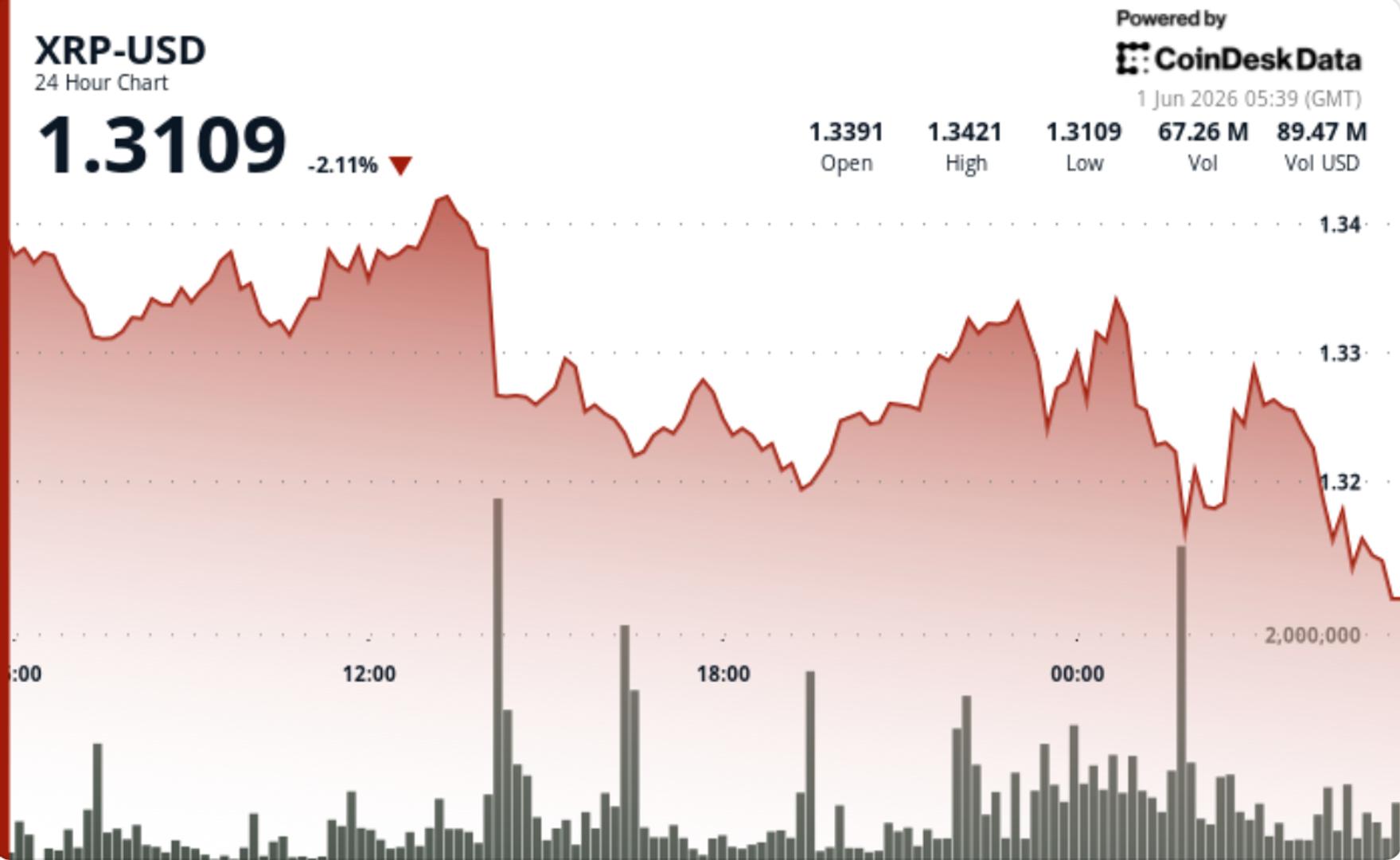
XRP has fallen to $1.32 as selling pressure dominates the market, with sellers overpowering previously anticipated relief from exchange outflows. The decline reflects broader market volatility and investor concerns about cryptocurrency valuations in the current economic environment.
Overview
Ripple's native cryptocurrency, XRP, has experienced a significant decline, trading down to $1.32 in what analysts characterize as a critical breakdown in buyer support. Despite expectations that exchange outflows would provide price relief—typically interpreted as a bullish signal when large quantities of tokens move off exchanges and into long-term storage—sellers have overwhelmed the market with sustained selling pressure. This disconnect between traditional on-chain metrics and actual price performance highlights the complexity of cryptocurrency trading dynamics and the limitations of single-indicator analysis. The move comes at a sensitive time for XRP, which has faced regulatory uncertainty and competitive pressures from other blockchain platforms seeking to capture market share in the cross-border payment space.
The $1.32 level represents a significant breakdown for XRP holders who had positioned themselves for an upside move. Multiple technical support levels have been breached in recent trading sessions, suggesting that algorithmic selling and margin liquidations may have compounded the initial selling pressure. Market observers note that the failure of exchange outflows to provide the expected bullish catalyst represents an important shift in market structure, potentially indicating that on-chain metrics alone are insufficient for predicting XRP price action without considering macroeconomic factors and investor sentiment.
This decline has rekindled debate among cryptocurrency analysts about the reliability of exchange flow analysis as a predictive tool. While the premise is sound—tokens leaving exchanges suggest holders are moving assets to cold storage rather than liquidating—the relationship between this metric and price performance has proven inconsistent, particularly during periods of broad-based selling in the cryptocurrency market. The XRP price action underscores how quickly sentiment can shift in cryptocurrency markets and how readily previously bullish indicators can be overridden by fundamental selling pressure.
Background
XRP's journey to becoming one of the top-10 cryptocurrencies by market capitalization has been characterized by significant volatility and regulatory challenges. Ripple, the company behind XRP, has positioned the token as a utility asset designed to facilitate fast, low-cost international payments through the XRP Ledger network. Unlike Bitcoin, which operates on a fully decentralized proof-of-work consensus mechanism, or Ethereum, which powers a broader ecosystem of decentralized applications, XRP's value proposition centers specifically on payment efficiency and adoption by financial institutions.
The regulatory environment has played an outsized role in XRP's recent price history. The U.S. Securities and Exchange Commission's (SEC) lawsuit against Ripple, alleging that XRP was sold as an unregistered security, created significant headwinds for the token from 2020 through 2023. While Ripple achieved a partial victory in the litigation, with a U.S. federal judge determining that secondary market sales of XRP should not have been subject to securities laws, the legal uncertainty has continued to weigh on institutional adoption and investor confidence. Many institutional investors remain cautious about accumulating significant XRP positions until the regulatory landscape becomes more clearly defined.
Competition in the cross-border payments space has intensified substantially in recent years. Central bank digital currencies (CBDCs) are under development by numerous countries, and established financial institutions have invested heavily in alternative blockchain solutions and traditional fintech platforms for international transfers. Ripple's partnerships with banks and payment providers have not expanded at the pace many bullish observers anticipated, raising questions about the actual utility adoption of XRP. Furthermore, newer blockchain platforms have emerged offering faster settlement times and lower fees, creating a crowded competitive landscape that has challenged XRP's core value proposition.
The broader cryptocurrency market has also experienced significant cycles of boom and bust that have affected all digital assets, including XRP. The collapse of major exchanges and lending platforms in 2022 and 2023 created systemic risk perceptions that have lingered in the market, despite industry efforts to improve transparency and risk management. Macroeconomic headwinds, including elevated interest rates and inflation concerns, have shifted investor preferences away from speculative assets and toward perceived safe-haven investments, creating challenging conditions for cryptocurrency valuations across the board.
Key Developments
The immediate catalyst for XRP's decline to $1.32 appears to be a failure of anticipated relief mechanisms to materialize. Exchange outflow data, which tracks the movement of XRP from centralized exchanges to self-custody addresses, had been accumulating in recent weeks. This metric had been closely watched by technical analysts as a potentially bullish signal, as sustained outflows typically indicate institutional or sophisticated retail investors moving tokens into secure storage, which theoretically reduces selling pressure as these tokens exit the exchange orderbook.
However, the expected price relief from these outflows failed to materialize, and sellers instead ramped up their activities, overwhelming any buying pressure that might have emerged. This divergence between on-chain metrics and price action represents a critical development because it suggests that the primary drivers of XRP price in this period are fundamental market conditions and sentiment rather than technical indicators or on-chain activity. The selling pressure appears to have accelerated around specific technical levels, suggesting that algorithmic trading and stop-loss cascades may have amplified the initial downward move.
Analysts have pointed to weakness in Bitcoin and Ethereum, the two largest cryptocurrencies by market capitalization, as contributing factors to XRP's decline. Altcoins—all cryptocurrencies other than Bitcoin—typically experience outsized downside moves during periods of broad-based weakness in the broader cryptocurrency market. Bitcoin's performance serves as the primary directional indicator for the entire sector, and weakness in BTC prices often triggers a rotation of capital away from smaller-market-cap assets and back toward perceived safety. XRP, despite its substantial market capitalization, is still considered a higher-beta asset that amplifies broad market movements in both directions.
Volume analysis suggests that the selling has been substantial and relatively uniform across time periods, indicating that this is not a flash-crash scenario driven by a single large order but rather a more sustained shift in market structure. The breakdown has extended across multiple timeframes, with key daily, weekly, and monthly technical support levels failing in succession. This multi-timeframe breakdown suggests that longer-term holders are reassessing their positions and reducing exposure, which may indicate a shift in the fundamental outlook for the cryptocurrency.
Market Impact
The decline in XRP prices directly affects multiple constituencies within the cryptocurrency and blockchain industries. Ripple Labs, the company that continues to develop the XRP Ledger and related products, benefits from increased adoption and utility of the XRP token. A declining price for XRP can impact the company's ability to recruit talent, as compensation packages that include equity and token-based incentives become less attractive relative to fiat compensation. Additionally, if Ripple continues to hold substantial XRP reserves as indicated in past disclosures, the declining valuation reduces the company's total assets and available resources for strategic initiatives and acquisitions.
Holders of XRP face direct impacts as their holdings depreciate in value. The decline to $1.32 represents a significant loss for investors who accumulated positions at higher prices, particularly those who entered during the 2021 bull market when XRP reached prices substantially above current levels. For long-term believers in Ripple's vision and XRP's potential utility, the declining price may represent a buying opportunity, or conversely, a sign that their thesis has been invalidated. The psychological impact of significant drawdowns cannot be overlooked; as losses mount, investor capitulation often accelerates, creating a feedback loop that extends selling pressure.
The broader implications for exchange outflow analysis are significant. If exchange outflows fail to provide price support, this metric becomes less useful for traders and investors attempting to time market entries. This could lead to a reduction in reliance on this particular on-chain metric and a rebalancing toward other indicators such as on-chain transaction volume, active address counts, and developer activity. The failure of this bullish signal may cause some analysts to recalibrate their models and expectations for how on-chain metrics correlate with price movements.
For the larger blockchain and cryptocurrency ecosystem, XRP's weakness contributes to negative sentiment and reduced optimism about digital asset valuations. If one of the top-10 cryptocurrencies cannot hold support despite what appeared to be bullish technical signals, this raises questions about the overall health of the market and whether other assets have also become overvalued or dependent on unsustainable momentum. Reduced confidence in XRP can also cascade into reduced confidence in other payment-focused cryptocurrencies and blockchain platforms attempting to compete in the cross-border transaction space.
Risks and Considerations
One of the primary risks facing XRP is the ongoing regulatory uncertainty surrounding cryptocurrency classification and enforcement. While Ripple achieved a favorable ruling in its SEC litigation, regulatory authorities worldwide continue to grapple with how to classify and regulate digital assets. The possibility of adverse regulatory developments in major markets could serve as an additional catalyst for selling pressure. Additionally, regulatory clarity in some regions may impose restrictions on XRP trading or holding, reducing the addressable market for the token and limiting its utility.
Technical risks are also substantial at current price levels. The breakdown through multiple support levels suggests that additional downside pressure may emerge if trading continues to be characterized by sustained selling. Key support levels below $1.32 represent important price discovery points; if these are breached, further cascading liquidations could occur, particularly if leveraged long positions have established stop-losses at nearby levels. The speed and magnitude of the decline suggest that some leveraged participants may have been forced to liquidate positions, and additional cascades cannot be ruled out without evidence of stabilization.
Fundamental risks to XRP's long-term value proposition remain significant. The pace of adoption by financial institutions has not met the levels that early proponents anticipated. Many major banks and payment processors have explored alternatives or developed in-house blockchain solutions rather than integrating with the Ripple network. The emergence of CBDCs from central banks could undermine XRP's utility proposition by offering government-backed digital currencies with inherent advantages in terms of trust, stability, and interoperability with existing financial infrastructure. Ripple would need to demonstrate compelling advantages over CBDC solutions to maintain relevance in the international payments landscape.
Market structure risks include the potential for further losses if broader cryptocurrency market weakness persists or deepens. If Bitcoin and Ethereum, which anchor the overall sentiment and capital flows in the cryptocurrency market, experience significant declines, the impact on XRP would likely be highly amplified. Additionally, the concentration of XRP holdings among early investors and Ripple insiders represents a potential risk; if significant holders begin to liquidate positions, this could exert sustained downward pressure on prices independent of fundamental factors.
What to Watch
Market participants should closely monitor Bitcoin and Ethereum prices, as these assets serve as leading indicators for altcoin performance. Any stabilization or recovery in the major cryptocurrencies could provide relief for XRP and create technical conditions for a bounce from current depressed levels. Conversely, further weakness in BTC and ETH would likely extend the decline in XRP and test additional support levels. The correlation between XRP and broader market movements will be critical for determining whether this decline represents an isolated weakness specific to XRP or part of a broader market correction.
On-chain metrics such as active addresses, transaction volume, and holder behavior should be monitored for signs of capitulation or institutional accumulation. If on-chain metrics show that selling pressure is dissipating and that new holders are accumulating at lower prices, this could signal that the decline is nearing completion. Conversely, if these metrics show continued deterioration and declining network activity, this would suggest that the fundamental outlook continues to weaken and that further downside is likely.
Regulatory announcements and legal developments related to Ripple and XRP should be closely followed. Any adverse regulatory developments in major markets or new litigation could serve as additional catalysts for further selling pressure. Positive regulatory clarity or new partnerships could provide relief and stability to the price. The ongoing dialogue between regulatory authorities and Ripple should be monitored for signals about the regulatory pathway forward for both the company and the token.
Technical resistance levels above $1.32 represent important price points to monitor. If XRP can stabilize and establish a trading range, this would suggest that the downside pressure is moderating. However, if the asset continues to break down through support levels with increasing volume, this would suggest a more severe shift in market structure that could extend the decline significantly. Volume patterns and the breadth of participation in both buying and selling should be analyzed to determine whether any attempted recoveries have sustainable conviction behind them.
Conclusion
XRP's decline to $1.32 represents a significant deterioration in market conditions and investor confidence in the token's short-term prospects. The failure of exchange outflows—a traditionally bullish signal—to provide price support indicates that broader market dynamics and sentiment are currently the dominant price drivers. The combination of selling pressure overpowering anticipated relief mechanisms, technical breakdowns across multiple timeframes, and broader cryptocurrency market weakness creates a challenging environment for XRP holders and believers in Ripple's vision.
While long-term believers in XRP's utility and Ripple's technology may view current prices as accumulation opportunities, the technical and sentiment indicators suggest caution is warranted. The price breakdown indicates that there may be additional downside risks before stability is established, and investors should carefully consider their risk tolerance and time horizons before adding to positions at current levels. The broader implications for on-chain metric reliability and cryptocurrency market structure deserve continued analysis by market participants and analysts seeking to improve their trading and investment frameworks.
The path forward for XRP will likely depend on broader cryptocurrency market conditions, regulatory developments, and progress by Ripple in securing meaningful institutional partnerships and adoption. Short-term technical recovery would require a stabilization of broader market conditions and evidence that selling pressure is genuinely diminishing. In the medium to longer term, XRP's value will ultimately be determined by the utility of the XRP Ledger network and the extent to which it captures meaningful transaction volume in the international payments market. Current market conditions are challenging, but they also present potential opportunities for patient investors willing to tolerate significant volatility while waiting for potential recovery catalysts to emerge.
Original Source
CoinDesk