Bitcoin Plunges Below $63K as Market Selloff Accelerates Through June
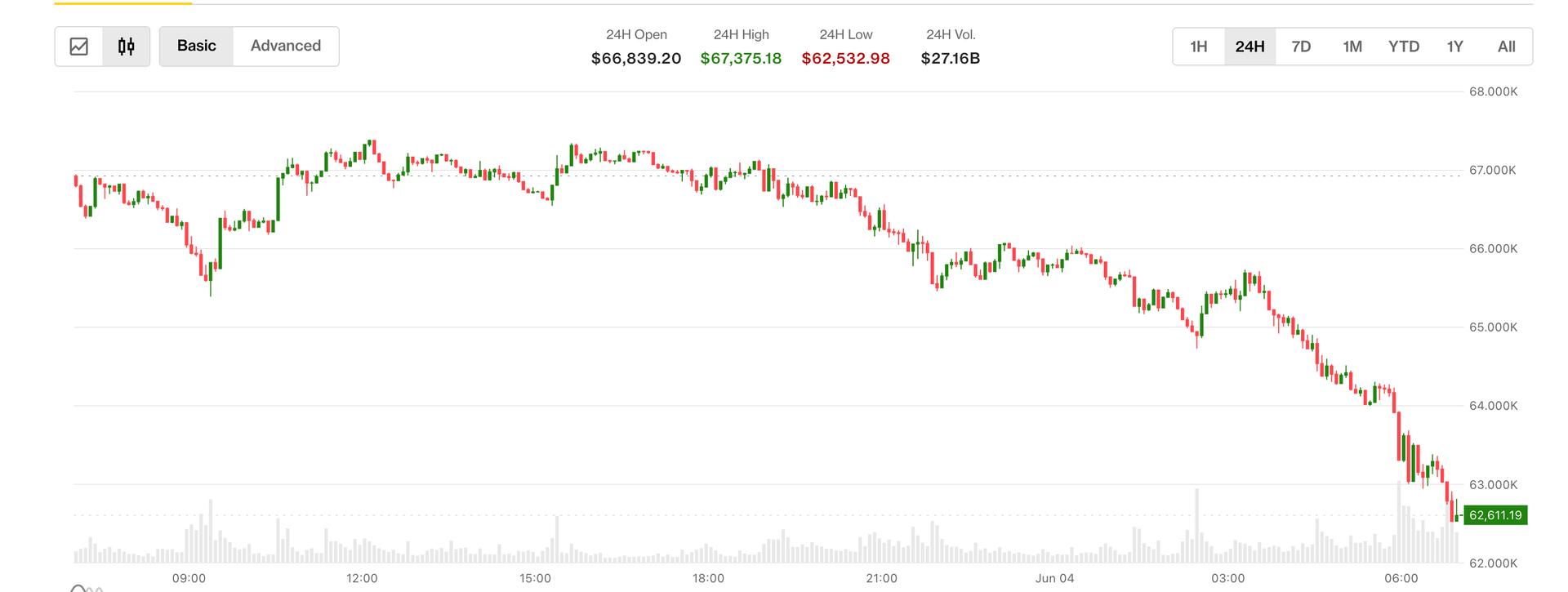
Bitcoin dropped below $63,000 for the first time since February, marking a significant deterioration in market sentiment. The steep decline reflects broader concerns about macroeconomic conditions and regulatory uncertainty. Analysts warn that further downside could test critical support levels as trading volumes surge.
Overview
Bitcoin has breached a critical psychological barrier, trading below $63,000 for the first time since February 2026 as the cryptocurrency market experiences an intensified selloff. This price movement represents a substantial pullback from the asset's recent trading ranges and signals a potential shift in investor sentiment that extends beyond the crypto sector. The decline has reverberated across digital asset markets, with alternative cryptocurrencies and blockchain-related equities following Bitcoin's downward trajectory with varying degrees of severity.
The significance of Bitcoin trading below $63,000 cannot be overstated, as this price level has served as a crucial support point throughout the spring trading season. The breach of this level represents a technical breakdown that many traders view as a harbinger of further weakness in the near term. Market participants who have been maintaining long positions at higher price levels are now facing substantial unrealized losses, potentially forcing liquidations that could accelerate the downward pressure on prices.
Analysts across the financial media landscape have been scrambling to interpret the meaning of this move, with opinions ranging from temporary volatility to a fundamental reassessment of Bitcoin's valuation. Some commentators point to the cyclical nature of cryptocurrency markets, while others suggest that macroeconomic headwinds have finally caught up with the digital asset class. What remains clear is that the $63,000 level has proven to be unable to withstand sustained selling pressure, marking a significant technical event for traders and investors monitoring Bitcoin's price action.
The timing of this decline—occurring in early June—presents an interesting case study in seasonal cryptocurrency market behavior. Historically, summer months have been associated with lower trading volumes and increased price volatility in digital asset markets. However, the current selloff appears driven by more fundamental concerns than typical seasonal patterns, suggesting that external factors are weighing heavily on investor decision-making processes.
Background
Bitcoin's journey to its current price level has been characterized by significant volatility and competing narratives about the asset's future role in global finance. Throughout 2025 and into early 2026, Bitcoin experienced a period of relative stabilization around the $65,000 to $72,000 range, which many in the cryptocurrency community viewed as a period of healthy consolidation following previous rallies. This consolidation phase provided a foundation of confidence among institutional and retail investors alike, with multiple narratives supporting continued appreciation.
The broader cryptocurrency market had been benefiting from increased institutional adoption, with several major financial institutions announcing expanded cryptocurrency trading desks and custody solutions. These developments were widely interpreted as validation of Bitcoin's legitimacy as an asset class worthy of allocation within traditional investment portfolios. Additionally, technological developments within the blockchain ecosystem, including scaling solutions and improved interoperability protocols, had generated optimism about the long-term utility and value potential of digital assets.
Regulatory developments throughout the early months of 2026 had been characterized by a mix of progress and uncertainty. While some jurisdictions moved toward clearer regulatory frameworks for cryptocurrency trading and custody, others maintained restrictive positions or introduced new restrictions that raised questions about Bitcoin's utility in certain markets. This regulatory uncertainty created a backdrop of caution among investors, even as positive technical signals and institutional adoption stories dominated market commentary.
The period immediately preceding the current selloff had seen Bitcoin testing resistance levels around $70,000 on multiple occasions without achieving a decisive breakout. This repeated failure to break higher created a scenario where short-term traders accumulated profit-taking positions, while longer-term investors began questioning whether the previous narrative of sustained upside momentum remained valid. The combination of technical resistance and the absence of new positive catalysts created vulnerability to sharper declines whenever selling pressure emerged.
Key Developments
The immediate catalyst for the current selloff appears to be a confluence of factors that emerged over the past two weeks of May and the first few days of June. Macroeconomic data releases pointing to persistent inflation in certain sectors sparked concerns about the trajectory of interest rates and central bank policy. These concerns translated directly into digital asset markets, as investors reconsidered the appeal of non-yielding assets in an environment where traditional fixed-income investments offered increasingly attractive returns.
Additionally, several major cryptocurrency exchange announcements regarding regulatory compliance and operational changes generated uncertainty about market structure and the accessibility of trading venues for certain investor categories. These announcements forced market participants to reassess their operational assumptions and in some cases led to asset reallocation decisions. The combination of macroeconomic concern and operational uncertainty created a perfect environment for accumulated profit-taking positions to be triggered, initiating the current downward spiral.
Technical factors have played a substantial role in accelerating the decline once the initial selling pressure emerged. As Bitcoin fell through the $67,000 level—a previously established support point—the momentum of the decline increased noticeably. Traders who had been holding stop-loss orders at various levels below resistance points were forced to execute sales, which intensified selling pressure and created the waterfall effect characteristic of technical breakdowns. The crossing of key moving averages on daily and weekly timeframes further reinforced the bearish technical picture.
On-chain data has provided additional insight into the dynamics of the current selloff. Exchange inflows have increased substantially, indicating that investors are moving Bitcoin from self-custody solutions to exchange wallets in preparation for potential sales. Long-term holder positions have been reduced, with some evidence of capitulation-style selling occurring among investors who had been accumulating Bitcoin at lower price levels in previous years. These behavioral indicators suggest that the selloff reflects more than temporary profit-taking among short-term traders.
International regulatory announcements have also contributed to the negative sentiment. Statements from financial regulators in major economies expressing concerns about cryptocurrency market concentration, leverage, and systemic risk have reminded market participants of ongoing regulatory risks. These reminders arrive at a moment of technical weakness, multiplying their impact on market psychology and investor positioning decisions.
Market Impact
The broader cryptocurrency market has experienced a sharp decline in aggregate valuation as Bitcoin has slumped, with the total cryptocurrency market capitalization falling by substantial amounts in just a few trading days. Alternative cryptocurrencies have experienced even steeper percentage declines than Bitcoin itself, indicating that Bitcoin's weakness is driving risk-off sentiment across the entire digital asset sector. Ethereum, the second-largest cryptocurrency by market capitalization, has fallen below important support levels as traders exit positions across the board.
Blockchain-related equities have also suffered in sympathy with cryptocurrency price declines, with publicly traded companies focused on Bitcoin mining, cryptocurrency trading, and blockchain infrastructure seeing sharp stock price declines. This connection between cryptocurrency prices and blockchain equity valuations demonstrates the interconnectedness of digital asset markets with traditional capital markets. Investors who sought exposure to cryptocurrency trends through equity holdings rather than direct cryptocurrency holdings have found their investment thesis under pressure.
Trading volumes have surged dramatically as the selloff has progressed, with both spot market volumes and derivatives market volumes reaching levels last seen during previous major market dislocations. Futures markets have seen liquidations of long positions, with open interest declining as leveraged traders have been forced to close positions at losses. The elevated volatility and volume create feedback loops that can amplify price movements and accelerate the pace of decline once selling momentum begins.
Stablecoin reserves on major exchanges have increased significantly, indicating that investors are raising cash to either wait for better entry points or prepare for additional withdrawals from the cryptocurrency sector entirely. The accumulation of stablecoin balances on trading platforms provides some measure of demand potential if prices decline sufficiently to attract contrarian buyers, but it also indicates that many participants view the current environment as unsuitable for holding volatile digital assets.
Peer-to-peer Bitcoin trading prices in certain jurisdictions have deviated from major exchange spot prices, indicating that some market participants face obstacles to accessing major trading venues or are willing to pay premiums or discounts to execute trades outside of regulated exchange frameworks. These price divergences, while typically temporary, indicate strains in market structure and potential challenges to the free flow of capital across different trading venues.
Risks and Considerations
The primary risk confronting Bitcoin and the broader cryptocurrency market is the potential for overshooting on the downside as technical and psychological factors reinforce each other. In volatile markets characterized by rapid drawdowns, price discovery mechanisms can become distorted as rational valuation considerations are overshadowed by forced selling and panic dynamics. The current selloff, while reflecting legitimate concerns, may have progressed beyond what macroeconomic fundamentals alone would suggest is warranted, creating additional downside risk as momentum-following algorithms and leveraged traders continue to execute sales.
A critical consideration is the behavior of institutional investors who have accumulated Bitcoin holdings throughout the past several years. If institutional holders view the current correction as temporary and maintain their positions, this could eventually provide price support. Conversely, if major institutional holders reassess their cryptocurrency allocation thesis and decide to reduce positions, additional selling pressure could emerge from holders of substantial Bitcoin quantities. The actions of a handful of major institutional holders could significantly influence the trajectory of prices in coming weeks.
Regulatory risks remain elevated and could potentially trigger additional selloffs if policymakers introduce surprise regulatory restrictions or enforcement actions against major cryptocurrency platforms. The regulatory environment for cryptocurrencies remains in flux across most major jurisdictions, creating an ongoing source of uncertainty that could be crystallized through unexpected policy announcements. This regulatory uncertainty represents a risk that cannot be fully hedged or diversified away by cryptocurrency market participants.
Macroeconomic risks also deserve careful consideration, as the relationship between cryptocurrency prices and broader economic conditions remains incompletely understood. If economic growth concerns intensify or recession risks become more prominent, risk assets generally—including Bitcoin—could face additional pressure. Conversely, if inflation concerns re-emerge and monetary policy takes a different direction than currently expected, this could eventually provide support for Bitcoin's value proposition as an inflation hedge and uncorrelated asset.
Liquidity risks are also relevant to consider, as the selling pressure encountered thus far has been manageable within the structural capacity of major cryptocurrency markets. However, if selling pressure accelerates further and liquidity deteriorates, prices could move more sharply downward over shorter timeframes. The cryptocurrency derivatives market, while providing tools for hedging and speculation, can also amplify volatility when leverage unwinds rapidly across multiple platforms simultaneously.
What to Watch
Market participants should closely monitor Bitcoin's behavior around the $60,000 level, which represents the next significant technical support point below the current price. If Bitcoin breaks below $60,000 decisively, this could trigger additional technical selling and potentially open the door to further declines toward the $55,000 level and beyond. Conversely, if buying pressure emerges around the $60,000 to $62,000 range and sustains a recovery above $65,000, this would indicate that the current selloff is being interpreted as a buying opportunity by institutional and sophisticated market participants.
On-chain metrics warrant continuous monitoring as well, particularly the behavior of long-term holders and the flow of Bitcoin to and from exchange wallets. If long-term holders remain passive during the selloff and refuse to sell despite losses, this would indicate confidence in Bitcoin's long-term trajectory. If large quantity transfers to exchanges continue and accelerate, this could signal additional selling pressure ahead. The ratio of long-term holder coins to short-term trader coins provides insight into the composition of current Bitcoin ownership and the potential for additional selling.
Macroeconomic data releases, particularly inflation reports and central bank communications, will continue to influence Bitcoin prices as the market interprets implications for future monetary policy. Additionally, any regulatory announcements or enforcement actions against major cryptocurrency platforms could trigger sharp repricing as risk premiums adjust upward. Market participants should maintain awareness of regulatory developments across major jurisdictions to assess the probability of surprise negative developments.
Derivatives market structure, particularly the behavior of futures markets and options positioning, deserves attention as indicators of trader sentiment and potential pressure points for liquidation-driven volatility. Large open interest in short-dated futures contracts concentrated around specific price levels could indicate vulnerability to sharp movements if price targets are reached. Similarly, options market positioning can reveal areas where concentrated interest might trigger additional volatility.
Cross-asset correlations should also be monitored carefully, as Bitcoin's relationship with stocks, commodities, and fixed-income markets continues to evolve. If Bitcoin begins trading more closely in sync with equity market weakness, this could indicate risk-off sentiment dominating capital flows across asset classes. Conversely, any decoupling of cryptocurrency from broader market weakness could suggest that cryptocurrency-specific factors are driving the current selloff rather than systematic risk-off positioning.
Conclusion
Bitcoin's descent below $63,000 marks a significant technical and psychological breakdown that carries important implications for cryptocurrency market participants and observers. The combination of macroeconomic concerns, regulatory uncertainty, and technical deterioration has created a challenging environment for digital assets. While temporary bounces and short-term recoveries are likely as short-term traders attempt to capitalize on oversold conditions, the underlying technical and sentiment backdrop argues for caution until clearer signals of stabilization emerge.
The current selloff should be understood within the context of cryptocurrency market cycles, which have historically been characterized by substantial drawdowns interspersed with rapid recoveries. The question that confronts investors is whether the current decline represents a healthy correction within a longer-term uptrend, a meaningful bear market that will test investor conviction, or the beginning of a more substantial revaluation of Bitcoin's fair value. The answer to this question will likely become clearer over the coming weeks as additional data points and news developments provide new information to market participants.
For long-term Bitcoin investors and proponents of blockchain technology, the current environment presents both challenges and opportunities. Investors who maintain conviction in Bitcoin's long-term utility and value proposition may view current prices as attractive accumulation points, particularly if they believe that the current selloff reflects temporary momentum dynamics rather than fundamental value destruction. Conversely, investors who have come to question Bitcoin's role in their portfolios or who are concerned about regulatory headwinds may view the current weakness as a helpful repricing that makes exit decisions easier to execute.
The coming period will be crucial in determining whether Bitcoin's current decline stabilizes at a higher level through renewed demand, or whether selling pressure continues to press lower as additional support levels are tested and overcome. The behavior of institutional holders, regulatory developments, and broader macroeconomic trends will all play important roles in determining the trajectory of Bitcoin prices over the next several weeks and months. Market participants are advised to carefully monitor these factors while maintaining appropriate risk management given the elevated volatility and uncertainty characteristic of the current environment.
Original Source
CoinDesk