Bitcoin Slips Below $63K Amid Geopolitical Tensions and Asian Market Turmoil
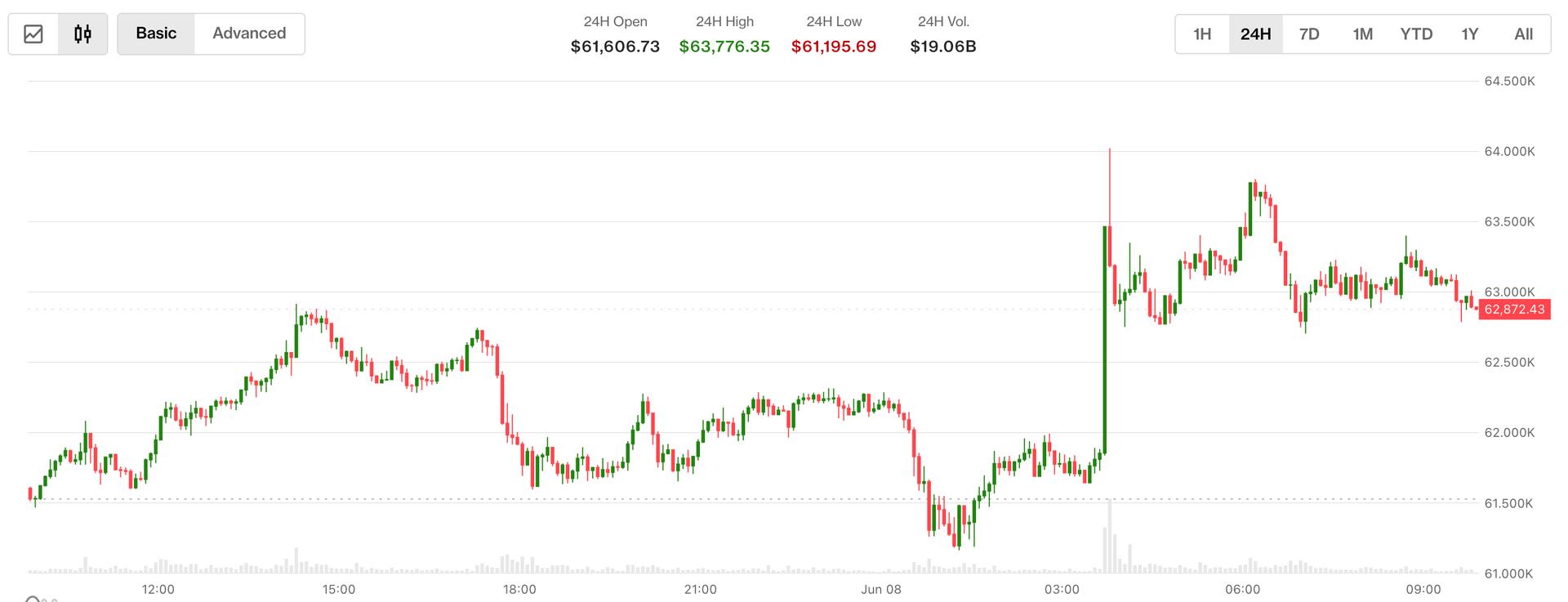
Bitcoin retreated below the $63,000 level as escalating Iran-Israel trade disputes and a significant Korean stock market decline weighed on risk assets globally. The selloff reflects broader investor anxiety about geopolitical stability and economic headwinds affecting major Asian economies.
Overview
Bitcoin's price action on June 8, 2026, painted a cautionary picture for cryptocurrency investors as the world's largest digital asset fell below the $63,000 threshold, marking a meaningful pullback from recent highs. The decline coincided with deteriorating conditions across global markets, particularly in Asia, where a sharp downturn in Korean equities signaled broader concern about economic resilience. The cryptocurrency market's sensitivity to macroeconomic shocks and geopolitical developments once again demonstrated the interconnected nature of modern financial systems, where digital assets no longer exist in isolation but respond dynamically to traditional market pressures.
The timing of Bitcoin's retreat is particularly noteworthy given the ongoing Iran-Israel trade tensions that have escalated throughout the week. These geopolitical flashpoints, while often localized in their immediate impact, reverberate through global supply chains and investor sentiment in ways that traditional finance analysts increasingly struggle to predict. The combination of heightened international tensions and weakness in a tech-heavy market like South Korea created a perfect storm for risk-off sentiment, pushing investors toward defensive positions and away from speculative assets like cryptocurrencies.
Market observers have noted that Bitcoin's correlation with equity markets, particularly in technology-heavy indices, has strengthened considerably over the past 18 months. This structural change has fundamental implications for cryptocurrency's role in portfolio construction and its utility as a purported hedge against traditional market downturns. As institutional adoption of Bitcoin has expanded, the asset class has increasingly traded in tandem with equities, particularly during periods of heightened volatility and risk aversion.
Background
The geopolitical backdrop to this week's market turmoil is rooted in escalating tensions between Iran and Israel that have moved beyond rhetoric into economic consequences. Recent trade disputes between the two nations, coupled with secondary sanctions affecting broader Middle Eastern commerce, have created uncertainty about energy prices and regional stability. Oil markets, which serve as a barometer for geopolitical risk, have reflected this uncertainty through elevated volatility, with prices testing new ranges amid conflicting signals about supply security and global demand.
The relationship between oil prices and cryptocurrency valuations has become increasingly complex in recent years. While some analysts argue that Bitcoin benefits from energy security concerns and inflation hedging narratives that emerge from geopolitical crises, the contemporary market data suggests a more nuanced relationship. During periods of acute risk aversion, investors tend to liquidate speculative positions across all asset classes, including cryptocurrencies, to raise cash and rotate into defensive havens like government bonds and precious metals. This dynamic has proven more powerful than any narrative about Bitcoin's value proposition during times of uncertainty.
South Korea's stock market decline represents another critical factor in the week's broader market movement. The Korean exchange, home to major technology companies and manufacturing exporters, has historically served as a leading indicator for global economic sentiment. A significant downturn in Seoul's primary indices signals investor concern about corporate earnings, international trade dynamics, and the health of key supply chains. Given South Korea's outsized importance in semiconductor manufacturing, display technologies, and electronics exports, any significant weakness there reverberates through global technology sector valuations and investor risk appetite.
The backdrop of a strengthening U.S. dollar has compounded pressures on cryptocurrency valuations. As the Federal Reserve has maintained its restrictive monetary policy stance throughout 2026, the dollar has appreciated against a basket of major currencies, making dollar-denominated assets like Bitcoin more expensive for non-U.S. investors. This currency headwind, combined with rising real interest rates that make non-yielding assets less attractive in a competitive yield environment, has created structural headwinds for cryptocurrencies.
Key Developments
The specific trigger for Bitcoin's break below $63,000 appears to have been a combination of technical factors and deteriorating sentiment rather than any single newsworthy event. Technical analysts noted that the $63,000 level had served as a psychological support point, and once it was breached in moderate volume, cascading selling emerged as stop-losses were triggered and trend-following algorithms adjusted positions. The breakdown occurred during Asian trading hours on June 8, with the initial weakness originating from Korean and other Asian exchanges before spreading to European and North American markets.
Onchain metrics provided mixed signals during this period. Bitcoin exchange inflows, which often precede sell-offs, had accelerated throughout the week, suggesting that large holders were moving coins to exchanges in preparation for potential liquidation. Conversely, long-term holder positioning remained relatively stable, indicating that the most conviction investors were not capitulating. This dichotomy suggested that weakness was driven primarily by intermediate-term traders and institutional investors managing risk rather than a capitulation event that might signal a market bottom.
Analysts at major cryptocurrency trading firms noted that implied volatility in bitcoin options markets had spiked higher, with put options (bearish bets) trading at elevated premiums relative to calls. This indicated that sophisticated market participants were pricing in potential for further downside, though the options skew had not reached the extreme levels typically associated with panic capitulation. The options market's messaging suggested concern but not desperation, implying that large holders and institutions were hedging exposure rather than fleeing in fear.
The impact of the Iranian sanctions and trade restrictions expanded beyond energy markets into broader investment flows. Several cryptocurrency funds and institutional investors with exposure to Middle Eastern counterparties faced increased operational complexity and compliance scrutiny as sanctions regulations tightened. This regulatory uncertainty added another layer of friction to cryptocurrency market participation, particularly for institutional actors bound by strict compliance frameworks.
Korean cryptocurrency exchanges reported heavy trading volumes throughout June 8, with the Korean won weakening against the U.S. dollar alongside the broader equity market decline. The weakness in the won created additional selling pressure as Korean investors faced mark-to-market losses on their cryptocurrency holdings denominated in dollar terms. Local exchanges reported elevated outflows as retail investors moved toward won-denominated holdings during periods of perceived currency weakness.
Market Impact
The cryptocurrency market capitalization declined by approximately $120-150 billion during the June 8 trading session, reflecting broad-based selling across all major digital assets. Bitcoin's decline represented roughly 40-45% of this overall destruction of value, while Ethereum and other major altcoins experienced steeper percentage declines, as typically occurs during risk-off environments. The pattern reflected the historical correlation structure where smaller-cap assets experience amplified volatility relative to Bitcoin during market stress.
Stablecoin transfer volumes surged higher as investors sought to lock in losses or prepare dry powder for potential accumulation at lower prices. The behavior of stablecoin markets has become an increasingly reliable indicator of investor sentiment and intention, with rising stablecoin balances on exchanges suggesting preparation for additional downside, while declining balances suggest emerging accumulation interest. The June 8 data clearly pointed toward the former dynamic, with investors raising cash reserves rather than deploying capital.
Institutional crypto-linked products experienced notable outflows as traditional investment managers reallocated portfolios in response to deteriorating market conditions. Bitcoin futures markets reported significant liquidations, particularly in leveraged long positions that had accumulated during the prior weeks' strength. The cascade of liquidations, while painful for leveraged traders, actually contributed to the overall market adjustment by clearing out weak hands and reducing speculative excess that had built up during the prior rally.
Correlation between Bitcoin and the S&P 500 equity index spiked higher to approximately 0.75-0.80, near the highest levels observed during the 2026 calendar year. This elevated correlation underscored the reality that Bitcoin had become increasingly responsive to macro factors and traditional market sentiment rather than idiosyncratic cryptocurrency narratives. The implication was clear: during periods of broad financial stress, Bitcoin traded as a risk asset rather than as a hedge or alternative to equities.
The trading volumes across major cryptocurrency exchanges remained robust despite—or perhaps because of—the declining prices. Bybit, Binance, Kraken, and other major platforms reported strong twenty-four-hour volumes exceeding $35-40 billion, well above typical daily levels. This high volume suggested that the selling was distributed across a broad base of market participants rather than concentrated among a small number of major holders, which would have been more concerning from a market structure perspective.
Risks and Considerations
The immediate risk facing cryptocurrency investors centered on whether the breakdown below $63,000 represented a temporary correction within a broader uptrend or the beginning of a more sustained bear market. Historical precedent offered limited clarity, as cryptocurrency markets had evolved significantly since prior major downturns. The current environment featured substantially greater institutional involvement, more sophisticated derivatives markets, and tighter correlation with traditional assets, all of which changed the dynamics of market capitulation and recovery.
The Iranian sanctions threat represents a tail risk that could trigger additional volatility. If trade restrictions expanded or military tensions escalated, oil prices could spike sharply, creating cascading effects through energy-dependent economies and broader financial system stress. While such extreme scenarios remain relatively low probability, the market's reaction to relatively modest developments suggested that investors were already pricing in meaningful risk of further geopolitical deterioration.
The Korean stock market's weakness could persist if it reflects genuine concerns about corporate earnings rather than a temporary shock. South Korean companies' exposure to Chinese export demand, which faces cyclical headwinds, and their dependence on stable semiconductor demand cycles meant that weakness in Seoul could presage broader Asian market stress. If Korean equities enter a sustained bear market, the correlation drag on risk assets like Bitcoin could prove substantial.
A critical technical risk involved whether lower support levels—particularly the $60,000 and $58,000 zones that have held psychological and technical significance—would be tested. If those support levels failed, the potential for panic selling increased materially. Conversely, accumulation interest at lower price levels would likely emerge if Bitcoin approached these historically significant zones, potentially creating a floor for the decline.
The U.S. dollar's continued strength poses a persistent headwind for cryptocurrencies throughout the intermediate term. If Federal Reserve policy remains restrictive and inflation continues moderating, the dollar could maintain elevated levels, creating unfavorable conditions for non-yielding assets. This structural backdrop could suppress rallies even as tactical overshoots occur.
What to Watch
Investors should closely monitor developments in Iran-Israel tensions over coming days and weeks, as any escalation could trigger additional risk-off positioning. Conversely, any diplomatic progress or de-escalation rhetoric would likely support relief rallies in equities and cryptocurrencies. The nexus between geopolitical risk and financial market volatility remained one of the most important dynamics to track in June 2026.
The trajectory of Korean and broader Asian equity markets deserves particular attention, as weakness in Seoul could presage declines in other export-dependent Asian economies. If the contagion spreads to Japanese, Singaporean, or Thai markets, the broader risk-off environment would intensify, creating additional headwinds for Bitcoin and other risk assets. Conversely, stabilization in Asian equities would likely relieve pressure on cryptocurrencies.
Onchain analytics will be crucial to interpreting whether current weakness represents distribution by long-term holders or capitulation by short-term traders. Rising exchange inflows coupled with sharply declining whale holdings could signal bottom formation, while rising exchange inflows alongside stable whale positioning would suggest further liquidation risk. The divergence between different participant groups offers critical intelligence about whether capitulation is complete or ongoing.
Technical analysis of key support zones—particularly $62,500, $61,000, and $60,000—should guide tactical decision-making. Bitcoin's ability to stabilize above these levels would suggest that demand was emerging, while decisive breaks below them would indicate that selling pressure remained dominant. Volume analysis alongside price action would help distinguish between capitulation selling and mere consolidation.
The behavior of institutional crypto products—including Bitcoin ETFs and cryptocurrency-linked notes—will reveal the extent to which institutional investors are adjusting their allocations. Substantial net outflows from these products during further weakness would signal institutional risk reduction, while stabilization of outflows would suggest that much of the institutional repositioning had already occurred.
Federal Reserve communications and U.S. economic data throughout June 2026 will remain critical variables affecting broader market conditions and the dollar's trajectory. Any signals of potential policy pivot toward easing would likely support risk assets, while further hawkish signals would reinforce the dollar strength and elevated real rates that pressured Bitcoin valuations.
Conclusion
Bitcoin's descent below $63,000 on June 8, 2026, reflected a convergence of macro headwinds, geopolitical stress, and Asian market weakness that created challenging conditions for risk assets broadly. The cryptocurrency market's demonstrated correlation with equities and sensitivity to global risk sentiment underscored that Bitcoin had evolved into a financial asset with characteristics more similar to growth equities than to a non-correlated hedge. This structural shift carried profound implications for how institutional investors should construct portfolios and how cryptocurrency advocates should frame the asset's value proposition.
The immediate outlook for Bitcoin appeared contested, with technical support zones offering potential stabilization points but with no guarantee that sellers would relent at these levels. The breadth and distribution of selling pressure suggested that multiple participant types were adjusting positions, which typically indicates that market-clearing mechanisms were functioning appropriately even if price action was painful for long-term holders. Whether the current weakness constitutes a healthy correction within a broader uptrend or the onset of a sustained bear market phase remained uncertain and dependent on developments in geopolitics, Asian economic data, and Fed policy signals.
Investors should maintain disciplined approaches focused on their long-term allocations and risk tolerance frameworks rather than attempting to time tactical moves based on week-to-week volatility. The intersection of cryptocurrency markets with macroeconomic conditions, geopolitical dynamics, and institutional portfolio construction had created new complexities that made forecasting short-term price movements increasingly difficult. For those with conviction in Bitcoin's long-term value proposition, periods of weakness offer opportunities for patient capital accumulation, while for those questioning that conviction, the current environment provides valuable data about how Bitcoin actually behaves during financial stress—increasingly as a correlated risk asset rather than as an insulating hedge.
Original Source
CoinDesk