AI Selloff Cascade Pushes Bitcoin Below $63K as Risk-Off Spreads
Bitcoin plummeted below $63,000 as a broad risk-off sentiment swept across markets, with the AI sector selloff spreading from equities into cryptocurrency. The decline reflects growing investor caution over inflated AI valuations and widening concerns about overextended positions across digital assets.
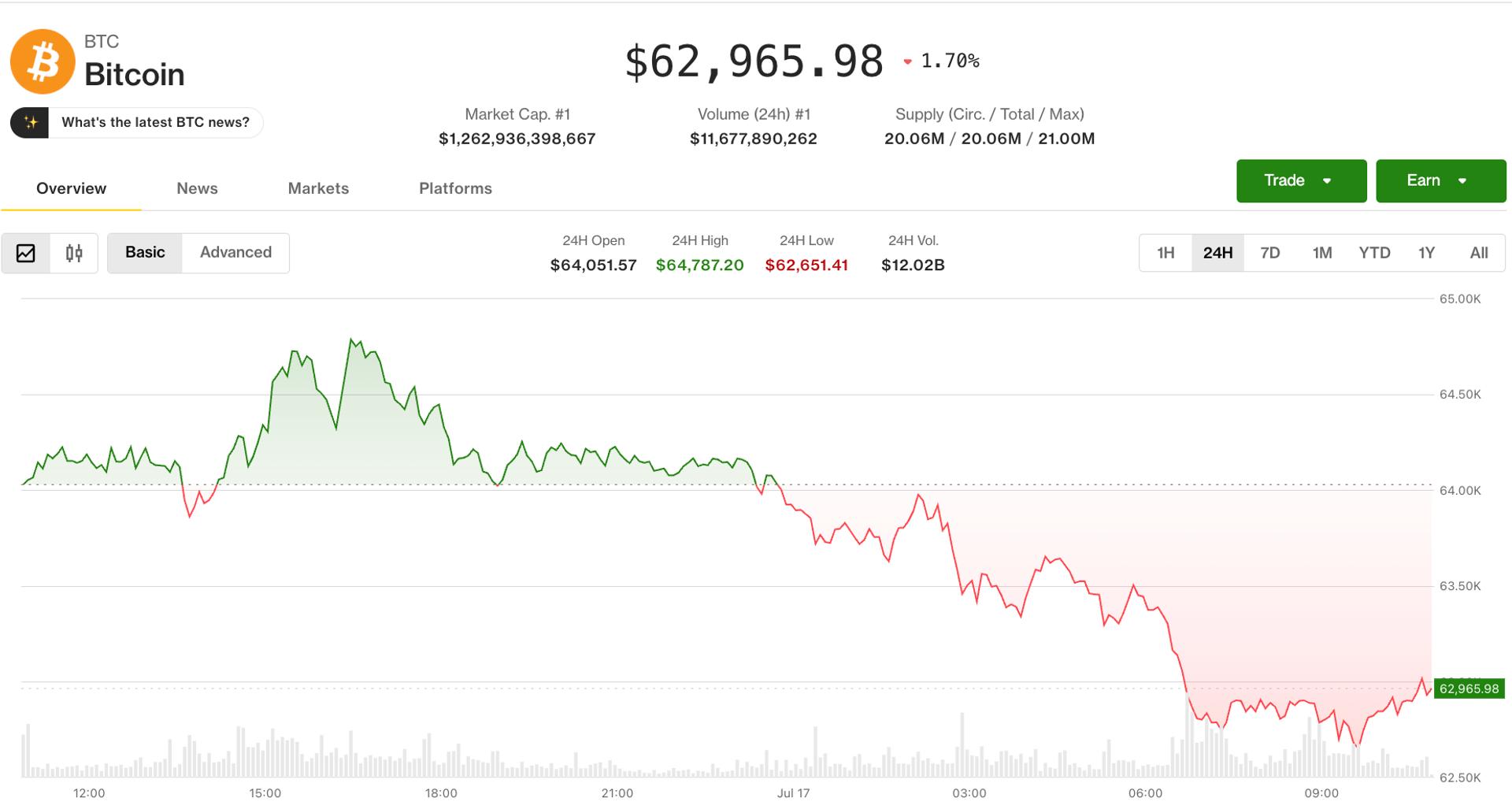
Overview
Bitcoin tumbled below the $63,000 mark on Thursday, July 17, 2026, marking a significant correction in cryptocurrency markets as a wave of risk-averse sentiment spread from technology stocks into digital assets. The decline represents the continuation of a broader market adjustment that began in traditional equity markets, where AI-focused stocks have faced substantial profit-taking after months of aggressive gains. This latest pullback underscores the increasingly interconnected nature of cryptocurrency and traditional financial markets, demonstrating how sentiment shifts in one asset class can rapidly cascade into others.
The sell-off comes amid a period of elevated volatility in tech equities, where several mega-cap AI companies have seen their valuations compressed following disappointing earnings forecasts and concerns about the sustainability of artificial intelligence adoption rates. As institutional capital retreats from high-growth technology plays, spillover effects have become apparent in digital assets, which had benefited from the same risk-on sentiment driving tech stocks to record highs. Analysts point to this cross-asset correlation as evidence that cryptocurrency markets are no longer isolated from traditional financial system dynamics, a shift that carries implications for portfolio construction and risk management.
The movement through the $63,000 level, previously viewed by many technical analysts as a critical support zone, has triggered algorithmic selling and liquidations across leveraged positions. This technical breakdown has compounded the fundamental concerns driving the sell-off, creating a feedback loop where price weakness induces further selling. Market observers note that the current environment mirrors previous episodes of risk-off sentiment, but with notably different characteristics given the maturation of cryptocurrency infrastructure and the presence of significant institutional holdings.
Background
The genesis of the current market correction traces back to revelations about artificial intelligence sector valuations and profitability timelines. Over the past eighteen months, artificial intelligence stocks had experienced unprecedented appreciation, driven by investor enthusiasm about the transformative potential of large language models and generative AI applications. Companies in the AI ecosystem—from chip manufacturers to software providers to specialized AI infrastructure firms—commanded premium valuations based on expectations of explosive near-term revenue growth and market share expansion.
However, the narrative began shifting in late June 2026 when several major technology companies released guidance suggesting that AI monetization would take longer than previously anticipated. Enterprise adoption rates, while growing, proved more gradual than the market had priced in. Additionally, concerns emerged about the escalating capital expenditure requirements for AI model training and deployment, which threatened to compress margins even as revenues grew. These revelations triggered a reassessment of AI sector valuations across both public and private markets.
Cryptocurrency markets, which had cooled somewhat after Bitcoin's advance to $72,000 in May 2026, had nonetheless benefited from the risk-on environment and elevated technology sector sentiment. Bitcoin and Ethereum became perceived as beneficiaries of AI adoption through their potential roles in decentralized infrastructure and blockchain-based AI applications. Additionally, the yield environment in traditional assets had deteriorated, prompting some capital to seek returns in higher-risk, higher-volatility asset classes including cryptocurrencies. This dynamic created a structural connection between AI equity sentiment and crypto price action.
The macro backdrop also played a significant role in setting the stage for the current correction. Central banks globally had held interest rates at elevated levels to combat residual inflation, creating a challenging environment for duration-heavy assets and growth stocks. Inflation readings in the second quarter of 2026 showed less progress than policymakers had hoped, pushing back expectations for rate cuts into the final quarter of 2026. This monetary backdrop made the aggressive valuations in technology stocks increasingly difficult to justify, and as reality checks emerged, the unwinding accelerated.
Key Developments
The immediate catalyst for this week's decline came on Tuesday, July 15, when a major index of AI-focused stocks declined 8.2% in a single session following disappointing earnings from a tier-one semiconductor company. The company, which supplies the vast majority of advanced processors used in AI model training, cited softening demand from enterprise customers and extended sales cycles. The earnings miss sparked concerns that the AI buildout cycle—long viewed as a multi-year tailwind—might be moderating faster than consensus expectations.
This sell-off in traditional markets created immediate ripples in cryptocurrency trading. Bitcoin, which had been trading in the $68,000-$70,000 range, declined 2.3% in the hours following the earnings announcement and related market volatility. Ethereum followed a similar pattern, dropping to $3,100 from prior levels near $3,350. The correlation between tech stock declines and cryptocurrency weakness became increasingly pronounced as the week progressed, with Bitcoin and Nasdaq-100 futures showing a rolling correlation approaching 0.75—significantly higher than the historical average of 0.35.
On Wednesday, July 16, the risk-off sentiment intensified as major cryptocurrency exchanges reported substantial outflows. Data from on-chain analysis firms indicated that approximately $2.8 billion in Bitcoin was transferred to exchange wallets, a sign often associated with preparation for sales. Spot exchange volumes remained elevated at $34 billion in daily trading, well above the recent average of $24 billion, suggesting panic-driven liquidations alongside methodical position unwinding. The funding rates on Bitcoin futures turned decidedly negative, indicating that traders holding short positions were capturing significant premiums from those holding longs—a configuration that typically precedes further downside.
By Thursday morning, July 17, a coordinated wave of selling emerged across all major cryptocurrencies. Bitcoin broke through the $65,000 level around 7:30 AM UTC, accelerating losses as stop-loss orders were triggered. The digital asset briefly traded at $62,850 before recovering slightly to $62,920, representing a 7.1% loss in less than 24 hours. The speed of the decline caught many market participants off-guard, with several leveraged position holders facing forced liquidations that further accelerated the decline. Liquidation cascades across major derivatives platforms exceeded $340 million in the first eight hours of trading on Thursday, compounding selling pressure.
Market Impact
The broader cryptocurrency market cap declined by approximately $310 billion during the three-day decline, falling from $2.84 trillion to $2.53 trillion. This retracement erased roughly three weeks of gains and returned market capitalization to levels last seen in late June 2026. The impact was not uniformly distributed; altcoins focused on AI applications experienced disproportionate declines, with AI-focused tokens declining 12-18% on average compared to Bitcoin's 7.1% drop. This pattern reflects the elevated sensitivity of speculative positions to shifts in AI sector sentiment.
The correlation between cryptocurrency and technology equity markets reached levels last observed during the 2020 pandemic-driven shock, suggesting that cryptocurrencies are increasingly responding to macro sentiment rather than idiosyncratic factors. This dynamic challenges the traditional narrative that digital assets serve as uncorrelated diversifiers within multi-asset portfolios. Instead, the current environment demonstrates that in risk-off scenarios driven by fundamental concerns about asset class valuations, cryptocurrencies respond with even greater magnitude than their equity counterparts due to their higher leverage and greater concentration of speculative positioning.
Institutional cryptocurrency funds and hedge funds face significant mark-to-market losses, with estimates suggesting losses exceeding $8 billion for funds focused on digital assets. Several funds specializing in crypto strategies reported single-day declines exceeding 3% of assets under management, levels that trigger redemption concerns and potential forced liquidations. One notable crypto-focused hedge fund, previously valued at $850 million, announced they would suspend new subscriptions and implement a capital recall to manage redemptions—suggesting that client confidence has been shaken by the rapid decline.
Traditional finance institutions with cryptocurrency exposure also face headwinds. Several banks that had recently received regulatory approval to offer cryptocurrency prime brokerage services experienced significant trading volume declines as hedge funds and sophisticated investors retreated from positions. Crypto lending platforms, which had experienced robust growth throughout 2025 and early 2026, reported meaningful deposit outflows as investors retreated to custody solutions. One major platform reported outflows of $340 million in Bitcoin and Ethereum deposits during the single day of Wednesday, July 16—the largest single-day outflow since the platform launched.
Risks and Considerations
The current market environment presents several material risks that investors must carefully evaluate. First, the correlation dynamics between crypto and equity markets create the potential for cascading losses if the AI sector correction deepens further. Consensus expectations for peak AI-related capital expenditure are in 2027-2028, suggesting that disappointments could continue to emerge over coming quarters as investment efficiency in AI infrastructure becomes a focal point. A scenario in which AI sector earnings disappoint for multiple consecutive quarters would likely trigger additional crypto selling as investors reassess the narrative linking blockchain technology to AI adoption.
Second, the leverage embedded in cryptocurrency markets amplifies both upside and downside moves. Futures market positioning data indicates that long leverage in Bitcoin futures markets remains elevated at 3.2:1, suggesting that significant capacity for forced liquidations still exists if prices move substantially lower. A breakdown through $60,000 would likely trigger additional algorithmic selling and cascade additional liquidations, potentially creating a self-reinforcing decline dynamic that could push prices toward $55,000-$58,000 support levels. The speed of such a move would create significant challenges for retail investors seeking to exit positions.
Third, regulatory developments could compound the current weakness. The U.S. Securities and Exchange Commission has pending rule-makings on spot Bitcoin and Ethereum exchange-traded funds, with decisions expected in August 2026. A delay in approvals or more restrictive guidance could trigger additional selling, as would any aggressive regulatory posture by international financial regulators responding to the current volatility. Several jurisdictions have indicated interest in implementing stricter position-limit rules for cryptocurrency derivatives, which could further compress trading volumes and deepen liquidity constraints.
Fourth, the concentration of Bitcoin and Ethereum ownership among relatively few large holders creates systemic risks in scenarios where margin calls or forced rebalancing occur. On-chain data indicates that addresses holding more than 1,000 Bitcoin increased selling pressure during the recent decline, suggesting that large holders are taking losses rather than "buying the dip." If this pattern continues, it could indicate a shift in sentiment among sophisticated market participants that would have implications for near-term price support levels. A wholesale shift by large holders from accumulation to distribution posture could represent a significant structural headwind.
Fifth, stablecoin supply and demand dynamics bear close monitoring. During the recent decline, USDC and USDT volumes surged, with stablecoin holdings on exchanges reaching their highest levels in five months. This pattern typically reflects defensive positioning as market participants move out of volatile assets into stablecoins, often in anticipation of further downside. However, the sustained elevation of stablecoin balances could also reflect dried-up trading confidence; large uninvested stablecoin balances only support prices if holders are willing to deploy capital opportunistically, which current sentiment suggests is uncertain.
What to Watch
Market participants should closely monitor several key indicators over the coming days and weeks. First, the $60,000 level in Bitcoin represents a critical technical support point; a breach of this level with high volume would likely signal an extension of the current downtrend toward $55,000-$58,000. Conversely, stabilization and recovery back above $65,000 on high volume would suggest that institutional buyers are viewing the current dip as an opportunity, potentially leading to a rebound toward the $68,000-$70,000 range.
Second, equity market developments, particularly the technology sector, warrant close attention. If the AI sector stabilizes and the Nasdaq-100 finds a floor, cryptocurrency weakness may similarly stabilize. Conversely, additional disappointments from technology companies or deterioration in semiconductor sector guidance could trigger additional crypto selling. Investors should monitor technology sector earnings reports and forward guidance through late July and August with particular attention to commentary on AI-related capital expenditure plans.
Third, Federal Reserve communications and economic data should be tracked carefully. Markets are currently pricing in an approximately 65% probability of a rate cut in September 2026, with additional cuts potentially coming in Q4 2026. If economic data suggests rate cuts may be delayed, further upward pressure on real interest rates could drag on risk assets broadly, including cryptocurrencies. Conversely, evidence of slower economic growth could accelerate rate-cut expectations and potentially lift crypto valuations.
Fourth, cryptocurrency exchange flows and derivatives positioning deserve continued monitoring through on-chain analysis platforms. Large inflows to exchanges typically precede further selling, while outflows and movement to cold storage would suggest accumulation rather than distribution. Funding rates in Bitcoin futures have turned sharply negative, compressing potential rewards for holding long positions; if these remain negative for extended periods, short-term speculative positioning will likely continue to unwind.
Fifth, regulatory announcements, particularly from the SEC regarding spot Bitcoin and Ethereum ETF approvals, could catalyze sharp moves in either direction. Approval of additional ETF applications would likely support prices by increasing accessibility for institutional investors, while delays or rejections could trigger additional weakness. Industry participants should monitor SEC communications and calendar deadlines through August 2026.
Conclusion
The recent decline in Bitcoin below $63,000 represents far more than a simple technical correction; it reflects a meaningful reassessment of cryptocurrency valuations against the backdrop of a significant shift in technology sector sentiment. The spillover of AI sector concerns from equity markets into digital assets demonstrates the increasing interconnection between cryptocurrency markets and traditional finance, challenging the narrative that digital assets serve as truly uncorrelated diversifiers.
The current environment presents both risks and potential opportunities. For investors with long-term convictions, the recent weakness has reduced valuations across crypto assets and created more attractive entry points than existed when Bitcoin traded above $70,000. However, near-term price weakness could persist if the AI sector faces additional headwinds or if broader macroeconomic concerns drive further risk-off sentiment across all asset classes.
The path forward depends critically on developments in several domains: the sustainability of the AI investment thesis, macro monetary policy developments, regulatory progress on institutional crypto infrastructure, and the performance of leveraged positioning within cryptocurrency derivatives markets. The velocity of recent moves—Bitcoin's 7.1% decline in less than 24 hours—underscores the high leverage and sensitivity to sentiment shifts that characterize modern cryptocurrency markets.
Market participants would be wise to treat the current correction as a reminder that cryptocurrency valuations remain sensitive to both idiosyncratic factors and broader financial system dynamics. The days when crypto could move independently of macro sentiment have clearly passed; investors must now account for correlations with equity markets and sensitivity to interest rate expectations in their portfolio construction and risk management processes. Whether the recent dip represents a near-term tactical opportunity or the beginning of a more significant correction will depend on forthcoming developments in AI sector earnings, monetary policy, and the evolution of positioning within leveraged derivatives markets.
Original Source
CoinDesk