Bitcoin Surges Past $65K as Geopolitical Tensions Ease, Oil Plummets
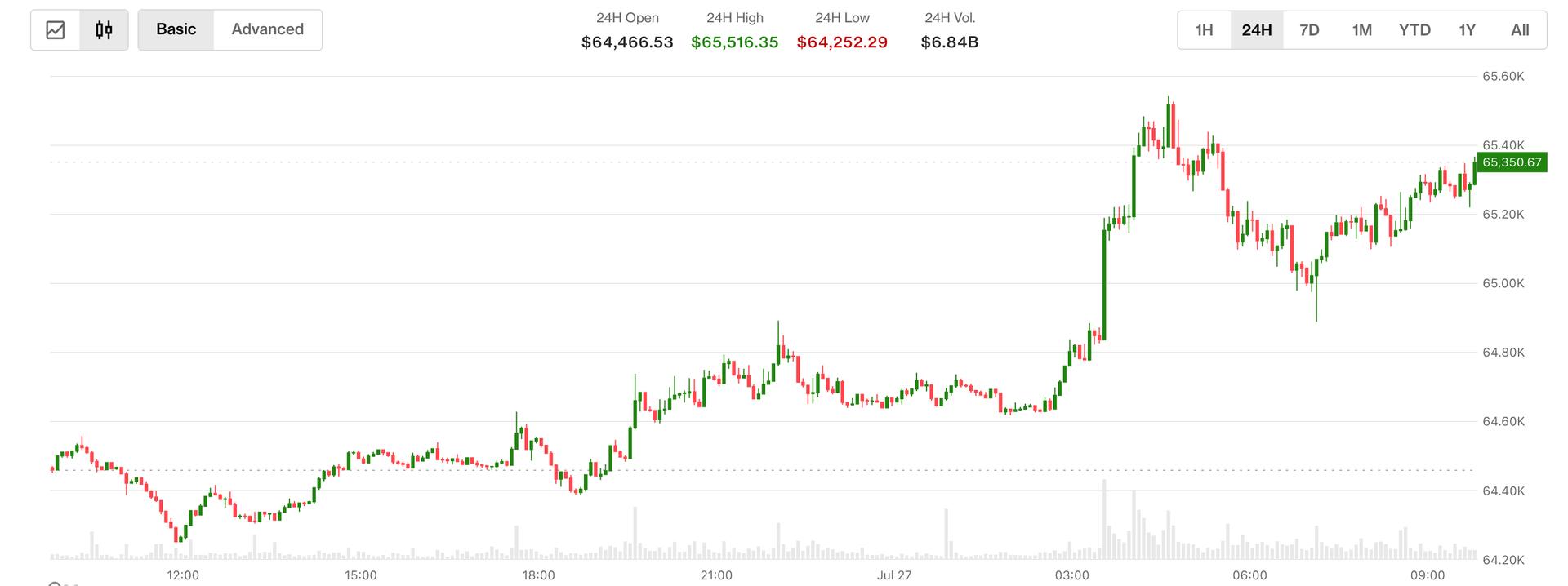
Bitcoin has rallied above $65,000 following de-escalation signals between the U.S. and Iran, alongside a sharp 5% drop in crude oil prices. The simultaneous decline in energy costs and recovery in risk assets suggests growing confidence in a potential resolution to Middle Eastern tensions, marking a significant shift in macro sentiment.
Overview
Bitcoin has reclaimed ground above the $65,000 threshold on July 27, 2026, in what analysts describe as a risk-on reversal driven by de-escalation signals between the United States and Iran. The cryptocurrency's rebound coincides with a notable 5% decline in crude oil prices, reflecting broader market relief over reduced geopolitical risk premiums. This dual dynamic—Bitcoin's recovery paired with falling energy costs—represents a meaningful reset in market psychology, moving away from conflict hedging and toward risk appetite restoration. The move suggests investors are recalibrating expectations around Middle Eastern stability, a sentiment that typically translates into reduced volatility across multiple asset classes.
The timing of this rally highlights crypto's evolving role as a barometer for geopolitical risk and macroeconomic sentiment. Where Bitcoin once traded primarily on technical factors and retail demand, it increasingly serves as a leading indicator of institutional expectations regarding geopolitical outcomes and monetary policy. The convergence of Bitcoin's rise with declining oil futures underscores how cryptocurrency and traditional commodity markets are becoming more integrated in the eyes of macro-focused investors. Understanding the drivers behind this move requires examining both the immediate political catalysts and the deeper structural shifts reshaping how crypto responds to global events.
Background
Geopolitical tensions between the United States and Iran have represented a persistent source of market volatility throughout 2026, with periodic flareups sending shockwaves through commodity markets and creating defensive postures among equity and cryptocurrency investors. The region's significance to global oil supply chains ensures that even the threat of escalation translates into material economic impacts. Historically, market participants have treated Middle Eastern tensions as a core risk factor, with crude oil serving as the primary transmission mechanism to broader financial conditions. When tensions rise, oil premiums expand, inflation expectations tick higher, and riskier assets—including cryptocurrencies—often face selling pressure as investors rotate toward defensive positions.
However, the relationship between geopolitical risk and cryptocurrency valuations has evolved substantially. Early in this decade, Bitcoin was primarily viewed through a monetary policy and inflation lens, with geopolitical factors playing a secondary role. The 2022-2024 period saw growing institutional adoption of Bitcoin as a macro hedge, alongside its continued function as a speculative vehicle. By 2026, a more nuanced understanding has emerged: Bitcoin benefits from de-escalation scenarios that reduce tail risks and restore risk appetite, making it attractive to momentum-driven investors and hedge funds rebalancing away from defensive positions. This marks a departure from earlier assumptions that geopolitical instability would necessarily drive Bitcoin higher.
The current cycle has also been shaped by shifts in oil market fundamentals, including slowing demand growth in developed economies, accelerating energy transition investments, and discussions around production discipline from major exporters. These structural headwinds have limited oil's upside in recent months, even when geopolitical risks spiked. Today's 5% drop in crude thus reflects not only reduced geopolitical premiums but also underlying demand and supply dynamics that continue to weigh on energy prices. This creates an unusual environment where both oil and Bitcoin can move together in a relief rally, rather than trading as traditional hedges against each other.
Key Developments
The immediate catalyst for today's market moves appears to center on diplomatic signals suggesting both the United States and Iran are stepping back from further military escalation. While specific statements remain limited in the public record, asset price action and reporting suggest both sides have signaled willingness to engage in de-escalatory diplomacy rather than pursue additional provocative actions. For cryptocurrency markets, this represents a critical inflection point: the removal of a tail-risk scenario that could have justified further defensive positioning. Traders and algorithms had priced in a material probability of further incidents in recent weeks; the shifting tone has triggered a rapid repricing across risk assets.
Bitcoin's move above $65,000 reflects a combination of factors amplifying the immediate relief rally. Short covering has likely played a role, with traders who positioned defensively ahead of further geopolitical shocks now forced to buy back positions at higher prices. Technical factors also contributed, as Bitcoin has faced resistance around $63,000-$64,500 in recent trading; breaking above $65,000 triggered momentum buying from technical traders and algorithms tuned to follow breakout patterns. Macro rotation flows from bond funds and hedge funds reducing defensive positioning have added further bid to risk assets, including Bitcoin.
The simultaneous 5% drop in crude oil reflects both the reduction in geopolitical premiums and the reality that oil markets had become increasingly detached from fundamental supply-demand dynamics. Market participants have been grappling with persistent questions about demand growth in developed economies, with some forecasters lowering consumption expectations for 2026-2027. The relief rally thus allows crude prices to reset toward levels more closely aligned with these fundamental considerations, unencumbered by the fear premium that had accumulated. This creates an interesting dynamic where falling oil actually reflects improved market sentiment rather than economic weakness.
Another contributing factor to Bitcoin's rebound is the interaction with bond markets and expectations around central bank monetary policy. If geopolitical risks recede, there is less justification for defensive central bank action, which could include interest rate cuts designed to stabilize financial conditions. This removes one traditional catalyst for Bitcoin appreciation. However, in the near term, the immediate relief from tail risks has proven a stronger driver, as investors broadly prefer to reduce hedges when catastrophic scenarios appear to have been averted. The momentum from this repricing may persist in the near term, potentially extending Bitcoin's gains above $65,000.
Market Impact
The implications of this rally extend well beyond Bitcoin and into the broader cryptocurrency market, traditional finance, and macroeconomic expectations. Altcoins have historically demonstrated higher sensitivity to macro risk-on conditions than Bitcoin, suggesting we could see notable outperformance in Ethereum, Solana, and other major protocols if this move represents a sustained shift in sentiment. Relative value trades between Bitcoin and altcoins may also be recalibrating, as investors re-risk portfolios that had become too defensive. Decentralized finance (DeFi) platforms, which function best in lower-volatility environments, may also benefit from a period of sustained risk appetite.
In traditional markets, the relief in geopolitical tensions has broader consequences. Equity markets, particularly defensive sectors and dividend-yielding stocks, could face rotation pressure as investors move away from safe havens. Small-cap and emerging market equities, which had lagged during periods of geopolitical uncertainty, may attract renewed interest. Currency markets could also see repositioning, with risk currencies strengthening against traditional hedges like the Swiss franc and Japanese yen. Energy sector equities face a more complex calculus: while lower oil prices reduce input costs for downstream industries, integrated energy companies see margin compression, creating a mixed bag.
For monetary policy, the implications are more subtle. Central banks have been sensitive to tail risks this year, and a material reduction in geopolitical uncertainty may reduce the urgency for defensive policy moves. This could reinforce recent expectations that further rate cuts may be delayed or prove more limited in scope than market participants had been pricing. However, this dynamic cuts both ways: if the geopolitical relief leads to a broader risk-on move and inflation expectations tick higher, the case for maintaining higher rates becomes stronger. The outcome will depend substantially on how persistent today's sentiment shift proves to be.
Volatility indexes, both in traditional markets (the VIX) and in cryptocurrency (the CVIX), have likely moved lower on today's relief. This has important implications for options pricing and hedging strategies. Investors who had paid for tail-risk protection through options purchases may experience losses as these hedges decline in value, a classic example of the cost of insurance when catastrophe is avoided. Conversely, this creates opportunities for those looking to reset hedges at lower prices.
Risks and Considerations
While today's moves reflect genuine de-escalation signals, substantial risks remain that could reverse this narrative relatively quickly. Geopolitical situations in the Middle East have historically demonstrated high volatility and potential for rapid escalation. A single incident, miscalculation, or political development could rapidly restore tail risk premiums. Investors should remain cognizant that relief rallies, while powerful in the near term, can reverse sharply if underlying conditions shift. Bitcoin's surge above $65,000 should be viewed through this lens: it represents a repricing of probabilities, not a fundamental structural change in geopolitical risk.
Another critical risk involves the sustainability of the oil price decline. A 5% drop is significant, but crude oil remains elevated by historical standards, and structural factors suggest prices could potentially fall further if geopolitical premiums are fully released. This could create deflationary pressures or demand concerns that would ultimately pressure oil-sensitive currencies and emerging markets. For Bitcoin specifically, while falling oil prices support the current rally, a scenario in which lower energy costs trigger broader economic concerns could reverse supportive sentiment.
Technical risks also merit attention. Bitcoin's move above $65,000 has likely triggered stop-losses above certain levels and could face resistance at $66,000-$67,500, levels that defined previous trading ranges. If momentum slows and the market struggles to push higher, a rapid reversal back through $65,000 is plausible. Many of the flows driving today's move are momentum-driven and potentially algorithm-driven; if these flows reverse, they could accelerate a decline just as rapidly as they drove the rally.
There is also a risk that de-escalation rhetoric proves incomplete or insufficient to prevent further escalation later. Political developments in either the U.S. or Iran, or statements by regional allies, could rapidly shift the assessment of tail risks. Investors should monitor headlines closely and be prepared for volatility should the narrative shift again. The relief felt today should not create complacency about underlying geopolitical risks that remain very real and material to financial conditions.
What to Watch
Investors should monitor several key data points and developments to assess whether today's move represents a durable shift in sentiment or a temporary relief rally. Official statements from U.S., Iranian, and allied governments over the coming days will be critical, as formal commitments to dialogue or de-escalation would reinforce the current narrative. Watch for statements from military leaders, regional allies, and international mediators. Even small changes in rhetoric could shift market sentiment quickly.
Broader economic data will also be relevant. If the relief in geopolitical tensions allows investors to refocus on economic fundamentals, we may see attention shift to growth data, inflation readings, and central bank communications. Any signs of economic weakness could constrain Bitcoin's gains, even in a de-escalation environment. Conversely, signs of resilient growth could support both Bitcoin and equities.
Oil price action deserves close attention. Watch whether the 5% decline holds or extends further. If oil stabilizes and begins rising again despite the geopolitical relief, it would suggest demand concerns rather than just risk-premium release. Additional moves below $70 per barrel would represent a significant structural shift with broad implications. Conversely, if oil stabilizes and begins recovering, it could limit Bitcoin upside as risk sentiment stabilizes rather than improves.
Technical levels in Bitcoin are crucial. The $65,000-$65,500 level is now a critical support; a break below here would signal reversal of the relief rally and potentially trigger further selling. Upside resistance exists around $66,500, $67,200, and $68,000. Monitor volume on moves through these levels to assess whether the rally has institutional conviction or is primarily momentum-driven.
Central bank communications, particularly from the Federal Reserve, will also matter. Any shift in Fed rhetoric toward earlier rate cuts, prompted by reduced tail risks, would be supportive for Bitcoin. Conversely, if the Fed maintains a hawkish stance despite the geopolitical relief, Bitcoin could face headwinds as real rates remain elevated.
Conclusion
Bitcoin's move above $65,000 on the back of de-escalation signals between the U.S. and Iran represents a meaningful reset in market sentiment, reflecting both reduced tail risks and broader risk-on positioning. The simultaneous 5% drop in crude oil prices underscores the extent to which geopolitical risk premiums had accumulated in energy markets. This convergence creates an opportunity to assess how cryptocurrency markets are evolving to respond to macro conditions and geopolitical developments.
The rally itself, while powerful, should be understood within the context of underlying risks that remain material. Geopolitical situations are inherently unpredictable, and rapid reversals are always possible. Investors should use this window of reduced uncertainty to carefully assess their risk positioning and consider whether de-escalation appears durable or merely temporary.
For Bitcoin specifically, today's move reflects several positive developments: reduction in tail risks, momentum-driven buying, and technical breakouts through established resistance. However, the cryptocurrency remains sensitive to broader macro developments, including central bank policy, inflation expectations, and traditional risk sentiment. A sustained move higher will likely require reinforcement from broader positive economic data, stable or rising equity markets, and sustained geopolitical calm.
In the intermediate term, watch for clues about the durability of de-escalation efforts and the broader economic implications of reduced geopolitical premiums. Bitcoin's role as a macro hedging instrument is evolving, and this episode provides fresh evidence of how cryptocurrency markets increasingly track macro tail risks and geopolitical developments. The next critical period will involve monitoring whether de-escalation rhetoric translates into durable diplomatic progress or proves ephemeral, as this outcome will substantially determine whether today's relief rally marks the beginning of a broader risk-on cycle or merely a tactical bounce within a persistently uncertain environment.
Original Source
CoinDesk