Bitcoin Holds Ground Above $64,000 as Crypto Markets Await Fed Policy Signal
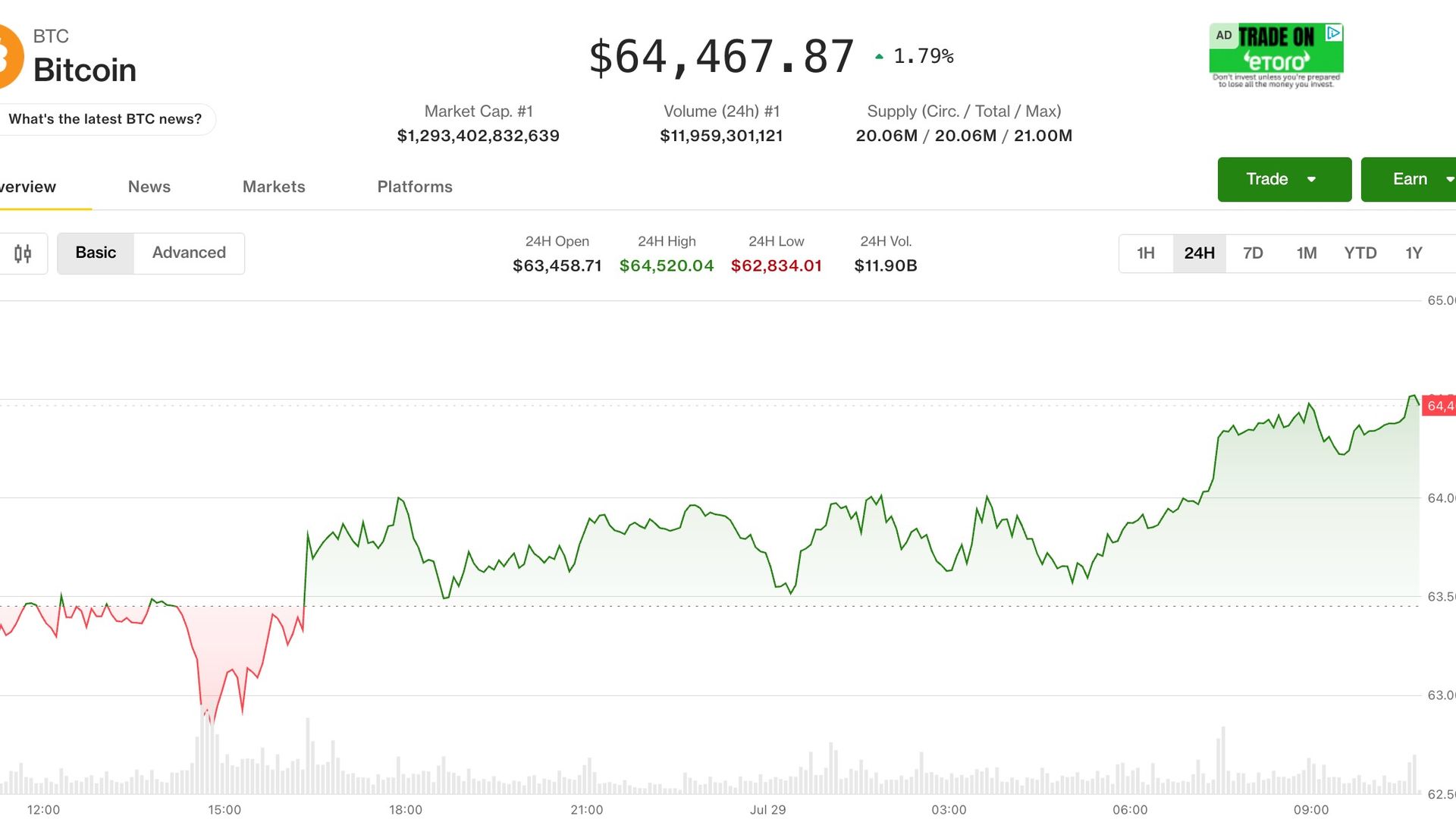
Bitcoin has stabilized above the $64,000 level as cryptocurrency markets await the Federal Reserve's forthcoming interest-rate decision. The relative price stability reflects investor sentiment tied to macroeconomic policy expectations, with traders positioning for potential volatility around the Fed announcement.
Overview
Bitcoin has demonstrated notable resilience in recent trading sessions, maintaining a position above the $64,000 level as the broader cryptocurrency market awaits the Federal Reserve's critical interest-rate decision. This price stability marks an important technical milestone for the leading digital asset, which has experienced significant volatility throughout 2026 in response to shifting macroeconomic conditions and monetary policy signals. The cryptocurrency's ability to hold this support level suggests that market participants are carefully positioning their portfolios ahead of the Fed's expected announcement, which could have substantial implications for risk assets across all markets.
The current price action reflects a delicate balance between bullish factors supporting cryptocurrency adoption and headwinds from broader economic uncertainty. Market analysts point to the Fed's monetary policy trajectory as the dominant factor influencing Bitcoin and other digital assets, as interest rates remain a key driver of investor appetite for non-yielding assets like cryptocurrency. The stabilization above $64,000 indicates that a floor has formed at this price level, even as traders grapple with conflicting signals about the economic outlook and inflation dynamics that might influence the central bank's decision.
Crypto market participants have been closely monitoring economic data releases and Fed communications for clues about the timing and magnitude of potential interest-rate cuts. Recent inflation reports, employment data, and central bank commentary have created an environment of heightened anticipation, with many investors awaiting clarity that only an official policy announcement can provide. The relative calm in Bitcoin's price action—despite this uncertainty—suggests that sellers have largely exhausted their positions at lower levels, while buyers appear committed to defending the $64,000 support zone.
Background
Understanding the current Bitcoin price dynamics requires examining the broader relationship between Federal Reserve policy and cryptocurrency valuations. Historically, digital assets have moved inversely to real interest rates, as higher yields on traditional risk-free assets like Treasury securities reduce the relative attractiveness of non-yielding alternatives such as Bitcoin. Throughout 2022 and 2023, aggressive Fed rate hikes drove cryptocurrencies to multi-year lows as investors fled to newly attractive fixed-income opportunities. This relationship between monetary policy and crypto performance has persisted as a dominant theme, shaping both institutional and retail trading strategies.
The Federal Reserve's current monetary policy stance entered 2026 with rates at their highest levels in more than two decades, reflecting years of cumulative increases implemented to combat inflation. However, recent inflation readings have shown signs of moderating toward the Fed's 2% target, creating speculation about whether the central bank might begin easing monetary conditions. This prospect of a policy pivot has provided meaningful support to risk assets generally, including cryptocurrencies, as investors anticipate that lower rates would reduce opportunity costs for holding non-yielding assets. The mere possibility of eventual rate cuts has been sufficient to stabilize crypto markets, even though the Fed has not yet committed to any specific course of action.
Bitcoin's performance has historically served as a barometer for broader risk appetite in financial markets. During periods of monetary tightening and rising rates, Bitcoin often trades under pressure as investors rotate away from speculative assets toward safer alternatives. Conversely, when central banks signal policy accommodation or when growth concerns dominate inflation fears, Bitcoin typically strengthens as investors search for yield and appreciate the asset's portfolio diversification properties. The current environment sits in a gray zone between these extremes, with uncertainty about the economic outlook creating confusion that has been reflected in Bitcoin's sideways trading pattern around key price levels.
The psychological importance of key price levels in cryptocurrency markets cannot be overstated. Technical traders have identified $64,000 as a meaningful support level that, if maintained, could encourage further consolidation and potentially set the stage for additional gains. Conversely, a breakdown below this level could trigger cascade selling and test lower support zones. Market participants have been trading with this binary outcome in mind, with positioning tilted toward defending the current price level in anticipation of a bullish catalyst from Fed policy communications.
Key Developments
Several recent developments have contributed to Bitcoin's current price trajectory and the overall sentiment in cryptocurrency markets. First, recent inflation data releases have provided somewhat mixed signals about price pressures in the economy. While core inflation metrics have continued to moderate, certain categories have shown stickier readings than expected, creating debate among Fed officials about the appropriate policy path. These mixed signals have translated into uncertainty in financial markets more broadly, as investors struggle to handicap the probability of various Fed action scenarios. Bitcoin and other cryptocurrencies have responded to this uncertainty by consolidating near key price levels rather than engaging in sustained trending moves in either direction.
Second, a number of major financial institutions and corporate entities have made significant announcements regarding their cryptocurrency strategies during the period leading up to the current price action. Increased institutional participation in Bitcoin futures and spot markets has provided deeper liquidity and potentially more sophisticated trading, reducing the likelihood of extreme price swings driven by retail speculation alone. These institutional investors tend to take longer-term views and are less likely to panic-sell during periods of uncertainty, providing a stabilizing influence on prices. The infrastructure supporting institutional cryptocurrency investment has matured substantially, creating a more sustainable foundation for asset valuations.
Third, geopolitical developments and international monetary policy shifts have influenced Bitcoin's trajectory. Central banks outside the United States have taken differing approaches to monetary policy, with some maintaining tighter stance and others signaling potential accommodation. These divergent policies create both opportunities and challenges for Bitcoin as a global asset, since different investors in different regions face different sets of incentives regarding risk asset allocation. Additionally, ongoing geopolitical tensions in several regions have occasionally driven safe-haven flows that benefit Bitcoin despite its volatile reputation, suggesting that some global investors view cryptocurrency as preferable to certain traditional alternatives during periods of heightened risk.
Fourth, regulatory developments in major markets have continued to provide both clarity and uncertainty regarding the legal status and treatment of cryptocurrencies. The continued progress toward regulatory frameworks in jurisdictions like the European Union and the ongoing debates in the United States have influenced institutional participation. Market participants believe that increased regulatory certainty will ultimately benefit Bitcoin by reducing perceived legal risks, though the transition period itself can create volatility as compliance requirements shift. The expectation that regulatory maturation will proceed regardless of current price action has provided a degree of longer-term confidence that supports current price levels.
Market Impact
Bitcoin's stability above $64,000 carries significant implications for the broader cryptocurrency market ecosystem. When Bitcoin, as the largest and most established digital asset, demonstrates price stability and meaningful support levels, it creates confidence for investors to deploy capital into other cryptocurrencies. Smaller altcoins and newer blockchain projects often move in correlation with Bitcoin's price action, with investors using Bitcoin's relative strength to gauge the risk environment for digital assets more broadly. The current consolidation in Bitcoin has therefore likely provided opportunity for a broader stabilization across cryptocurrency markets, reducing the cascading selling pressure that can occur when major assets experience sharp declines.
The price stability has also had measurable effects on cryptocurrency derivatives markets and options positioning. Traders using leverage to take directional positions have found it more challenging to generate profit in a sideways trading environment, which can actually be healthy for markets by discouraging excessive speculation. The reduced volatility has made it more difficult to implement profitable momentum-trading strategies, potentially causing some leveraged speculators to reduce positions. This unwinding of speculative leverage positions can actually set the stage for more sustainable price movements once a catalyst emerges, as the market becomes less prone to violent reversals driven by cascading liquidations.
Institutional cryptocurrency platforms and exchanges have reported that client activity levels remain elevated despite the sideways price action, suggesting that investors are using the consolidation period to reposition and prepare for the next significant move. Some investors have been accumulating Bitcoin at prices near $64,000, believing that the Fed's eventual pivot toward easier policy will drive prices higher. Others have been reducing exposure or hedging their positions to protect against downside risk, should economic data deteriorate or the Fed's messaging prove more hawkish than markets currently expect. The balance of these flows has resulted in the observed price stability.
Cryptocurrency lending platforms and decentralized finance protocols have also reflected the current market sentiment. Borrowing rates for Bitcoin have remained relatively stable, and liquidation thresholds have been set cautiously by investors who have learned from past volatile episodes. The overall health of cryptocurrency financial infrastructure appears robust, with most platforms maintaining adequate capital reserves and risk management practices. This should limit the potential for cascading failures or crisis dynamics even if market prices move sharply in response to Fed announcements.
Risks and Considerations
While Bitcoin's stabilization above $64,000 might be interpreted positively by bull-case investors, significant risks remain that could quickly reverse current price action. The most obvious risk stems from the Fed's actual policy announcement and forward guidance. If the central bank maintains a more hawkish stance than markets currently discount—perhaps by signaling that rate cuts will occur more gradually or in smaller increments than some investors expect—the disappointment could trigger swift selling in Bitcoin and other risk assets. Conversely, if economic data deteriorates sharply before the Fed announcement, markets might begin pricing in even deeper rate cuts, which could accelerate Bitcoin's rally beyond current levels.
Inflation dynamics represent another significant source of uncertainty. While headline inflation has moderated considerably from recent peaks, certain components remain elevated. Energy prices remain vulnerable to disruption from geopolitical developments, food prices can fluctuate based on agricultural conditions, and services inflation has proven somewhat sticky. If inflation re-accelerates rather than continuing to moderate, the Fed would likely be forced to maintain restrictive policy for longer than currently expected, creating headwinds for Bitcoin. Market participants should remain vigilant about inflation indicators and Fed communications on this topic.
Geopolitical risks have also intensified in certain regions, and these could influence capital flows into Bitcoin through multiple channels. If tensions escalate significantly, capital flight into perceived safe havens might support Bitcoin prices. However, if geopolitical crises trigger sharp stock market declines and risk-off positioning broadly, Bitcoin could face selling pressure as investors liquidate positions to raise cash or derisk portfolios. The direction of Bitcoin's movement in response to geopolitical events is not always consistent, creating additional unpredictability.
Regulatory risks remain an ongoing concern for cryptocurrency investors. While the overall regulatory trajectory has been toward increased clarity, adverse regulatory developments in major markets could undermine Bitcoin's value proposition. For instance, if major governments implemented measures to restrict institutional participation in cryptocurrency markets or restricted stablecoin usage, this could meaningfully reduce demand for Bitcoin. Investors should monitor regulatory developments carefully and maintain awareness of the policy risks inherent in Bitcoin's current regulatory environment.
Technical risks in cryptocurrency infrastructure also warrant attention. While blockchain technology has demonstrated its resilience over more than a decade, the software supporting Bitcoin and related systems continues to evolve. Security vulnerabilities or technical issues that emerged unexpectedly could temporarily undermine confidence and trigger selling pressure. Additionally, the custody and settlement infrastructure supporting Bitcoin trading, particularly for institutional investors, continues to mature. Any significant operational incidents at major cryptocurrency exchanges or custodians could create temporary price disruptions.
What to Watch
Market participants should closely monitor several key indicators and events in the coming days and weeks as Bitcoin and cryptocurrencies respond to the Fed policy decision and subsequent developments. First and foremost, the Federal Reserve's official policy statement, updated economic projections, and Chair Powell's press conference remarks will be absolutely critical for determining Bitcoin's near-term direction. Investors should pay particular attention to language about the pace and magnitude of potential rate cuts, as well as any shifts in the Fed's assessment of economic conditions and inflation trends.
Following the Fed announcement, subsequent economic data releases will influence whether the market's initial reaction was appropriate. Employment reports, retail sales data, inflation readings, and other key statistics will either reinforce or challenge the narrative that emerges from the Fed's communication. Bitcoin's price action in response to this data will reveal market sentiment about the accuracy of the central bank's assessment. Sustained price strength above $64,000 following the Fed announcement and subsequent data releases would suggest that the market believes the central bank has appropriately calibrated its policy stance.
Investors should also monitor developments in global monetary policy, as Bitcoin functions as a global asset influenced by monetary conditions across major economies. Central bank actions and communications from the European Central Bank, Bank of Japan, and other major institutions will collectively influence Bitcoin's price direction. Additionally, changes in international capital flows and currency movements could impact Bitcoin valuations, as the asset's pricing is frequently expressed in multiple currencies simultaneously.
Cryptocurrency market-specific indicators deserve attention as well. On-chain metrics that track transaction volumes, wallet accumulation patterns, and derivatives positioning can provide insights into whether the current price levels represent genuine support or a fragile consolidation prone to reversal. Sustained accumulation by large holders during the current consolidation period would suggest more durable support, while evidence of large-scale distribution might indicate that current price levels are unstable.
Finally, market participants should maintain awareness of technical price levels both above and below $64,000 that could serve as catalysts for accelerated price movements. Resistance levels above current prices could trigger profit-taking or distributional selling, while support levels below could trigger stop-loss orders and cascade selling. Understanding the distribution of orders and positioning in Bitcoin futures markets can help traders anticipate likely price behavior in response to Fed announcements and subsequent developments.
Conclusion
Bitcoin's stabilization above the $64,000 level represents an important technical development in cryptocurrency markets, particularly given the heightened uncertainty surrounding the Federal Reserve's policy decision. The asset has demonstrated meaningful support at this price level despite the considerable economic uncertainty facing financial markets more broadly. This stability should be interpreted as a modest positive for the digital asset, though the true test of conviction in cryptocurrency valuations will come only after the Fed provides clarity on its policy intentions and economic outlook.
The relationship between Bitcoin's price and Federal Reserve policy has been well-established and remains the dominant factor influencing cryptocurrency valuations in the current environment. Investors awaiting the Fed's decision are essentially wagering on how drastically monetary conditions will ease and how quickly that easing will occur. Bitcoin's maintenance of support above $64,000 suggests that a growing base of investors believes that a policy pivot is imminent and sufficiently favorable to justify current valuations. However, the asset remains vulnerable to disappointment if the Fed's actual stance proves more restrictive than markets currently expect.
Looking forward, Bitcoin's price trajectory will likely remain tethered to macroeconomic developments and Fed communications for the foreseeable future. Cryptocurrency's maturation as an asset class has brought it into closer alignment with broader financial market dynamics, reducing the likelihood of decoupling from traditional financial assets and monetary policy shifts. This development is arguably healthy for Bitcoin's long-term viability, as it suggests the asset is less subject to pure speculation and more grounded in fundamental economic relationships.
For investors considering Bitcoin exposure, the current consolidation period represents a relatively lower-risk entry point compared to periods of euphoric speculation or capitulatory panic selling. However, the considerable uncertainty around Fed policy and broader economic conditions dictates that position sizing should reflect the genuine risks inherent in Bitcoin investment. Those with longer time horizons and greater risk tolerance might find current levels attractive for accumulation, while more conservative investors might prudently await clarity from Fed communications before committing significant capital.
Ultimately, Bitcoin's steadiness above $64,000 should be understood as a market awaiting resolution of critical macroeconomic uncertainty. The asset has found buyers at current levels and sellers have not been aggressive, creating a rough equilibrium. This balance will persist only until the Fed provides clarity on policy direction and economic outlook. When that catalyst arrives, Bitcoin's price behavior will reveal how accurately current market pricing reflects the true probability of various Fed action scenarios. Market participants should remain vigilant and prepared to adjust positions swiftly in response to official Fed communications and the market's interpretation of those communications.
Original Source
CoinDesk